Domain and hosting explained: what they are, what they cost and who should own them
A plain guide to domain names and web hosting for UK small business owners: what each one does, how they fit together, real prices from UK providers, why renewals cost more, how email fits in, and how to make sure your business owns both.
By GP 13 minute read
TL;DR: A domain is your website’s address, such as yourbusiness.co.uk, and hosting is the computer that stores the website and sends it to visitors. You need both, and they can come from different companies. When we checked in October 2026, Hostinger listed a .co.uk domain at £10.99 a year after any first-year offer and its Single hosting plan at £1.49 a month on a 48-month term, renewing at £7.99. Register both in your business’s own name.
Key takeaways
- A domain is your website’s address; hosting is where the website lives and runs.
- You need both for a website, and they can be bought from the same company or from different ones.
- Hostinger listed a .co.uk domain at £10.99 a year after any first-year offer when we checked in October 2026.
- Hosting offers are cheapest in the first term; Hostinger’s Single plan was £1.49 a month on 48 months, renewing at £7.99, excluding VAT.
- Register the domain and the hosting account in your business’s own name, so you can always move.
What is the difference between a domain and hosting?
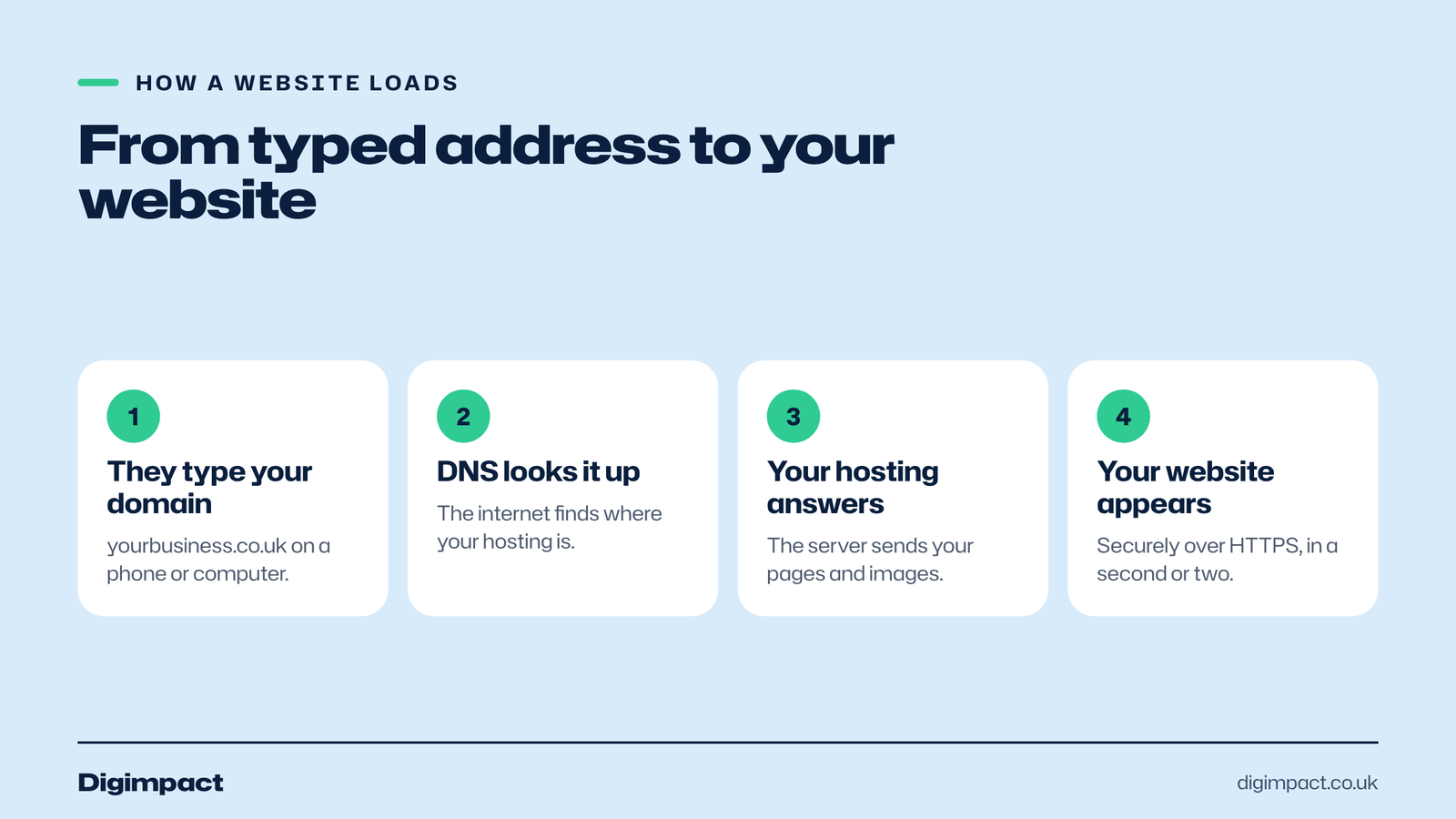
The difference between a domain and hosting is simple: the domain is the address and the hosting is the building. A domain name, such as yourbusiness.co.uk, is what people type to find you. Hosting is a computer, called a server, that stores your website’s files and sends them to each visitor’s phone or computer.
You need both. A domain on its own points nowhere, and hosting on its own has no easy address. When someone types your domain, the internet looks up where your hosting is and loads your website from there. That lookup is handled by the domain name system, or DNS, which works like a phone book for the internet.
Think of it this way: you can own an address without a building, and a building without a signposted address, but customers need both to find you. Most small business owners never need to touch DNS. But knowing what domain and hosting each do helps you understand quotes, avoid paying twice, and keep control of your website if you change designer or provider.
What is a domain name?
A domain name is the unique address of your website, such as yourbusiness.co.uk. You rent it from a registrar, usually by the year, and you can renew it for as long as you want. The ending, such as .co.uk or .com, is called the extension.
UK domains ending in .uk, including .co.uk, are run by Nominet. Nominet describes the registrant as the company or individual the domain is registered on behalf of, in its registry field definitions. For a limited company, that should be the company itself, with its Companies House number, not a director, an employee or a web designer.
Choose a domain that is short, easy to spell and easy to say over the phone. Avoid hyphens and numbers if you can. If you trade mainly in the UK, a .co.uk address tells customers where you are; if the .com is also free, many businesses register both and point one at the other.
Which domain ending should you choose?
For a UK business that mainly serves UK customers, a .co.uk domain is the natural choice: it tells people where you are, and UK customers recognise it. A .com suits a business that trades internationally or wants a global feel. A .uk ending is also available and is shorter, though fewer people are used to typing it.
If you can, register your name with the endings people are most likely to type, and point the extras at your main website, so customers who guess the wrong one still find you. Whatever you choose, use the same domain on your signage, your Google Business Profile, your social media and your email, so customers see one consistent address.
What is web hosting?
Web hosting is the service that keeps your website online. A hosting company runs the servers, keeps them connected to the internet, and stores your website’s pages, images and database. When someone visits your domain, the hosting sends them the website.
There are several kinds. Shared hosting, where your site shares a server with others, is the cheapest and is enough for most small business websites. Cloud and VPS hosting give a site more of its own resources, which helps busy shops and booking systems. Website builders such as Shopify, Wix and Squarespace include hosting in their monthly plan, so you do not buy it separately.
What matters most for a small business is speed, backups, security and support, not storage. Google’s page experience guidance asks whether your pages are served securely over HTTPS, and good hosting includes a free security certificate so your address shows as secure.
How much do a domain and hosting cost?
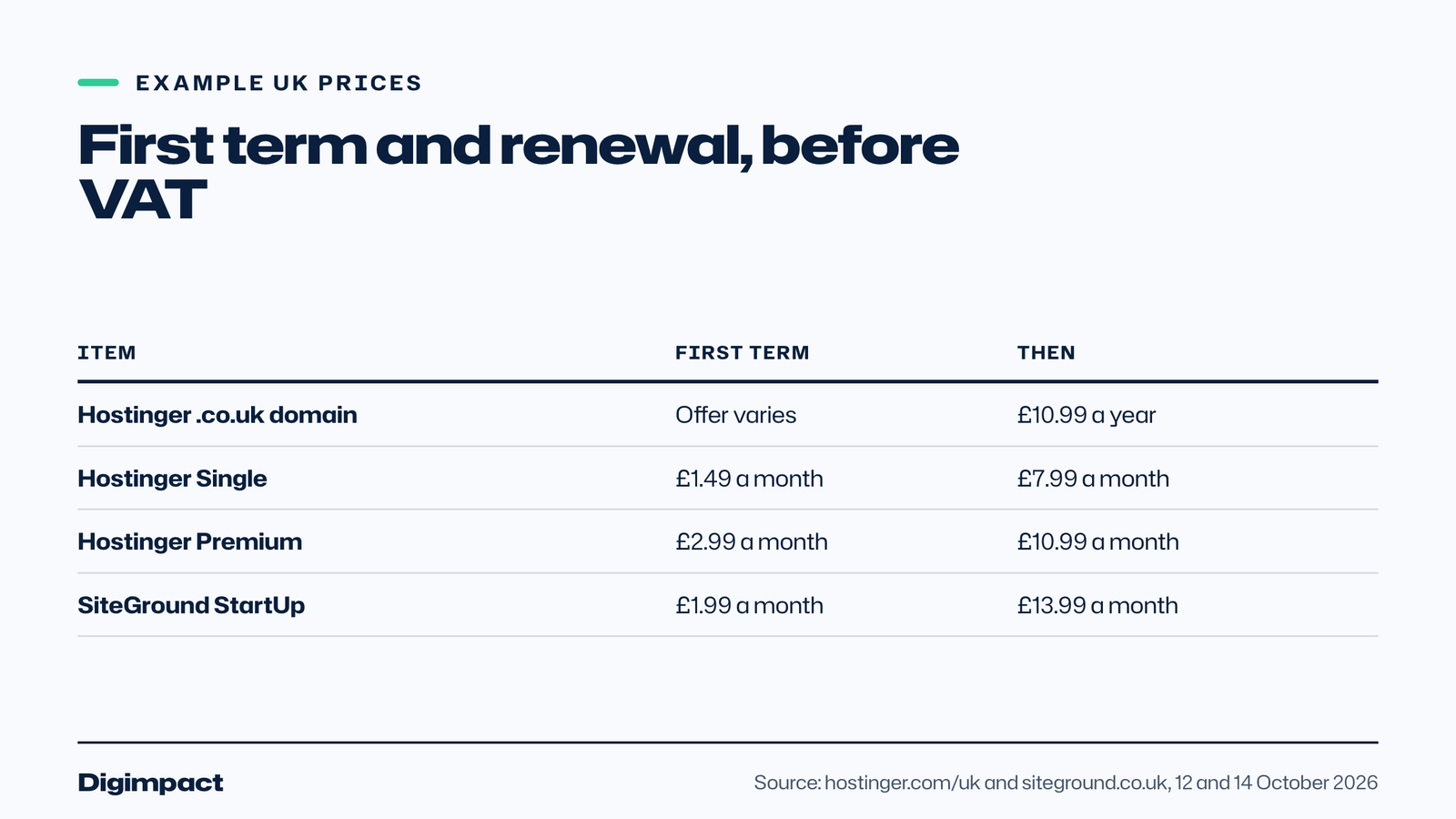
When we checked in October 2026, Hostinger listed a .co.uk domain at £10.99 a year after any first-year offer, and its Single hosting plan at £1.49 a month on a 48-month term, renewing at £7.99 a month. SiteGround listed StartUp at £1.99 a month for 12 months, renewing at £13.99. Hosting prices exclude VAT.
| Item | Example price | Where from |
|---|---|---|
| .co.uk domain | £10.99 a year after any first-year offer | Hostinger domain search, 12 October 2026 |
| Hostinger Single hosting | £1.49 a month on 48 months, then £7.99 | Hostinger UK, 14 October 2026 |
| Hostinger Premium hosting | £2.99 a month on 48 months, then £10.99 | Hostinger UK, 14 October 2026 |
| SiteGround StartUp hosting | £1.99 a month for 12 months, then £13.99 | SiteGround UK, 14 October 2026 |
The first-term prices are offers to win your business; the renewal price is what you pay from then on. Hostinger says its plans are paid upfront, with the monthly rate being the total divided by the number of months. Always compare renewal prices, and check what the total will be over three years.
Prices were read on Hostinger’s hosting page, its domain search page and SiteGround’s hosting page.
Do you need to buy domain and hosting from the same company?
No. Many businesses buy the domain and hosting from the same company because it is simpler, with one bill and one login. But you can keep your domain with one registrar and your hosting with another, and point the domain at the hosting by changing its settings.
Keeping them separate has one advantage: if you ever leave your hosting company, your domain stays put, and you simply point it at the new host. Keeping them together is easier to manage. Either works, as long as both accounts are in your business’s name and you have the logins.
What should you ask a host before you buy?
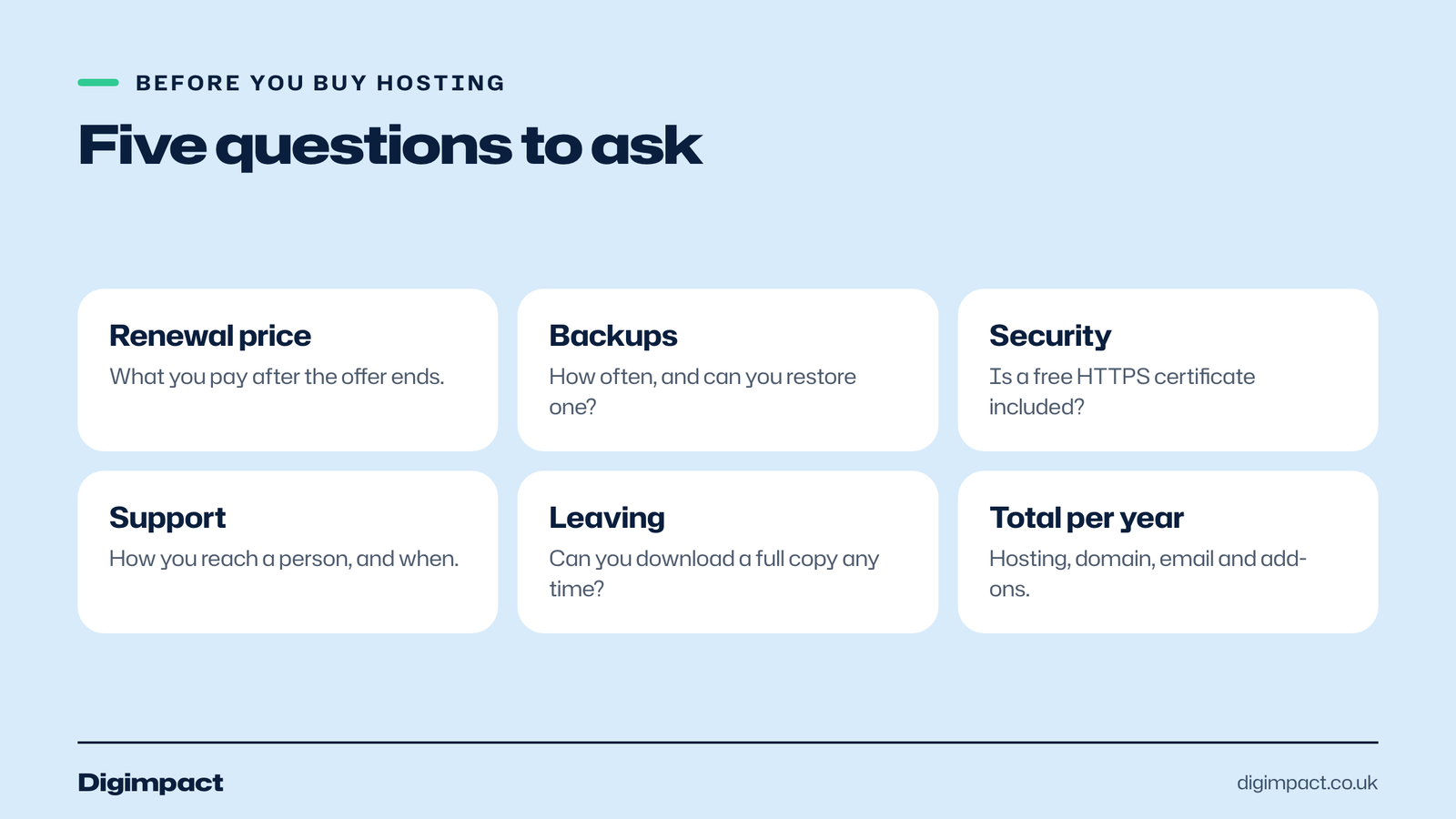
Before you buy hosting, ask about the things that matter once the site is live: the renewal price, backups, the security certificate, support hours, and how easy it is to leave. A host that is cheap in year one but slow, hard to reach or expensive to renew costs more in the end.
- What is the renewal price? The first term is an offer; the renewal is what you will pay for years.
- How often are backups taken, and can I restore one myself? Daily backups suit a site that changes often or takes bookings.
- Is a security certificate included? Your address should show as secure, over HTTPS, at no extra cost.
- Where is support, and when is it open? Find out how you reach a person when the site is down.
- Can I move away easily? Ask whether you can download a full copy of your site and database at any time.
Write the answers down with the price, so you can compare two or three hosts like for like. Ask the same questions of any web designer who offers to host your site for you, because their hosting is only as good as the company behind it, and you should know where your website actually lives. If a host cannot answer clearly, that is useful to know before you trust it with your website.
What else does a website cost each year?
Domain and hosting are the fixed running costs of a website, but they are rarely the only ones. A business website may also pay for email accounts, paid plugins or apps, security monitoring, and someone to keep the software up to date. An online shop adds card fees on every sale.
Look at the total yearly cost, not each item on its own. A cheap host plus several paid add-ons can cost more than a plan that includes them. When you get a quote for a website, ask what is included each year and what would be extra, so there are no surprises at renewal time.
What about email on your own domain?
An email address on your own domain, such as hello@yourbusiness.co.uk, looks more professional than a free email account and stays with the business if staff change. It needs email hosting, which is sometimes included with web hosting and sometimes sold separately by email providers.
The domain’s settings tell the internet where to deliver your email, separately from where your website is hosted. That is why you can move your website without moving your email, or the other way round. When you change providers, check that both still work before you cancel anything.
Who should own the domain and hosting?
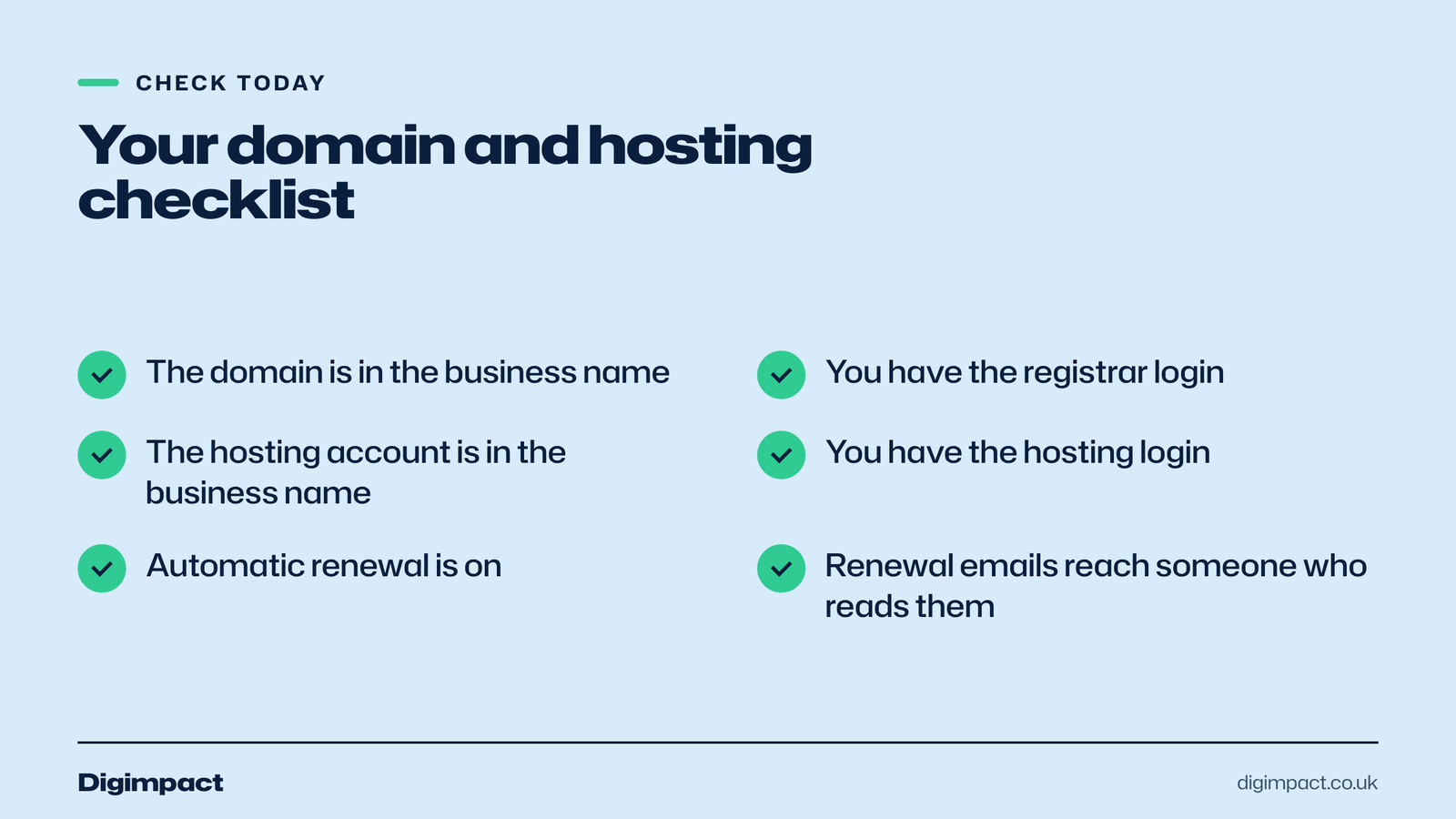
Your business should own both. Register the domain with your business as the registrant, and open the hosting account in the business’s name, with an email address the business controls. Keep the logins somewhere safe, and give your designer access rather than letting them hold the accounts.
This matters more than it sounds. If a former designer holds your domain, you cannot move or change your website without their help, and if they let it lapse, your website and email can stop working. In our check of 935 local business websites in October 2026, a quarter did not load at all, and some had simply expired.
What happens if your domain expires?
If your domain expires, your website and any email on that domain stop working until it is renewed. After a grace period, the domain can be released and registered by someone else, who could use it for their own website. Turn on automatic renewal and keep the payment card on the account up to date.
Set a reminder a month before each renewal date, and make sure renewal emails go to an address someone reads. If your domain was registered by a former designer or employee, ask your registrar how to move it into the business’s name now, before it becomes urgent.
How do you connect a domain to hosting?
You connect a domain to hosting by changing the domain’s settings at your registrar, either by pointing its nameservers at your host or by adding records that point to your host’s server. Your hosting company gives you the exact values, and the change usually takes effect within hours.
If you are not comfortable doing this, your web designer or host can do it with access to your registrar account. Before changing anything on a live site, note the current settings, so you can put them back if something goes wrong, and remember that email settings live in the same place.
How do you move to a new host without breaking your website?
Moving a website to a new host means copying the files and database to the new server, testing the site there, then pointing the domain at the new host. Done in that order, visitors see no gap. Most hosts offer free or low-cost migration help.
Keep the old hosting running until the new site is live and working, check your email still arrives, and only cancel the old plan once everything has been running smoothly for a few days. If your page addresses change during the move, Google advises mapping old addresses to new ones with permanent redirects, in its guidance on site moves.
If your business is in Portsmouth or nearby, we design and build websites from £300 a year with hosting and your domain included. See web design in Portsmouth.
Frequently asked questions
Do I need both a domain and hosting?
Yes, for your own website. The domain is the address and the hosting is where the website is stored. Website builders such as Shopify, Wix and Squarespace include hosting in their plans, but you still need a domain.
Can I buy a domain without hosting?
Yes. Many businesses register their domain early to secure the name, then add hosting when the website is ready. You can also use a domain just for email.
How much does a .co.uk domain cost?
Prices vary by registrar. When we checked in October 2026, Hostinger listed a .co.uk domain at £10.99 a year after any first-year offer.
Who owns my domain if my web designer registered it?
The registrant named on the domain controls it. If that is your designer, ask them to move it into your business’s name. Nominet describes the registrant as the company or individual the domain is registered on behalf of.
Is cheap hosting good enough for a small business?
For most small business websites, a good shared hosting plan is enough. Look at the renewal price, backups, security certificate and support rather than the lowest first-year offer. Busy online shops may need more.
Can I move my website to a different host?
Yes. Copy the site to the new host, test it, then point the domain at it. Keep the old hosting until the new site is working and your email is confirmed.
Is hosting included with Shopify, Wix or Squarespace?
Yes. Hosted platforms such as Shopify, Wix and Squarespace include hosting in their monthly plan, so you only add a domain. The trade-off is that the website runs only on that platform, so moving later means rebuilding it somewhere else.
What is DNS?
DNS, the domain name system, is the internet’s address book. It turns your domain into the location of your hosting and tells email where to go. You change DNS settings at your registrar when you connect a domain to hosting or set up email.
Should my domain and hosting renew on the same date?
It helps. Lining up renewal dates means one check a year instead of two, and less chance of missing one. Whatever the dates, keep automatic renewal on and make sure the payment card on each account is current.
Does hosting affect Google rankings?
Hosting affects how fast and how reliably your pages load, and whether they are served securely over HTTPS, which Google’s page experience guidance asks about. A slow or often unavailable host makes it harder for customers and search engines to reach your site.
Want domain and hosting sorted for you?
Our websites start from £300 a year per site, including hosting, your domain and five pages, with one fixed price in writing before any work starts. The domain is registered in your business’s name and you own the finished website. See our website design service, or start with a free website check of your current site.
Keep reading
- How to make Reels for business on a phone, step by step A practical guide to filming Instagram Reels for a local business on a phone: what to film, how long Reels should be, how to edit and caption them, when to post and how to reuse them on other platforms.
- Apple Business Connect is now Apple Business: how to get your business on Apple Maps (2026 UK guide) Apple Business Connect became part of Apple Business in April 2026. This UK guide shows how to add your business to Apple Maps in seven steps, what is free and available in the UK, and how to use showcases, action buttons and insights.
- How to choose your Google Business Profile categories How to choose the right Google Business Profile categories, why the primary category matters most, when additional categories help, the mistakes Google warns against, and how to change them safely.
Free website check
How does your own website do?
Enter your website and see a quick check on screen in about 20 seconds: speed, Google, phones and the details that win the click. A full written report follows within two working days, free and with no sales call unless you ask.
Want help with this?
Tell us about your business. We reply within one working day with a time for a 30-minute call, and a fixed quote afterwards.
Rather talk now? Call 07551 079787.
Thanks, that is with us.
We will reply within one working day with a time for a call.