How long does SEO take? A realistic timeline for UK small businesses, with Google’s own answer
How long SEO takes for a UK small business: what Google says today and used to say, what a study of millions of pages found, a realistic four stage timeline, how local SEO differs, and the red flags in any promise of fast rankings.
By GP 15 minute read
TL;DR: SEO usually takes months, not weeks. Google says crawling a page can take a few days to a few weeks, that you should wait a few weeks to judge a change, and that site-wide improvements can take several months to show. Google’s guide to hiring an SEO used to say results typically take four months to a year. A study by Ahrefs found only 1.74% of new pages reached Google’s top 10 within a year, so start with local and specific searches, and judge progress by impressions and enquiries first.
Key takeaways
- How long does SEO take? For most small businesses, months rather than weeks: early signs within weeks, steady results over roughly four months to a year, and longer for competitive searches.
- Google says crawling a page can take anywhere from a few days to a few weeks, and that you should wait a few weeks before judging whether a change worked.
- Google’s guide to hiring an SEO used to say results typically take from four months to a year. The current version drops the timeframe and tells you to ask your SEO what to expect.
- An Ahrefs study found only 1.74% of newly published pages reached Google’s top 10 within a year, and 72.9% of top 10 pages are more than three years old.
- Local SEO has quicker first steps: Google says Business Profile verification reviews take up to five working days, and a complete profile helps from day one.
- Judge early SEO results by indexed pages, impressions and enquiries, not by your position for one big keyword.
- Nobody can guarantee a number one ranking, and Google does not accept payment to rank a site higher.
How long does SEO take? It is a fair question to ask before you pay anyone to do it. The honest answer is that it depends on where you start and what you want to rank for, but it is never overnight, and anyone who promises page one by next month is selling something you should not buy.
This guide pulls together what Google itself says about timing, what a study of millions of pages found, and a realistic SEO timeline for a UK small business. It also covers how local SEO differs, how to tell whether SEO is working before rankings move, and the promises that should worry you.
How long does SEO take? The short answer
For a typical small business website, expect Google to pick up fixes and new pages within days to weeks, to see early movement on specific and local searches within a few months, and to wait six months to a year or more for competitive searches. These are typical ranges based on Google’s guidance and published data, not guarantees.
Three things decide where you land in that range: how competitive your searches are, how healthy and established your website already is, and how much useful work goes in each month. A café in a small town and a national online shop are running very different races.
What does Google say about how long SEO takes?
Google says changes can take anywhere from a few hours to several months to show, and recommends waiting a few weeks before judging whether a change worked. Its pages never promise a fixed date, because so much depends on your site and your competitors.
The clearest statements come from Google’s own documentation:
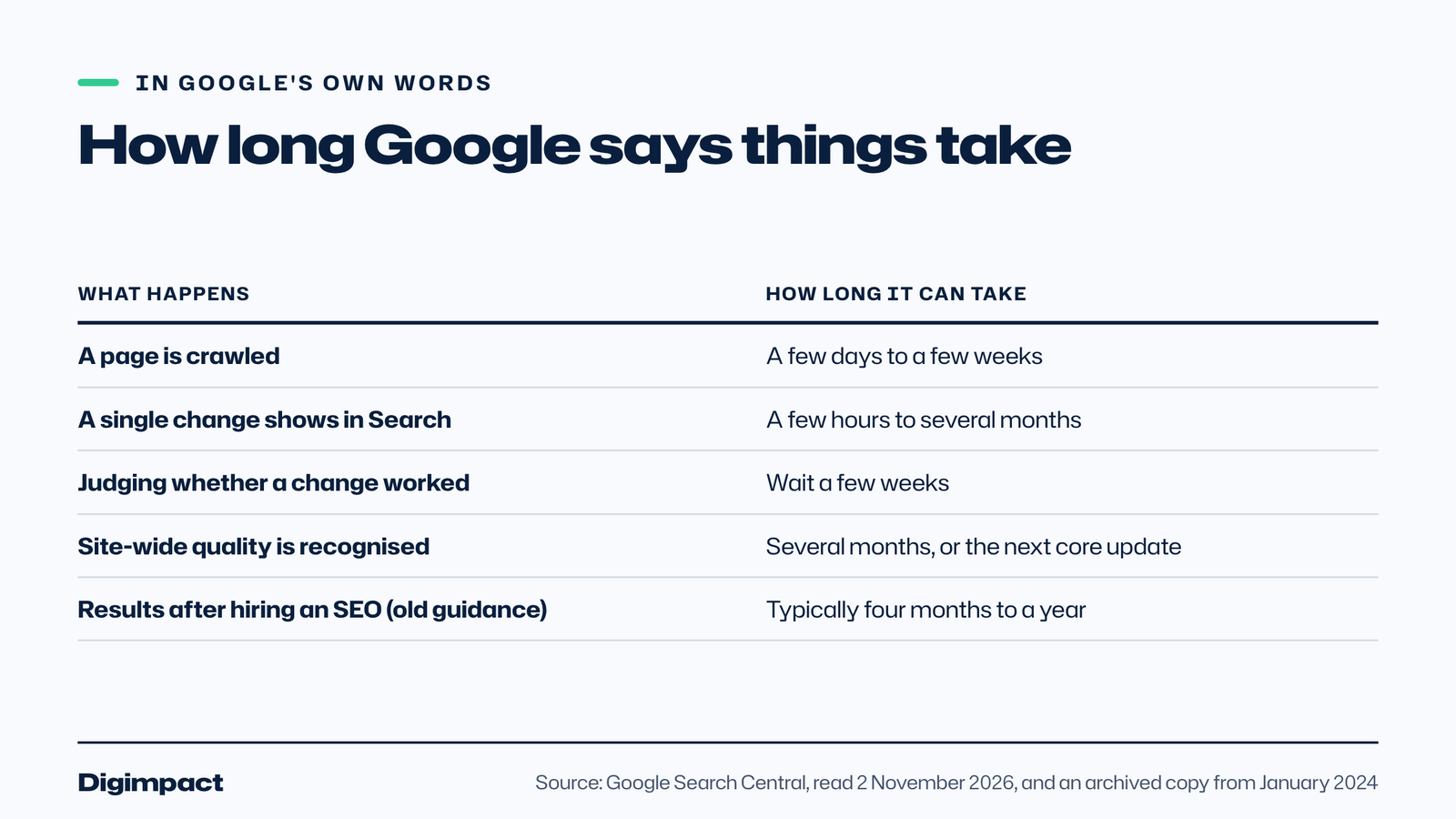
- Crawling takes days to weeks. Google’s page on asking Google to recrawl your URLs says crawling can take anywhere from a few days to a few weeks, and that requesting a crawl many times for the same page will not get it crawled any faster.
- Judge a change after a few weeks. The SEO Starter Guide says some changes might take effect in a few hours and others could take several months, and that you will likely want to wait a few weeks to assess whether your work helped.
- Site-wide quality takes months. Google’s guidance on core updates says some improvements can show in a few days, but it could take several months for its systems to learn and confirm that a whole site is now producing helpful, reliable content.
Google’s four months to a year line has gone
For years, Google’s guide Do you need an SEO? told site owners that results typically take from four months to a year from when you begin making changes. You can still read that line in an archived copy of the page from January 2024.
The current version, last updated in June 2026, no longer gives a timeframe. Instead it tells you to ask any SEO what kind of results you should expect and in what timeframe, and how they will measure success. That is a sensible change: the right answer for a plumber in Havant is different from the right answer for a national retailer, and a good SEO should give you one in writing for your situation.
What does the data say about how long it takes to rank on Google?
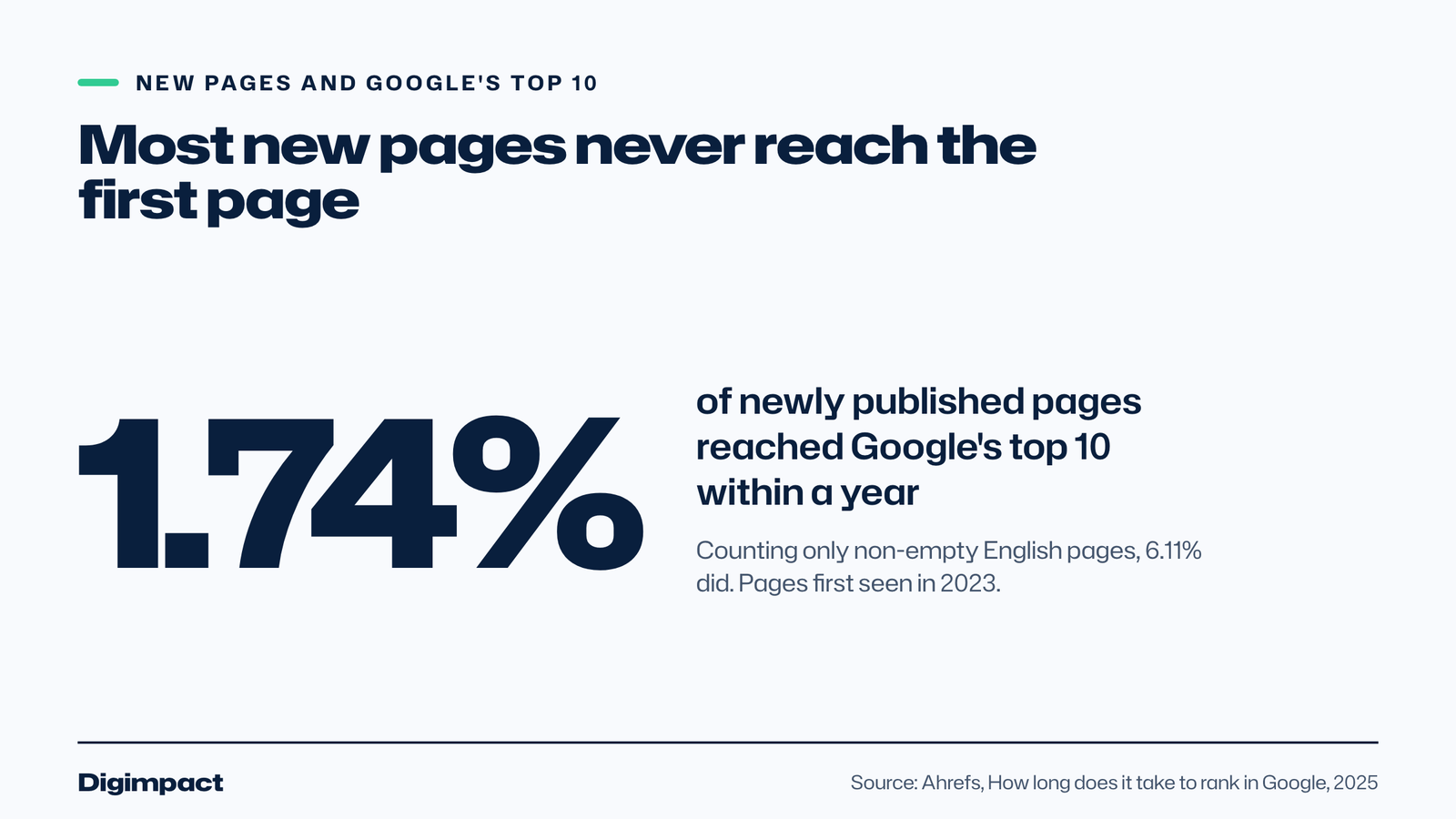
The data says new pages rarely rank on Google’s first page quickly, and the pages that do rank are usually old. In a study published by Ahrefs, written by Patrick Stox and updated in 2026, only 1.74% of newly published pages reached the top 10 within a year, down from 5.7% in the 2017 version of the study.
That figure came from 1 million random pages Ahrefs first saw in September 2023. Ahrefs also ran a fairer cut, looking only at 2 million non-empty English pages created in October 2023, and found 6.11% of those made the top 10 within a year. Either way, most new pages never rank on Google’s first page for anything.
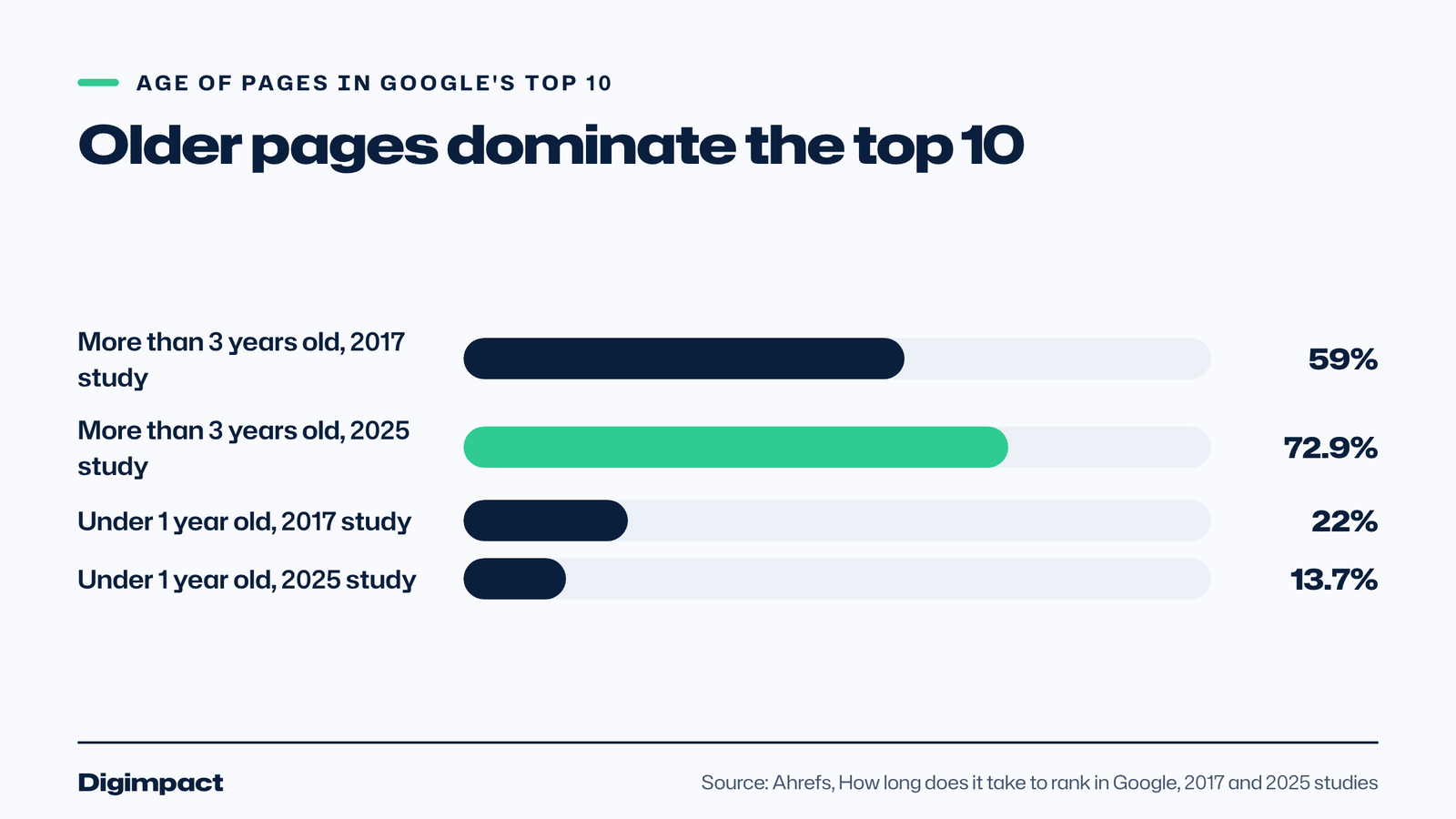
The study’s second finding explains why. On average, the page in position one is five years old, up from two years old in 2017, and 72.9% of pages in the top 10 are more than three years old. Only 13.7% of top 10 pages were under a year old, down from 22% in 2017.
There is good news in the same study. Of the pages that did reach the top 10, 40.82% got there within a month, and it took longer to rank for high-volume searches than low-volume ones. In plain terms, a page that answers a specific question well can rank fairly quickly, while broad, popular searches take far longer.
A realistic SEO timeline for a small business
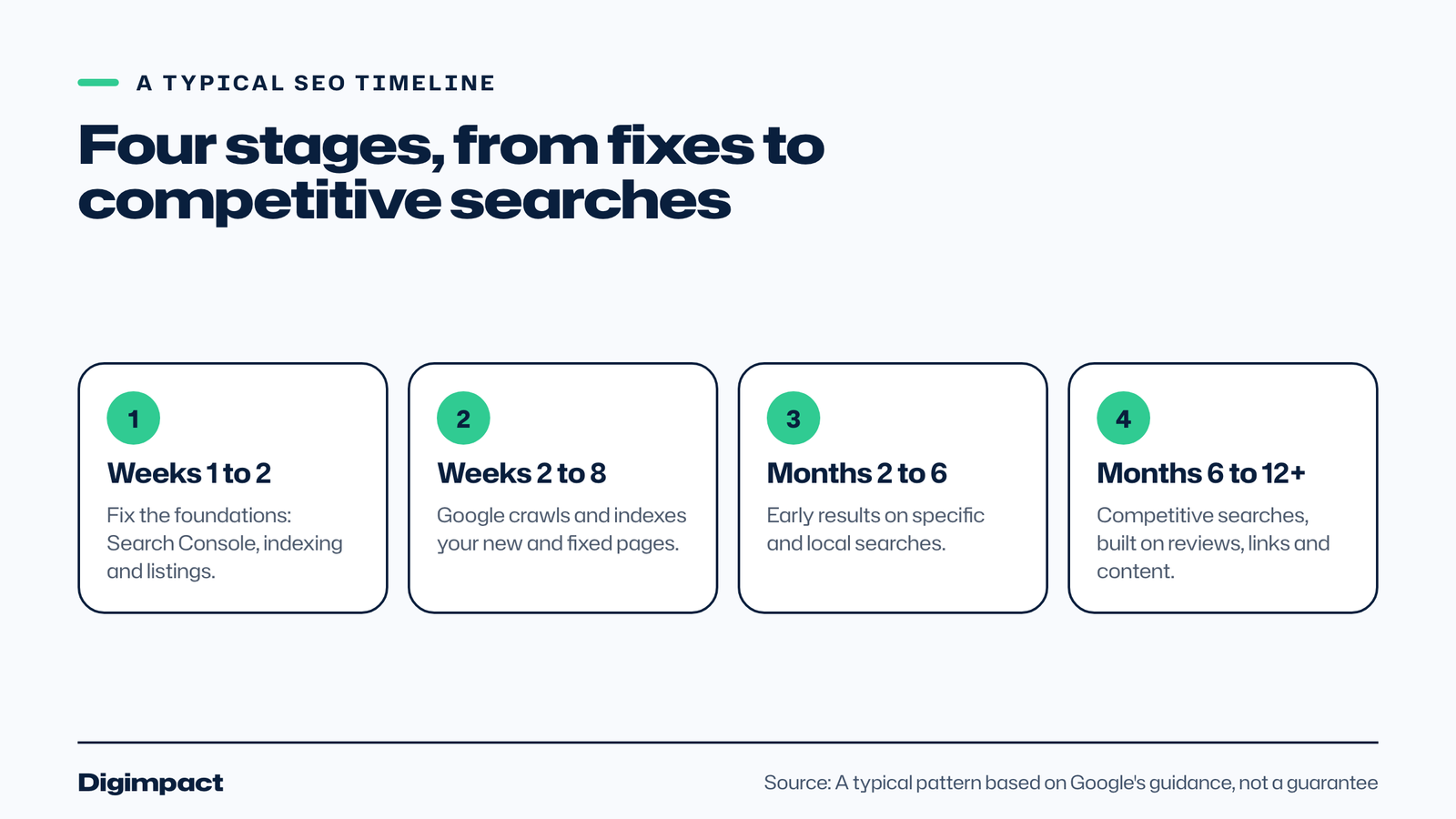
A realistic SEO timeline has four stages: fixing the foundations in the first weeks, getting pages crawled and indexed, early movement on specific and local searches, then slower gains on competitive searches over six to twelve months and beyond. Each stage builds on the one before, so skipping the first rarely makes the last arrive sooner.
Stage 1: weeks 1 to 2, fix the foundations
The first fortnight is about removing anything that stops Google finding and understanding your site. That means connecting Google Search Console, checking which pages are indexed, fixing broken pages and redirects, submitting a sitemap and making sure each important page has a clear title and description. If your site is missing from Google entirely, our guide to a website not showing on Google walks through the usual causes.
For local SEO, this stage also includes verifying and completing your Google Business Profile, Apple Maps and Bing listings with the same name, address, phone number and hours.
Stage 2: weeks 2 to 8, pages crawled and indexed
Once the foundations are fixed, Google needs to crawl and index the changes, which Google says can take from a few days to a few weeks. During this stage you may see impressions start to appear in Search Console for longer, more specific searches before anything moves on your main keywords.
This is also when to publish or improve the pages that answer your customers’ real questions, one service or topic per page, linked together so Google can follow them.
Stage 3: months 2 to 6, early SEO results
If the foundations are right, this is when you can expect the first SEO results you can feel: more impressions, better positions for specific searches, more calls from Google Maps and the first enquiries that came from search. Reviews and local links start to add up too.
Ahrefs suggests that if a page is still outside the top 10 after about six months, it is time to update it rather than keep waiting. That is a useful checkpoint for your own pages.
Stage 4: months 6 to 12 and beyond, competitive searches
Competitive searches, such as plumber Portsmouth or wedding photographer Hampshire, take longest because the pages that rank on Google’s first page for them are usually older and better linked. Gains here come from steady work: keeping pages current, earning reviews and links, and adding content that answers what customers ask.
How long does local SEO take?
Local SEO can show its first results sooner than national SEO, because the first steps are quick and the competition is limited to businesses near you. Getting onto Google Maps can take days, while building the reviews and reputation that lift you above competitors takes months.
Google’s page on verifying your business says verification reviews take up to five working days, and that if you verify by postcard, most codes arrive within 14 days. Once you are verified, Google’s guide to improving your local ranking says local results are mainly based on relevance, distance and prominence.
Each one moves at a different speed. Relevance, how well your profile matches a search, improves as soon as you complete your categories, services and description. Distance you cannot change. Prominence, how well known your business is, builds slowly, because Google bases it partly on how many websites link to you and how many reviews you have. Our local SEO checklist covers what to do first.
What makes SEO faster or slower?
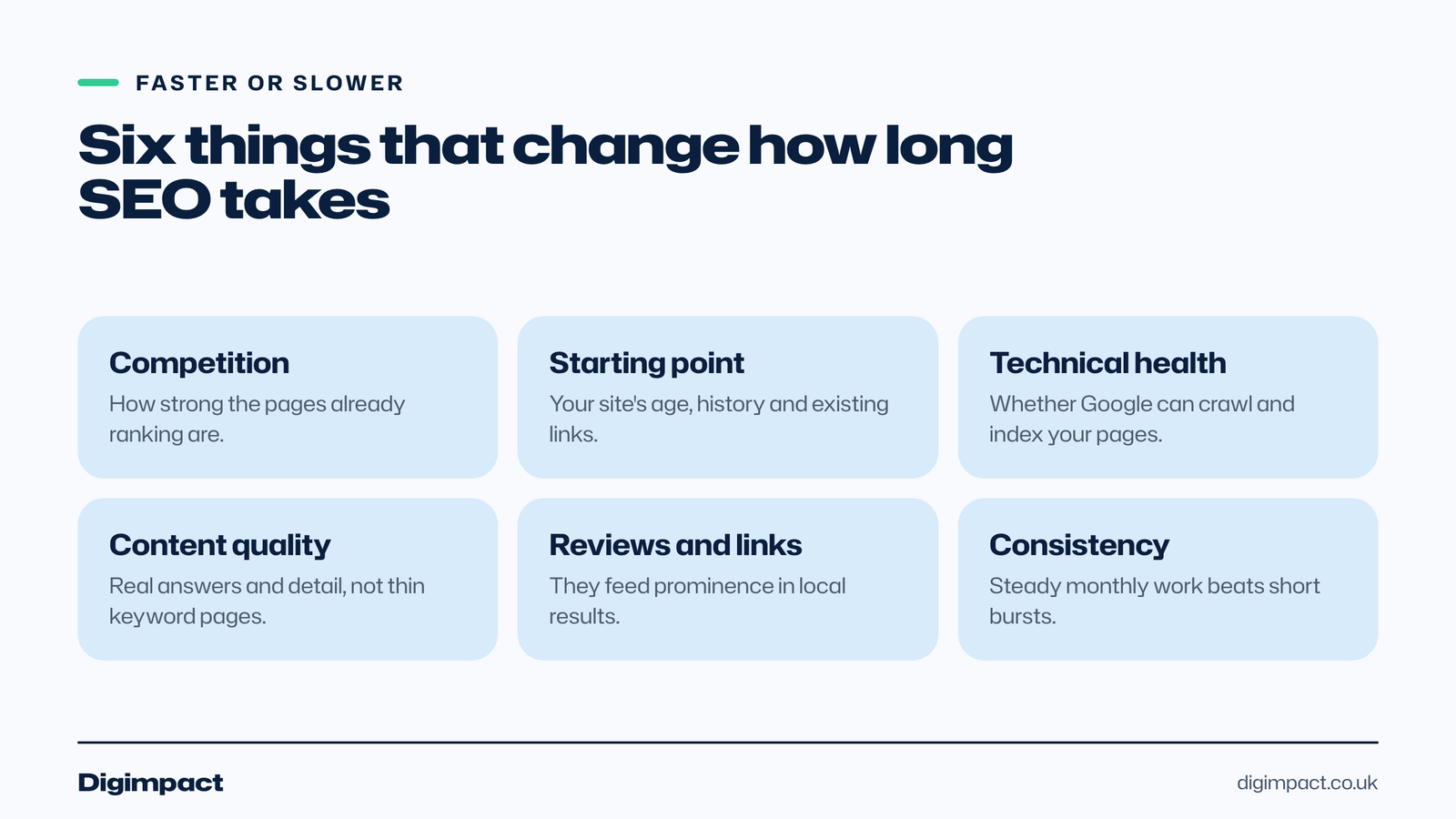
SEO moves faster when your site is technically sound, your searches are specific and local, and you already have some reviews and links. It moves slower on a brand new domain, in a crowded market, or when a site has old problems to clear first.
The main factors are:
- Competition: ranking for a search where ten established businesses have strong pages takes longer than ranking for one nobody has answered well.
- Your starting point: an older site with a clean history and some links usually moves faster than a brand new domain.
- Technical health: pages Google cannot crawl or index cannot rank, however good they are.
- Content quality: pages written for customers, with real detail, beat thin pages written around a keyword.
- Reviews and links: these feed prominence, which Google uses in local results.
- Consistency: steady monthly work compounds, while bursts of activity followed by months of nothing do not.
How do you know if SEO is working before rankings move?
You know SEO is working before rankings move when more of your pages are indexed, impressions in Search Console are rising, and specific searches start to show your pages in better positions. Calls, direction requests and enquiries usually follow those numbers, not lead them.
Check these monthly:
- Pages indexed in Search Console’s Page indexing report.
- Impressions and average position in the Performance report, especially for longer searches.
- Calls, website clicks and direction requests from your Google Business Profile.
- Enquiries and bookings that came from search, which is the number that pays the bills.
In the first months, these are the SEO results worth reporting on, because rankings for your biggest keywords move last.
New search features change what success looks like too. A page cited in Google AI Overviews can earn visibility without a click, so impressions matter as much as visits early on.
Red flags: SEO promises that should worry you
Treat any promise of a fixed ranking by a fixed date with suspicion. Google’s own page on hiring an SEO says no one can guarantee a number one ranking on Google, and warns about SEOs who claim a special relationship with Google or offer priority submission.
Google’s guide to how Search works is just as direct: Google does not accept payment to crawl a site more often or to rank it higher. So any offer to pay your way into the organic results is false. Paid ads are a different product, clearly labelled as sponsored.
Other warning signs include:
- Page one for a competitive search within weeks.
- Thousands of links for a small monthly fee.
- No access to your own Search Console or Google Business Profile.
- Monthly reports with no list of what was actually changed. Google suggests asking any SEO whether they will share every change they make to your site and explain why.
How long should you give SEO before judging it?
Give SEO at least three to six months before judging rankings, but expect to see signs of progress within the first few weeks: pages indexed, impressions rising and listings complete. If there are no SEO results at all after six months, the plan needs changing rather than more patience.
That fits both sources above. Google suggests waiting a few weeks to assess a change, and Ahrefs suggests updating pages that are still outside the top 10 after about six months. Between those points, keep publishing, keep collecting reviews and keep fixing what Search Console reports.
Can you speed up SEO?
You cannot buy a shorter SEO timeline, but you can stop wasting time. The quickest SEO results usually come from fixing indexing problems, improving pages that already get impressions, and targeting specific local searches before broad national ones.
Practical ways to get results sooner:
- Fix technical problems first, so new work is not wasted on pages Google cannot see.
- Improve existing pages that already appear on page two before writing new ones. The Ahrefs data shows older pages hold most top 10 positions, so improving an established page often beats starting from scratch.
- Target specific searches, such as a service plus your town, where competition is lower.
- Complete your Google Business Profile and keep it active with Google Business Profile posts, photos and fresh reviews.
- List your business everywhere customers search, including Apple Maps and Bing Places, with matching details.
- Link your pages together, so Google finds new pages quickly through the ones it already knows.
If you need customers this month, paid search can bring visits from day one while SEO builds. It stops when you stop paying, so it works best alongside SEO.
Want a realistic timeline for your business?
How long does SEO take for your business? It depends on your site, your town and your competitors, so it should be written down for your business, not quoted from a blog post. Our local SEO service starts with a check of your site, profile and listings against the businesses ranking above you, then a plan for the first months.
It runs for a fixed monthly fee agreed in writing after a 30-minute call, with no long contract and a plain report of what changed each month. Not sure where you stand? Start with a free website check.
Frequently asked questions
How long does SEO take for a new website?
A new website usually takes longest, because it has no history, links or reviews yet. Google can crawl new pages within days to weeks, but an Ahrefs study found only 1.74% of newly published pages went on to rank on Google’s first page within a year. Start with specific, local searches, where a new site can compete sooner.
How long does SEO take for a small business?
For a small business targeting local searches, expect early SEO results within two to six months and steadier gains over six to twelve months, in line with Google’s old guidance of four months to a year. Competitive national searches take longer, and a brand new site sits at the slow end of the range.
How long does local SEO take?
The first steps are quick. Google says Business Profile verification reviews take up to five working days, and completing your profile improves relevance straight away. Building prominence through reviews and links takes months, so expect the full benefit of local SEO to build over months rather than weeks.
Can SEO work in a month?
Some changes can show within days, and Ahrefs found that 40.82% of the pages that reached the top 10 did so within a month. Ahrefs also found that high-volume searches take longer than low-volume ones, so for competitive searches a month is too soon to judge.
Why do my rankings go up and down?
Rankings move as Google updates its systems, as competitors change their pages, and as Google learns more about your site. Google says it makes significant, broad changes called core updates several times a year. Look at the trend over months, not day to day.
How do I know if my SEO company is doing anything?
Ask for a list of every change made each month and the reason for it, plus access to your own Search Console and Google Business Profile. Google’s guide to hiring an SEO suggests asking exactly this. Rising impressions, more indexed pages and more enquiries over time are the signs that the work is landing.
Keep reading
- Email marketing rules UK businesses must follow: consent and the soft opt-in What PECR says about marketing emails and texts in the UK, when you need consent, how the soft opt-in for existing customers works, the different rules for companies and sole traders, and a checklist to stay compliant.
- How to make Reels for business on a phone, step by step A practical guide to filming Instagram Reels for a local business on a phone: what to film, how long Reels should be, how to edit and caption them, when to post and how to reuse them on other platforms.
- Apple Business Connect is now Apple Business: how to get your business on Apple Maps (2026 UK guide) Apple Business Connect became part of Apple Business in April 2026. This UK guide shows how to add your business to Apple Maps in seven steps, what is free and available in the UK, and how to use showcases, action buttons and insights.
Free website check
How does your own website do?
Enter your website and see a quick check on screen in about 20 seconds: speed, Google, phones and the details that win the click. A full written report follows within two working days, free and with no sales call unless you ask.
Want help with this?
Tell us about your business. We reply within one working day with a time for a 30-minute call, and a fixed quote afterwards.
Rather talk now? Call 07551 079787.
Thanks, that is with us.
We will reply within one working day with a time for a call.