We checked 935 local business websites in 2026. Here is what we found.
Original research: we ran a 13-point check on 935 small business websites across Hampshire, West Sussex and the Isle of Wight. A quarter did not load, and most miss simple details that win customers.
By GP 13 minute read
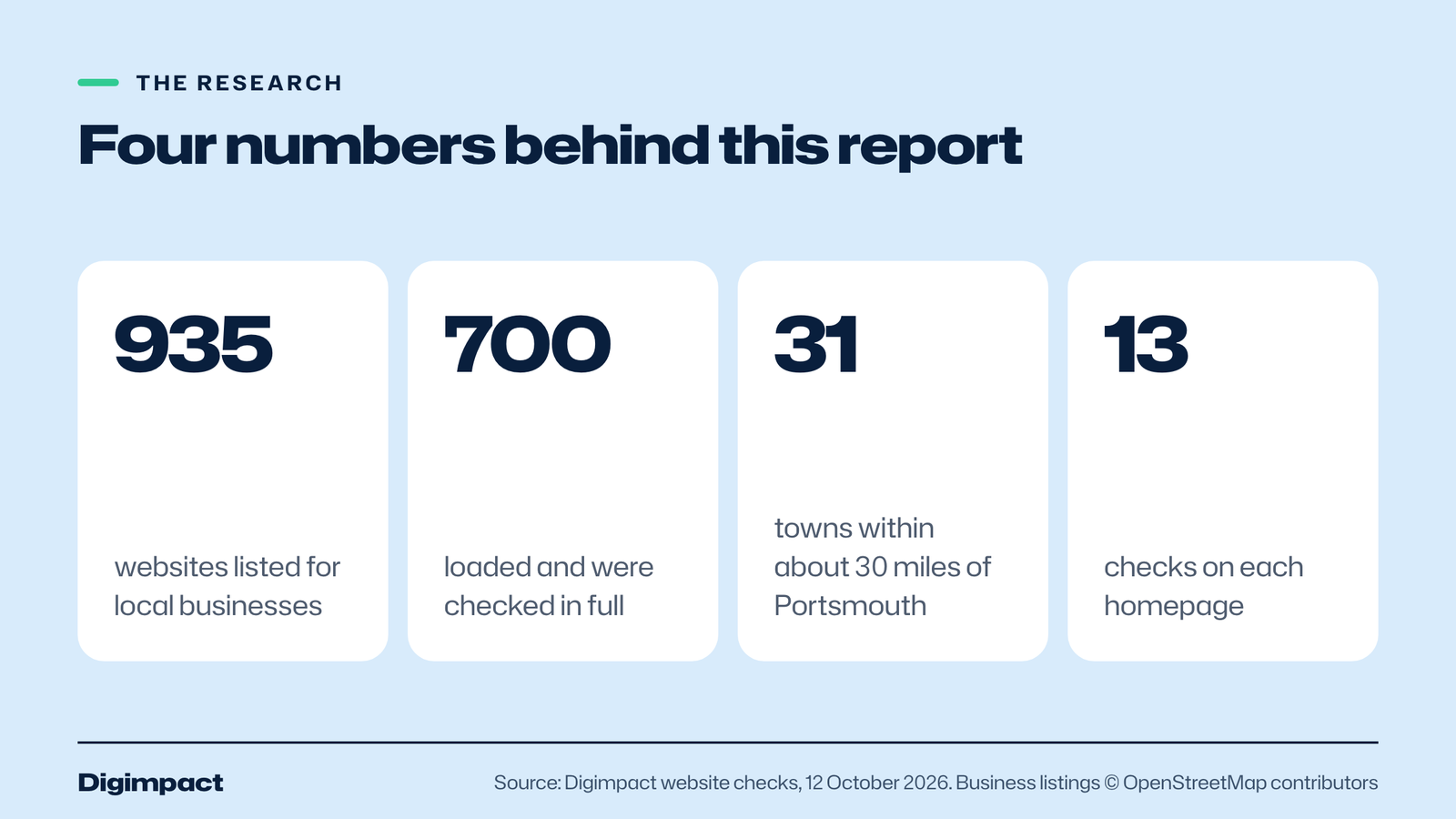
TL;DR: We checked 935 small business websites listed for 31 towns around Portsmouth on 12 October 2026. A quarter (25.1%) did not load at all. Of the 700 that did, 76.6% gave Google no structured business details, 54.3% had no tap to call link, and 52.0% set no picture for when the page is shared. Most of these take less than an hour to fix.
Key takeaways
- We checked 935 small business websites listed for 31 towns in Hampshire, West Sussex and the Isle of Wight on 12 October 2026.
- One in four (25.1%) did not load at all when we checked them.
- Of the 700 that loaded, 76.6% gave Google no structured business details such as opening hours and address.
- More than half (54.3%) had no tap to call link on their homepage.
- Only 2 of the 700 sites passed all 13 of our checks; the typical site passed 9.
How did we check 935 small business websites?
We took every business in 31 towns within about 30 miles of Portsmouth that lists a website on OpenStreetMap, removed duplicates, and ran our free 13-point website check on each homepage on 12 October 2026. That gave 935 small business websites, of which 700 loaded and were checked in full.
The list of businesses comes from OpenStreetMap, the open map that volunteers and businesses keep up to date, so it covers the restaurants, cafes, pubs, salons, shops, clinics and trades that people find on maps. OpenStreetMap data is available under the Open Database Licence, and the business listings used here are copyright OpenStreetMap contributors.
Each site was checked once, from our own server, with the same 13 tests that power our free website check. The tests read the homepage as Google first sees it, without running scripts, and look for the details that decide whether a customer finds you, trusts you and gets in touch.
What share of small business websites do not load?
One in four small business websites listed for local businesses did not load when we checked them: 235 of the 935, or 25.1%. Some had expired domains, some returned errors, and some did not answer within 15 seconds. To a customer tapping the link on a map, each one looks like a business that has closed.
The failure rate varied by type of business. Places to stay had the highest share of dead links in our sample, and trades and motor businesses the lowest, though both groups were small. Food and drink, the biggest group with 449 sites, had 27.4% that did not load.
When we looked more closely at Portsmouth in an earlier study of 195 sites, most failures were domains that had simply lapsed: the business still trades, but the web address on its listing no longer exists. Fixing it means either renewing the domain or updating the listing to the address that works.

What do most small business websites get wrong?
The most common gaps on the small business websites that did load were missing structured business details (76.6%), images without descriptions (58.1%), no tap to call link (54.3%), no picture set for sharing (52.0%) and the wrong number of main headings (48.9%). None of these is visible at a glance, which is why they go unnoticed.
Here is how often each of the 13 checks failed, out of the 700 sites that loaded:
| Check | What fails it | Sites failing |
|---|---|---|
| Business details for Google | No structured data naming the business type | 76.6% |
| Image descriptions | More than one in ten images with no alt text | 58.1% |
| Tap to call | No phone link on the homepage | 54.3% |
| Picture when shared | No sharing image set for social media | 52.0% |
| Main heading | Not exactly one main heading | 48.9% |
| Search description | Missing, or outside 50 to 165 characters | 47.0% |
| Page weight | Homepage code over 200 KB before images | 31.1% |
| Page title | Missing, or outside 10 to 65 characters | 24.1% |
| Sitemap | No sitemap for search engines | 17.7% |
| Server speed | Homepage took over 1.5 seconds to arrive | 10.9% |
| Works on phones | No instruction for phones to fit the page | 7.0% |
| Secure address | Not loading over https | 4.6% |
| Visible to Google | Homepage tells search engines not to list it | 1.3% |
The good news is at the bottom of the table. Nearly every site now loads securely and fits on a phone, and only nine told Google not to list them. The basics of web hosting have improved. What is missing is the layer of detail that helps a small business website win the click and the call.

Why do missing business details matter?
Structured business details are a short block of code that tells search engines, in a format they can read reliably, what kind of business you are, where you are, when you open and how to contact you. Three in four small business websites we checked did not have them, which leaves Google to guess from the page text.
The format comes from Schema.org, the shared vocabulary that Google, Microsoft and others use, and Google explains how it reads it in its guide to local business structured data. It does not guarantee a better ranking, but it removes doubt about your address, hours and type of business for any system that reads the page.
Places to stay and health businesses did best here, though just over half of each still lacked the details (52.6% and 53.2%), compared with 84.2% of shops and services. Most website builders can add it, and on WordPress a good SEO plugin does it in minutes.
Why does tap to call matter on a small business website?
A tap to call link turns your phone number into a button, so a customer on a phone can ring you with one tap instead of copying the number. More than half of the small business websites we checked (54.3%) had no such link on the homepage, and among food and drink businesses the share was 59.8%.
Local customers mostly look up a small business website on their phone, often while they are out. If they have to switch apps or remember a number to call you, some will simply call the next business instead. Adding the link takes a few minutes: the number is wrapped in a link that starts with tel: followed by the number.
One caution about this figure: our check reads the homepage code without running scripts, so a site that adds the button with JavaScript may have been counted as missing it. Even allowing for that, the gap is large.
How do different types of business compare?
Across business types, trades and motor, places to stay and health businesses passed the most checks on average (just over 9 of 13), while food and drink passed the fewest (8.4). Food and drink also had the most broken links, with 27.4% of listed websites not loading, and the most sites without a tap to call link, at 59.8%.
| Type of business | Websites listed | Did not load | No business details | No tap to call |
|---|---|---|---|---|
| Food and drink | 449 | 27.4% | 76.4% | 59.8% |
| Shops and services | 265 | 21.1% | 84.2% | 52.2% |
| Hair and beauty | 103 | 29.1% | 75.3% | 57.5% |
| Health | 57 | 17.5% | 53.2% | 36.2% |
| Places to stay | 32 | 40.6% | 52.6% | 36.8% |
| Trades and motor | 29 | 10.3% | 80.8% | 38.5% |
The smaller groups, places to stay and trades, should be read with care: with around 30 sites each, a few businesses change the percentages a lot. The pattern in the larger groups is clearer. Restaurants, cafes, pubs and takeaways have the most to gain from small fixes, because so many of their customers decide on a phone in the moment.

How does Portsmouth compare with nearby towns?
Broken links were most common in the centre of the city. Of the 149 websites listed for Southsea businesses, 40% did not load, and Portsmouth and Cosham were close behind at 32% and 30%. Towns further out did better: in Lymington only 7% of 45 listed sites failed, and in Waterlooville 13%.
| Town | Websites listed | Did not load |
|---|---|---|
| Southsea | 149 | 40% |
| Portsmouth | 106 | 32% |
| Cosham | 40 | 30% |
| Southampton | 45 | 27% |
| Winchester | 45 | 24% |
| Eastleigh | 45 | 24% |
| Chichester | 45 | 20% |
| Newport, Isle of Wight | 41 | 17% |
| Midhurst | 45 | 16% |
| Ryde | 37 | 14% |
| Waterlooville | 45 | 13% |
| Lymington | 45 | 7% |
Two cautions apply. For most towns we checked a sample of around 45 listed sites, while for Portsmouth and Southsea we checked every listed site, which picks up more old listings for businesses that have moved or closed. And a high-street area with lots of turnover, such as Southsea, will naturally have more out-of-date links than a market town where businesses stay put for decades.
What should you do if your website link is broken?
If your website link does not load, first find out why: an expired domain, a lapsed hosting plan, or a link pointing to an old address. Then fix the cause and update every place the address appears, starting with your Google Business Profile, because that is where most customers find the link.
The usual causes and fixes:
- The domain has expired. Log in to the company you registered it with and renew it. If it has lapsed for a while, check it has not been bought by someone else.
- The hosting has lapsed. The domain works but shows an error page. Renew the hosting, or move the site to a new host.
- The link is out of date. The business moved to a new web address, but old listings still point to the old one. Update the listing, and if you still own the old domain, redirect it to the new one.
After that, update your website address on your Google Business Profile, Facebook page, Instagram profile and any directories you are listed in. OpenStreetMap listings can be corrected by anyone with a free account, which is also how many map apps get their data.
How fast are small business websites?
Most of the small business websites we checked were quick to respond: the median homepage arrived in 0.3 seconds, and only 10.9% took longer than our 1.5 second limit. That is the time for the page’s code to arrive, not the full load with every image, so a site can pass this check and still feel slow on a phone.
The weight of the page matters as much as the server. Almost a third of sites (31.1%) sent more than 200 KB of code before a single image, which is common with page builders that load every feature on every page. Heavy pages cost the most on mobile data, which is how most local customers browse.
What does a small business website that passes every check look like?
A small business website that passes all 13 checks loads securely and quickly, fits a phone, has one clear main heading, a title and description that fit Google’s results, a sitemap, a sharing picture, descriptions on its images, a tap to call link and structured business details. Only 2 of the 700 sites we checked managed all of that.
None of it is expensive or technical once it is set up. The difference between the typical site, which passed 9 checks, and a perfect one is usually a few hours of tidying by whoever looks after the small business website: adding a phone link, writing a proper description, setting the sharing image and adding the business details. That is why we built the free check around these 13 points: each one is something a business can act on straight away.
Which five fixes would help most small businesses?
The five fixes that would help the most small business websites in our sample are: make sure the website address works, add structured business details, add a tap to call link, set a sharing picture, and give the homepage one clear main heading. Together they address the top problems for most of the 935 sites, and none needs a new website.
- Check your link works. Search your business on Google Maps, tap the website link and make sure it loads. If it does not, renew the domain or update the listing.
- Add business details for Google. Add LocalBusiness structured data with your name, address, phone and opening hours.
- Make the phone number a button. Wrap your number in a tel: link in the header of every page.
- Set a sharing picture. Choose the image that appears when someone shares your site on Facebook, WhatsApp or LinkedIn.
- Use one main heading. Make the homepage’s main heading say what you do and where, in plain words.

What are the limits of this research?
This research checked each small business website once, on one day, from one location, reading the homepage only. A site that was down for a few minutes would count as not loading, and features added by scripts may not have been seen. The sample covers businesses that list a website on OpenStreetMap, which leans towards hospitality and retail.
We think the findings are still a fair picture of the region, because the gaps we found are consistent across towns and business types and match what we see when we look at local sites one by one. If you run one of the businesses in the sample and want your own result, our free website check runs the same 13 tests on your site in about 20 seconds.
If your business is in Portsmouth or nearby, we design and build websites from £300 a year with hosting and your domain included. See web design in Portsmouth.
Frequently asked questions
How many small business websites did you check?
We checked 935 small business websites listed on OpenStreetMap for 31 towns within about 30 miles of Portsmouth, on 12 October 2026. Of those, 700 loaded and were checked in full against 13 tests, and 235 did not load at all.
What is the most common problem on small business websites?
Missing structured business details. Of the 700 sites that loaded, 76.6% had no structured data telling search engines what type of business they are, where they are and when they open. It is one of the easiest gaps to close.
What percentage of small business websites do not work?
In our sample, 25.1% of the websites listed for local businesses did not load when we checked them. The causes included lapsed domains, server errors and sites that did not answer within 15 seconds.
Do small business websites need a tap to call button?
Yes, if customers ever phone you. Most local customers look you up on a phone, and a tap to call link lets them ring you in one tap. In our sample, 54.3% of small business websites had no such link on the homepage.
Can I check my own website the same way?
Yes. Our free website check runs the same 13 tests used in this research on your homepage in about 20 seconds, shows the results on screen, and is followed by a full written report within two working days, with no obligation.
Want your website to be one of the 2 that pass everything?
Only 2 of the 700 small business websites we checked passed all 13 tests, which means almost every local business has easy wins waiting. Start with our free website check to see where your site stands, or talk to us about website design and local SEO if you want the fixes done for you.
See it in practice: how we built the VETHR website and SEO.
Keep reading
- How to make Reels for business on a phone, step by step A practical guide to filming Instagram Reels for a local business on a phone: what to film, how long Reels should be, how to edit and caption them, when to post and how to reuse them on other platforms.
- Apple Business Connect is now Apple Business: how to get your business on Apple Maps (2026 UK guide) Apple Business Connect became part of Apple Business in April 2026. This UK guide shows how to add your business to Apple Maps in seven steps, what is free and available in the UK, and how to use showcases, action buttons and insights.
- How to choose your Google Business Profile categories How to choose the right Google Business Profile categories, why the primary category matters most, when additional categories help, the mistakes Google warns against, and how to change them safely.
Free website check
How does your own website do?
Enter your website and see a quick check on screen in about 20 seconds: speed, Google, phones and the details that win the click. A full written report follows within two working days, free and with no sales call unless you ask.
Want help with this?
Tell us about your business. We reply within one working day with a time for a 30-minute call, and a fixed quote afterwards.
Rather talk now? Call 07551 079787.
Thanks, that is with us.
We will reply within one working day with a time for a call.