Showing the total price: what the CMA says UK small businesses must include so hidden fees do not break the law
What the CMA's price transparency guidance says about showing the total price up front, including mandatory fees such as delivery, booking and service charges, VAT, from prices, optional extras, subscriptions and how drip pricing can lead to fines of up to 10% of turnover.
By GP 14 minute read
TL;DR: Under the Digital Markets, Competition and Consumers Act 2024, the CMA says traders must give the customer the total price in the invitation to purchase, from the first advert onwards. The total price normally includes any mandatory charge, such as a delivery or booking fee or VAT, and showing it separately is not normally enough. Hiding additional fees until later is drip pricing. A from price is allowed if it includes all mandatory charges. Optional extras can be shown separately. A business found in breach can be fined up to 10% of turnover or £300,000, whichever is greater, and ordered to compensate customers.
Key takeaways
- The CMA says prices must be clear, complete and accurate, and traders must provide the total price up front. It is illegal to hide additional fees, taxes or other charges the customer will have to pay until later in the purchase process, sometimes called drip pricing.
- The duty applies to anyone who sells, advertises, markets or otherwise promotes a product to customers at any point in the purchase process, from early-stage advertising to the final sale. That includes a page on your website, a social media post and an email.
- The total price should normally include any unavoidable, or mandatory, charge: a fee such as a delivery or booking fee, tax such as VAT, or any other unavoidable payment. Providing them separately will not normally be enough.
- A from or indicative price is allowed if it includes all applicable mandatory charges and does not mislead customers about what the price covers.
- Optional charges, such as next-day delivery, must be shown in the invitation to purchase but do not have to be in the total price.
- If found in breach, you could be fined up to 10% of your turnover or £300,000, whichever is greater, and ordered to compensate affected customers.
A small events company advertises tickets to a gig at £25 on its website and in a social media post. When customers get to the checkout, a £3 booking fee, a £2 payment fee and a £1.50 delivery charge appear, and the price they pay is £31.50. Customers do not notice until the last step, and some complain. The company thinks it is being transparent, because the fees are listed, in full, before payment. The CMA’s guidance says that is not enough.
Pricing rules have tightened. Since the Digital Markets, Competition and Consumers Act 2024 came into force for commercial practices from 6 April 2025, the CMA can take direct action against traders who hide fees. This guide explains what the CMA’s price transparency guidance says about the total price, what counts as a mandatory charge, how from prices and optional extras work, how to deal with delivery, booking fees, VAT and subscriptions, and how to check your website, shop and social media. It is general information, not legal advice, and the CMA says to read its full guidance or take independent legal advice if in doubt.
What does total price mean?
The CMA says that when you tell a customer about a product and its price, this will normally be an invitation to purchase, and in the invitation you must give the customer the total price of the product in a clear and timely manner that they are likely to see. If you do not, the information will be treated as having been omitted.
The CMA’s price transparency guidance sits under the Digital Markets, Competition and Consumers Act 2024, and its page on providing clear and accurate information about prices summarises its guidance on price transparency (CMA209), which explains the relevant parts of the Digital Markets, Competition and Consumers Act 2024. It says an invitation to purchase can take many forms: a price on a product in a shop, an advert in a newspaper or on TV, online marketing such as an email or a social media post, or a page on your website. An invitation does not need to include an opportunity for the customer actually to buy.
That is why the rule starts at the first advert. A price on a Facebook post, a Google Business Profile product listing, a menu page or a banner on your homepage is an invitation to purchase. The total price must be there, not just at checkout.
The CMA says the aim is that consumers have the information they need to make informed decisions, shop around and compare the prices of competing products. It adds that if you do not provide complete and accurate prices that include charges consumers cannot avoid, you may be breaking the law and undermining consumers’ trust in your business.
What is drip pricing?
Drip pricing is hiding additional fees, taxes or other charges that the customer will have to pay until later in the purchase process. The CMA says it is illegal. If you are found to have broken the law, you could be fined up to 10% of your turnover or £300,000, whichever is greater, and ordered to compensate affected customers.
The pattern is familiar: a low headline price draws a customer in, then charges are added as they go through the steps. By the end, the customer has spent time and effort and may feel committed. The CMA’s rule is that the total price must be given at the start, so that the customer can compare it with competitors before they invest in the process.
The same rule applies to small businesses. The CMA says it applies to anyone who sells, advertises, markets or otherwise promotes a product to customers at any point in the purchase process, from early-stage advertising to the final sale. There is no exemption for size, though the practical risk for a small business is different from a multinational, and the guidance says that examples are not exhaustive.

Which charges must be included?
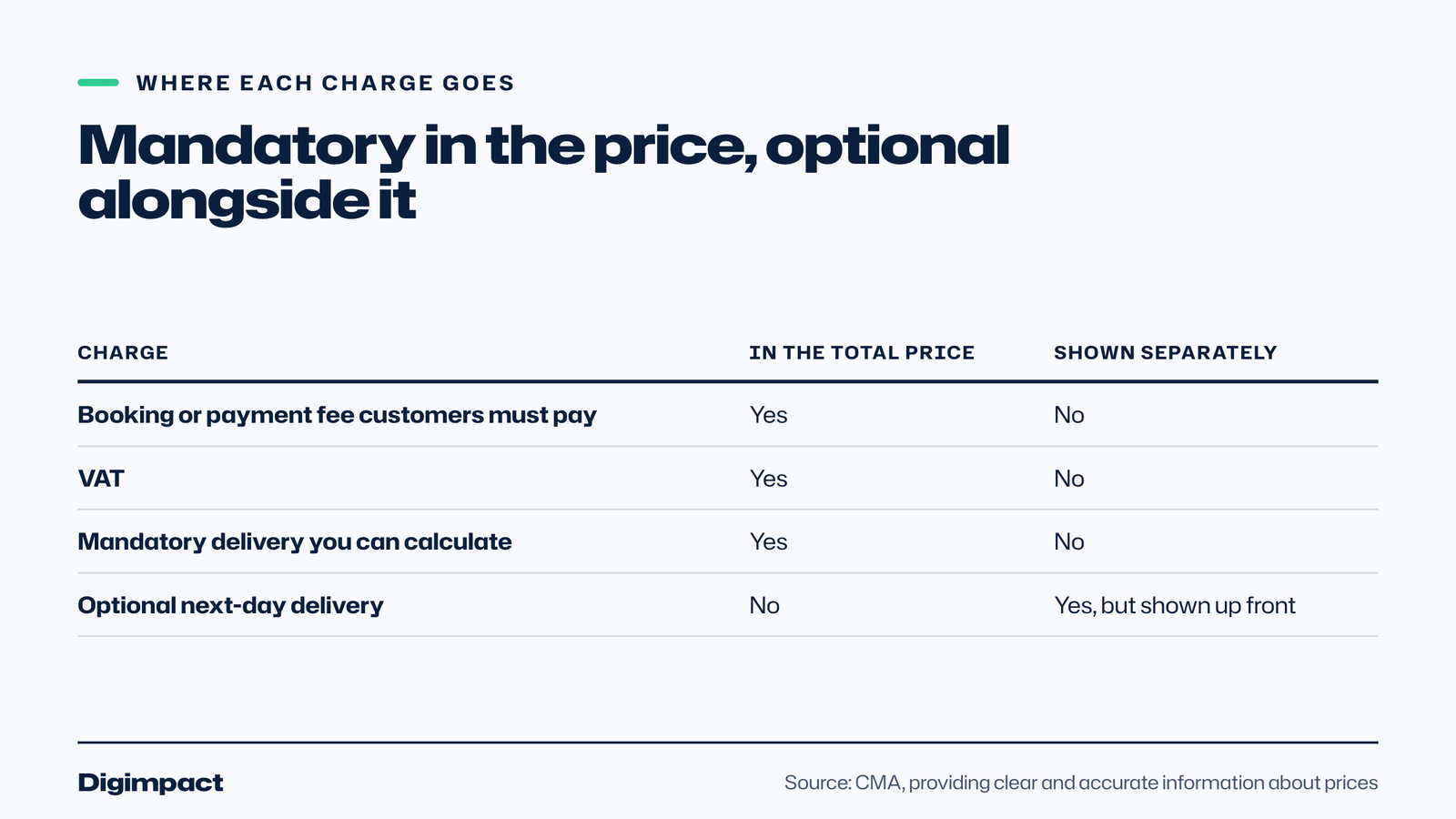
The CMA says the total price should normally include any unavoidable or mandatory charge. A charge is mandatory if the customer must pay it to buy the product. That includes fees such as delivery or booking fees, taxes such as VAT, and any other unavoidable payment the customer would have to make to purchase or receive the product.
Providing mandatory charges separately will not normally be enough to comply with the law. So a price of £25 plus a £3 booking fee shown next to it is not the same as £28. The total price shown to the customer must be the full amount they must pay for the product.
For a small business, common mandatory charges include a booking or table reservation fee, a service charge that customers cannot avoid, a mandatory delivery fee, a compulsory payment or admin fee, a mandatory deposit that is part of the price and VAT. Check each one against the test: can the customer buy without paying it? If not, it belongs in the total price.
Optional charges are different. The CMA says optional delivery charges, for example next-day delivery, must still be included in the invitation to purchase, but they do not have to be part of the total price and can be shown separately. Its example is shoes at £90 that includes standard delivery, with next-day delivery at an extra £5 presented separately.
What about from prices?
The CMA says the total price can be an indicative or from price as long as it includes all applicable mandatory charges and does not mislead customers about what the price covers. Its examples are a holiday priced on a 7-night stay for 2 people between specific dates, and photography services advertised as from £X.
If you use a from price, define the basis clearly: what is included, for how many people or hours, and in which circumstances the price changes. A from price that no customer can actually pay, or that omits a charge every customer must pay, is likely to mislead.
Where the nature of the product means you cannot calculate the total price, the CMA says you must give customers the information they need to work it out, with the same prominence as the part of the price you can calculate. In practice, set it out next to the part you can calculate. Its example is an advert for made-to-measure curtains that shows the unit price of £25 per metre prominently and the delivery charge of £9.95 directly below it.
That example suits many service businesses. A trades business that prices by the job, a salon that prices by hair length or a web designer that quotes by page count can show a from price and a clear explanation of what changes it. Our guide to website design for tradesmen shows how to present services and prices so that customers can work out what they will pay.
How do delivery and per-transaction charges work?
The CMA says mandatory delivery charges must be in the invitation to purchase, and in the total price if you can reasonably calculate them. If the customer has to choose between delivery options, include the cheapest until they choose another. A one-off flat booking fee is a per-transaction charge and must be in the total price, even in early-stage advertising.
On delivery charges that vary, for example by location, the CMA says if you do not know the charge you must include enough information in the invitation to purchase to enable the consumer to calculate the total price, presented with the same prominence as the headline price. As soon as you can reasonably calculate the charge, you must include it in the total price.
On retail websites, the CMA says you may be able to comply by prominently showing the delivery fees and providing a running total, including those fees, for the customer’s order throughout the purchase process. The running total must be clear and timely. Its examples include a food delivery basket showing a cheeseburger at £12.00 and a delivery fee of £2.49 for a total price of £14.49, and a basket that appears when the customer clicks add to basket, with items and a mandatory £5 delivery charge reflected in the total.
A per-transaction charge is a mandatory charge that applies to a purchase or order, not to an individual product, such as a flat booking fee. The CMA says to include it in the total price of the product, even in early-stage advertising, and to include it in a from price. Its example is an early-stage advert for a theatre production with a mandatory £2 per-transaction charge in the headline price.
What about subscriptions and memberships?
For a rolling monthly contract the customer can cancel at any time, the CMA says to show the total price the customer will pay each month, including mandatory charges in that period. For a contract with a minimum term, show either the cumulative price for the whole contract or the monthly price along with the number of months it is payable.
The CMA’s example is a gym offering a membership as £70 per month for 12 months, plus a £30 joining fee, with a total annual membership of £870. You can also present other pricing information as long as the total price is presented in a clear and timely manner the customer is likely to see.
The guidance adds that providing the total price up front does not stop you taking payment in instalments, charging a pro-rata price or requiring the customer to pay part of the price to a different trader such as a broker.
For service businesses with plans, such as a website care plan or a social media package, the same rule applies. If there is a setup fee that every customer must pay, include it in the price you advertise or show the cumulative price for the minimum term. We apply the rule to our own pricing: websites start from £300 a year per site, including hosting, your domain and five pages, with one fixed price in writing, and social media plans start from £300 a month.
How does it affect restaurants, venues and booking fees?
A mandatory service charge, cover charge or booking fee is a mandatory charge, so it belongs in the price the customer sees. An optional tip or an optional extra, such as a drink upgrade, can be shown separately. Show deposits clearly and say whether they are part of the price or a separate hold.
For a restaurant menu, that means thinking about any compulsory charge that is added to the bill. A set menu price that excludes a compulsory service charge may not show the total price. Make the charge part of the price, or if the charge is genuinely optional, say so clearly and make sure the customer can decline it without difficulty.
For event tickets, include all unavoidable fees in the headline price. For bookings, check that a booking system does not add fees at the last step. Our guide to restaurant booking software compares how booking tools charge, and the guide to reserve with Google explains one way to take bookings.
The CMA also covers local charges such as resort fees, and says to always include mandatory local charges and taxes in the invitation to purchase, with clear pay now and pay locally amounts where part of the price is paid at the venue. That is more relevant to hospitality that charges a fee at the point of arrival.
How do you check your own business?
Walk through each place you show a price: your website, product pages, menus, booking pages, Google Business Profile, social media posts, emails, flyers and third-party listings. For each, ask what a customer must pay to buy, and whether that figure is the one they see. Fix any that are not.

A practical audit:
- List every price you show and where.
- List every charge a customer must pay to buy, including VAT, booking, delivery, payment and admin fees.
- Compare the headline price with what the customer actually pays. If it is lower, change it.
- Separate optional extras and show them clearly alongside.
- Check from prices and say what they include.
- Check checkout and booking flows for fees that appear late.
- Check third-party platforms where your prices are listed.
- Record what you changed and when.
If you sell to other businesses only, different rules may apply, so take advice. The CMA’s guidance is about consumers. Check the full guidance (CMA209) for products or pricing structures that are more complex than the ones here.
What mistakes do small businesses make?
The common mistakes are advertising a low price and adding a booking fee at checkout, listing VAT separately, advertising a from price that nobody can pay, hiding mandatory charges in the small print, adding payment fees at the last step and forgetting third-party listings.
- Fees at checkout. A mandatory fee that appears late is drip pricing.
- VAT extra. For consumers, VAT is a mandatory tax that belongs in the price.
- A from price nobody can pay. It must include all mandatory charges.
- Small print. Separate disclosure is not normally enough.
- Payment fees. A mandatory fee for paying belongs in the price.
- Other platforms. Check what your listing on a booking or delivery site says.
Frequently asked questions
What is the total price?
The price the customer must pay to buy the product, including any mandatory charges such as fees and taxes. The CMA says it should be shown in the invitation to purchase, from the first advert.
Is it illegal to add fees at checkout?
If the fees are mandatory and were not in the price shown earlier, the CMA says it is illegal to hide them until later in the purchase process. That is drip pricing.
Can I advertise a from price?
Yes, if it includes all applicable mandatory charges and does not mislead customers about what the price covers.
Do optional extras have to be in the total price?
No. The CMA says optional charges, such as next-day delivery, must be shown in the invitation to purchase but do not have to be part of the total price.
What are the penalties?
The CMA says a business could be fined up to 10% of its turnover or £300,000, whichever is greater, and ordered to compensate affected customers.
Want a website that shows your prices clearly?
We build websites with clear pricing, booking and checkout pages that show the total price from the start. Websites start from £300 a year per site, including hosting, your domain and five pages, with one fixed price in writing. See our website design service, or start with a free website check.
Keep reading
- How to make Reels for business on a phone, step by step A practical guide to filming Instagram Reels for a local business on a phone: what to film, how long Reels should be, how to edit and caption them, when to post and how to reuse them on other platforms.
- Apple Business Connect is now Apple Business: how to get your business on Apple Maps (2026 UK guide) Apple Business Connect became part of Apple Business in April 2026. This UK guide shows how to add your business to Apple Maps in seven steps, what is free and available in the UK, and how to use showcases, action buttons and insights.
- How to choose your Google Business Profile categories How to choose the right Google Business Profile categories, why the primary category matters most, when additional categories help, the mistakes Google warns against, and how to change them safely.
Free website check
How does your own website do?
Enter your website and see a quick check on screen in about 20 seconds: speed, Google, phones and the details that win the click. A full written report follows within two working days, free and with no sales call unless you ask.
Want help with this?
Tell us about your business. We reply within one working day with a time for a 30-minute call, and a fixed quote afterwards.
Rather talk now? Call 07551 079787.
Thanks, that is with us.
We will reply within one working day with a time for a call.