How much does a website cost in the UK? A line by line breakdown of what you really pay in 2026
A line by line breakdown of what a website costs a UK small business in 2026: builders, local designers, rented sites, domains, hosting, email and upkeep, with published prices and a worked year one example for a five person business.
By GP 14 minute read
TL;DR: A UK small business website costs from about £12 a month on a do-it-yourself builder to £1,200 or more for a custom site from a local agency, and £2,500 or more for bespoke work. The price on the quote is only part of it, because the domain, email, upkeep and your own time also count.
Key takeaways
- How much does a website cost UK small businesses pay in 2026? From about £12 a month on a do-it-yourself builder, through £1,200 or more for a custom site from a local agency, to £2,500 or more for a bespoke build with bookings or integrations.
- The headline price is rarely the whole cost. The domain, business email, upkeep, photos and words, and your own time all sit outside a typical quote.
- Builder website prices come in tiers. Squarespace lists four plans between £12 and £89 a month on its UK page, while Wix and WordPress.com showed US dollar prices when we checked.
- Business email is a cost many people forget. Google Workspace lists £5.90 per user per month on its Starter plan, which is £354 a year for five people.
- Renting a site, which means paying a monthly fee and not owning the build, can be cheaper at the start but costs more over several years, so ask who owns the site if you stop paying.
- A fair quote lists what is included, who owns the finished site, what renewal costs and what happens after launch.

A café owner asks three people for a quote. One says £30 a month, one says £950 and one says £4,000. All three are telling the truth, and none of the quotes is comparable, because each one includes different things.
This guide breaks down the real website cost for a UK small business in 2026. It covers the three ways to get one, the running costs that most quotes leave out, a worked example of the first year for a five person business, and what a fair quote should include. Our shorter website cost guide has the headline ranges, and this post goes through where the money goes.
How much does a website cost UK small businesses pay in 2026?
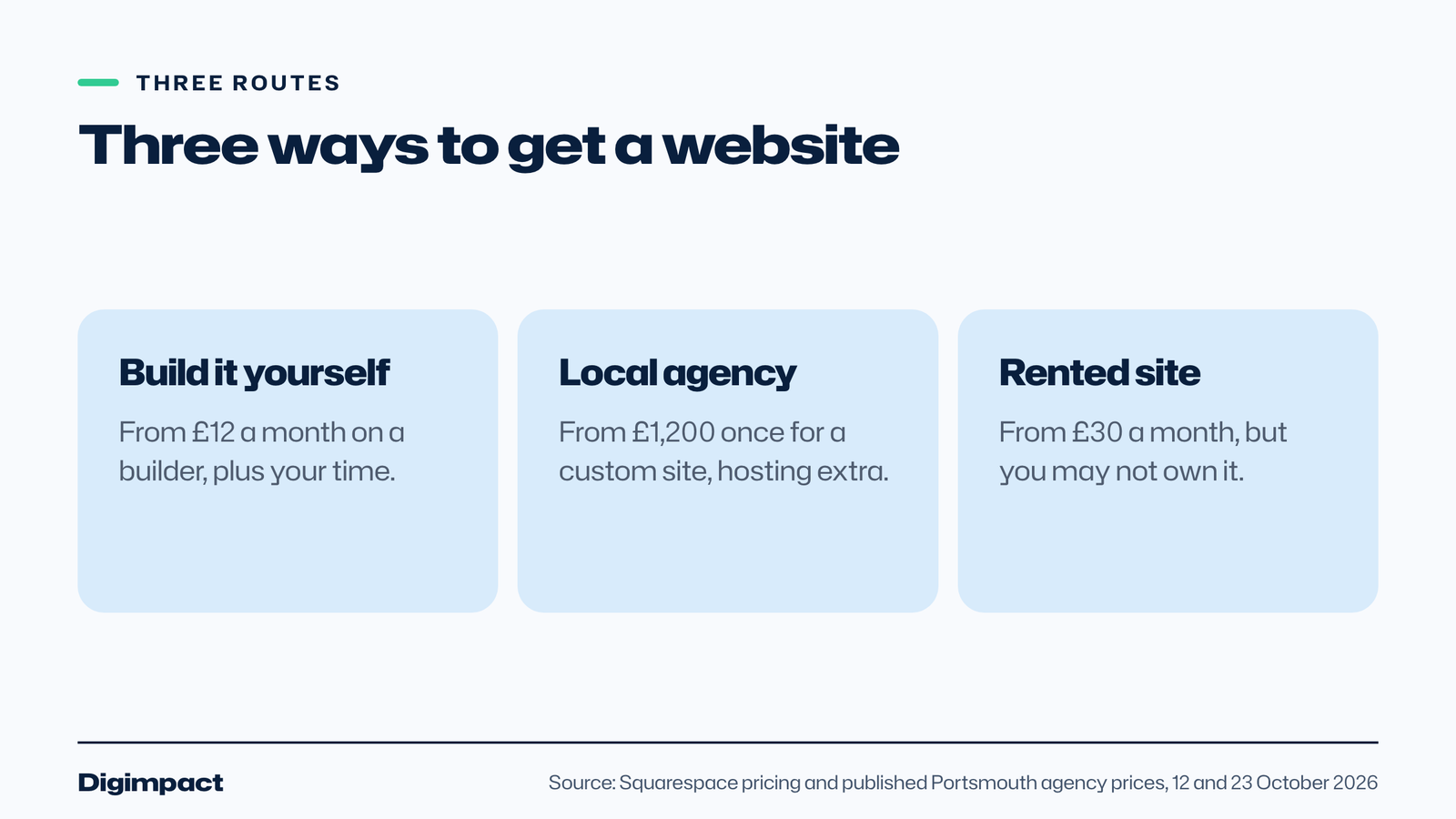
There are three routes, and each website cost has a different shape. You can build it yourself on a website builder, pay a designer to build it once, or rent a site that someone builds and runs for you.
| Route | Typical cost | What it covers |
|---|---|---|
| Do it yourself on a builder | £12 to £89 a month on Squarespace, depending on plan and billing | Hosting, a secure address and templates, but you do the work |
| Custom site from a local agency | From £1,200 once | A design made for you, forms and a secure address, with hosting and care billed separately |
| Bespoke site with bookings or integrations | £2,500 to £8,000 or more | Custom features, booking or payments built in |
| Online shop from an agency | From £3,500 | Products, checkout and delivery set up |
| Rented website, built and run for you | From £30 a month | Build, hosting and care for a monthly fee |
The ranges for local agencies come from prices published in Portsmouth, checked on 12 and 23 October 2026. Brambla lists 7 day websites from £1,200, custom builds from £2,500 to £8,000 or more, shops from £3,500 and monthly plans from £30, and another Portsmouth agency’s enquiry form starts its budget brackets at £750. Prices elsewhere in the UK can differ, so treat them as a guide.
Route 1: build it yourself on a website builder
A builder gives you templates, hosting and a secure address in one monthly fee, so the cost of a website is easy to see up front. It is the cheapest way to get online, and it suits you if you have the time to write the words, take the photos and learn the tool.
Squarespace lists four plans on its UK pricing page, from Basic at £12 a month to Advanced at £79 or £89 depending on the billing, and says all plans include fully managed cloud hosting and free security certificates. The page says annual purchases include one year of free domain registration, and that the domain renews at the standard rate after the first year.
Wix and WordPress.com showed US dollar prices when we viewed their pages from the UK. Wix lists yearly plans from $17.77 a month on Light to $39.77 on Business, paid in full for the year, and WordPress.com lists plans from US$4 a month on Personal to US$25 on Business on a 12 month term. Both say a free domain is included for the first year on yearly plans.
What a builder does not include is your time, and the hours are the real cost of a website you build yourself. A first website takes most people many hours, and the hours are the real cost if you could be earning in that time. Our guide to the best website builders for UK small businesses compares them, and the builder versus web designer guide helps you decide which route suits you.
Route 2: pay a local designer or agency
A designer builds the site for you, usually for a one off fee. For a custom website, the published prices we found in Portsmouth start at £1,200, and another agency’s enquiry form starts its budget brackets at £750. At those prices you should expect a design made for your business, a site that works on phones, contact forms, a secure address and basic search engine set up.
The web design cost rises quickly when the site has to do more. Booking, payments, a members area or integrations with other systems move a project into thousands, and the Portsmouth agency we checked publishes £2,500 to £8,000 or more for custom builds and from £3,500 for online shops. Our guide to ecommerce website costs covers shops in more detail.
Before you pay anyone, ask what is included and what is extra. Our guide on how to choose a web designer lists twelve questions to ask, including who owns the finished site and who writes the words.
Route 3: rent a website that someone builds and runs for you
Some agencies build the site and charge a monthly fee that includes hosting and care. Brambla lists monthly plans from £30 for up to five pages, with a free build, no contract and VAT included. The attraction is a low start, with no large bill up front and someone to call when something breaks.
The catch is ownership. With a rented site, you often do not own the build, and if you stop paying, the site may go. Over three or four years the monthly website cost can add up to more than a one off build with a care plan, so work it out before you choose.
Our own approach is a fixed yearly price. A Digimpact website starts from £300 a year per site and includes hosting, your domain and five pages, with one fixed price in writing before work starts. We build websites for a living, so weigh our view against the others, and ask any supplier the same ownership questions we are asking here.
What running costs do most quotes leave out?
This is where a website cost budget goes wrong. A quote for the build is not a quote for the whole website cost, because a website has running costs every year.
The domain name. A domain such as yourbusiness.co.uk is a yearly cost. Hostinger’s domain search page showed a .co.uk at £0.01 for the first year with £10.99 listed next to it, and does not label £10.99 as the renewal price, so check what the renewal rate is before you buy. Squarespace says domains renew at its standard rate after the first year.
Hosting and care. Builders include hosting. With a custom site, hosting and care are usually extra. Brambla lists WebsiteCare from £65 a month, covering hosting, security, backups, updates and support, and bills it separately from its 7 Day Website. Our guide to website maintenance lists what a site needs each month.
Business email. Many small businesses use a mailbox at their own domain. Google Workspace lists Starter at £5.90 per user per month on monthly billing, Standard at £11.80 and Plus at £18.40. For five people on Starter, that is £29.50 a month, or £354 a year.
Photos and words. A site needs real photos and clear writing. If you do not have them, you will need to budget for photography and copywriting, or spend the time yourself. This is the item that most often delays a launch.
Search visibility. A website that Google cannot read does not bring customers. Set up a Google Business Profile, and make sure the site has a sitemap and sensible titles. Our guide to the essential website pages covers the pages every small business needs.

What does year one cost for a five person business?
Here is a worked example of the cost of a website. It uses only website prices published on the pages above, and it counts the first year only. It leaves out your time and any photos or words.
| Item | Builder route | Digimpact route |
|---|---|---|
| Website, hosting and domain | Squarespace Core at £17 a month billed yearly, £204 | £300 a year, including hosting and domain |
| Business email, five people | Google Workspace Starter, £354 | Google Workspace Starter, £354 |
| Total for year one | £558 | £654 |
The builder is cheaper in cash, but you build and maintain the site yourself and pay with your time. The £300 route means someone else builds it, and the gap is £96 for the year. A local agency build from £1,200 would add hosting and care on top, such as WebsiteCare from £65 a month, which is why the one off price is only part of the picture.
Squarespace’s page does not label whether £17 is the yearly billing price, but it is the lower of the two prices shown for Core, so we have used it as the yearly rate. Check the plan page when you buy.

How does the cost of a website change with the type of business?
The same budget does not buy the same thing for every trade, because what the website has to do changes the web design cost. A site that only needs to be found and phoned is cheap, and a site that has to take payments is not.
A tradesperson or consultant usually needs a handful of pages, a clear phone number, a contact form and proof of past work. That is the cheapest end of website prices, and either a builder or a small custom site will do the job, as long as the site loads fast on a phone.
A café, pub or restaurant needs a menu that is easy to read on a phone, opening hours, a map and often a booking button. The website cost goes up if bookings are built into the site, and our restaurant booking software guide explains the options and what they charge.
A salon, clinic or studio needs online booking, and often deposits and reminders. That usually means a booking system as well as a site, and the monthly fee for the booking software sits on top of the website cost. Compare the two together before you decide.
A shop adds products, a basket, payment and delivery rules. This is the most expensive kind, with agencies publishing prices from £3,500, and the running costs include payment fees on every sale. Our ecommerce cost guide goes through them.
For all of them, the cost of a website is shaped by three choices: how many pages you need, whether the site has to take bookings or payments, and whether you want to do the work yourself. Decide those three first, and the quotes you receive will be much easier to compare.
What should a fair quote include?
Whoever you choose, a good web design cost quote answers these questions in writing before you pay.
- What exactly is included, such as the number of pages, forms and a booking or shop feature?
- Who owns the finished site, the design and the content?
- What do hosting, the domain and email cost each year, and when do they renew?
- Who writes the words and takes the photos, and what happens if you supply them?
- What happens after launch, and what does support cost?
- What does it cost to leave, and can you take the site with you?
- How long will it take, and what do you need to provide?
If a supplier will not answer these in writing, treat that as your answer.
What mistakes make a website cost more than expected?
The first is paying for the cheapest website prices without comparing what is included. A £300 build with no hosting, no email and a high renewal can cost more than a £900 one with all three.
The second is not owning the domain. Register it in your own name or company name, and keep the login. If the supplier registers it for you, ask for it to be transferred to you.
The third is buying features you will not use. A shop for six products or a booking system for a business that takes five calls a week is money spent on a problem you do not have.
The fourth is leaving the content to the end. The words and photos hold up more launches than the design, so start collecting them early.
The fifth is ignoring renewal. Many deals show a low first year price. Ask for the second year price in writing, for the domain, the hosting and any care plan.
What to do this week
- List the pages you need and the one thing the site must do, such as take bookings or sell products.
- Decide which route suits you: builder, designer or rented, using the table above.
- Ask two suppliers for the same quote in writing, using the seven questions.
- Add up year one, including the domain, hosting, email and care.
- Ask for the second year price as well.
- Gather your photos and the words for each page before the build starts.
- If you already have a site, run our free website check before you pay for a new one.
Frequently asked questions
How much does a website cost UK small businesses pay?
From about £12 a month on a do it yourself builder, to £1,200 or more for a custom site from a local agency, and £2,500 or more for bespoke work. Running costs such as the domain and email are extra.
What is a normal website cost per month?
A builder such as Squarespace lists plans from £12 to £89 a month on its UK page, and some agencies rent a site from £30 a month. Add email, which Google Workspace lists from £5.90 per user per month.
Is a cheap website worth it?
It can be, if the low website cost includes what you need and you own the result. Check the renewal price, who owns the site, what hosting and email cost and what support is included before you decide.
Do I own a website built for me?
Not always. With rented websites, the supplier often keeps the build. Ask in writing who owns the design, the content and the domain, and what happens if you stop paying.
What is the cost of a website after launch?
Expect a yearly domain, hosting or a care plan, and any business email. The ongoing cost of a website with a custom build is mainly a care plan, which Brambla lists from £65 a month, plus email from £5.90 per user per month on Google Workspace.
Want a fixed price in writing?
We build websites for UK small businesses from £300 a year per site, including hosting, your domain and five pages, with one fixed price in writing before work starts. See our website package or our website design service, or tell us what your site needs and we will say what it would cost.
Keep reading
- How to make Reels for business on a phone, step by step A practical guide to filming Instagram Reels for a local business on a phone: what to film, how long Reels should be, how to edit and caption them, when to post and how to reuse them on other platforms.
- Apple Business Connect is now Apple Business: how to get your business on Apple Maps (2026 UK guide) Apple Business Connect became part of Apple Business in April 2026. This UK guide shows how to add your business to Apple Maps in seven steps, what is free and available in the UK, and how to use showcases, action buttons and insights.
- How to choose your Google Business Profile categories How to choose the right Google Business Profile categories, why the primary category matters most, when additional categories help, the mistakes Google warns against, and how to change them safely.
Free website check
How does your own website do?
Enter your website and see a quick check on screen in about 20 seconds: speed, Google, phones and the details that win the click. A full written report follows within two working days, free and with no sales call unless you ask.
Want help with this?
Tell us about your business. We reply within one working day with a time for a 30-minute call, and a fixed quote afterwards.
Rather talk now? Call 07551 079787.
Thanks, that is with us.
We will reply within one working day with a time for a call.