How much does an ecommerce website cost in the UK?
The real cost of an ecommerce website in the UK, broken into the six things you pay for: the platform, hosting, a domain, card fees, apps and the build itself, with prices checked at each provider and a worked example for a small shop.
By GP 13 minute read Updated
TL;DR: An ecommerce website in the UK costs a platform fee or hosting, a domain, card fees on every sale, any paid apps or extensions, and the design and build. On 15 October 2026, Shopify Basic was £19 a month on yearly billing with online card rates from 2% plus 25p, while WooCommerce is free and Stripe lists 1.5% plus 20p on standard UK cards. Card fees are often the biggest yearly cost, so work out the total on your own expected sales.
Key takeaways
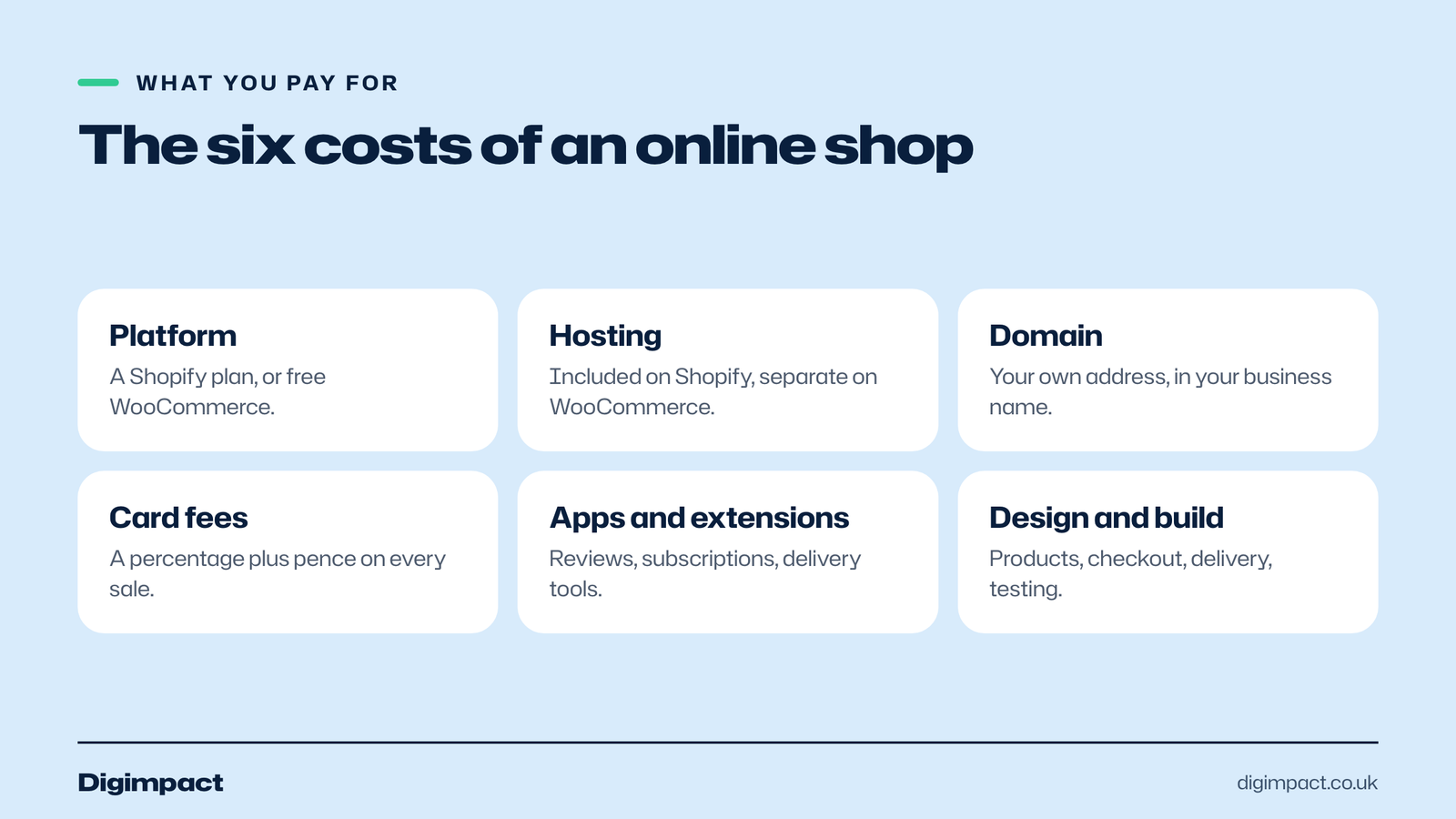
- An ecommerce website cost has six parts: the platform, hosting, a domain, card fees, apps or extensions, and the design and build.
- Shopify Basic costs £19 a month on yearly billing in the UK, with online card rates from 2% plus 25p, according to Shopify’s UK pricing page.
- WooCommerce is free; Stripe lists 1.5% plus 20p for standard UK cards, with no setup or monthly fees.
- Card fees grow with your sales and are often the biggest yearly cost of a busy online shop.
- Compare the total over a full year, including renewals, apps and VAT, not the first month’s price.
How much does an ecommerce website cost?
An ecommerce website cost in the UK is made of six things: a platform fee or hosting, a domain name, card fees on every sale, paid apps or extensions, the design and build, and your own time. A small shop can run for a few hundred pounds a year in fixed costs, while card fees rise with every order you take.
The headline monthly price of a platform is only one part of it. A shop on Shopify Basic at £19 a month can easily cost more in card fees than in its plan, and a WooCommerce shop with no platform fee still needs hosting, a domain and sometimes paid extensions. The right way to compare is to add up a full year on your own expected sales.
This guide breaks each part down with prices checked at the source on 15 October 2026: Shopify’s UK pricing page, WooCommerce’s pricing page and Stripe’s UK pricing page, plus hosting and domain prices we read at the hosts’ own UK pages on 12 and 14 October 2026.
1. The platform: Shopify plans or free WooCommerce
The platform is the software that runs your shop. Hosted platforms such as Shopify charge a monthly plan that includes hosting. WooCommerce, which runs on WordPress, is free software, so you pay for hosting separately instead of a platform fee.
On Shopify’s UK pricing page, Basic costs £19 a month on yearly billing or £25 monthly, Grow £49 yearly or £65 monthly, and Advanced £259 yearly or £344 monthly. Shopify was offering 3 days free, then £1 a month for 3 months, on most plans. WooCommerce describes itself as free and open source, with no monthly subscription.
| Platform | Monthly fee | Hosting |
|---|---|---|
| Shopify Basic | £19 (yearly) or £25 (monthly) | Included |
| Shopify Grow | £49 (yearly) or £65 (monthly) | Included |
| WooCommerce | £0 | Paid separately |
If you are weighing up the two, our Shopify vs WooCommerce comparison goes through ownership, ease of use and card fees in detail.
2. Hosting: included on Shopify, separate on WooCommerce
Shopify includes hosting in every plan. A WooCommerce shop needs a hosting plan, and the price depends on the host, the plan and how long you pay for upfront. First-term offers are much cheaper than the renewal price, so always check what you will pay from year two.
When we read the UK pages on 14 October 2026, Hostinger listed its Single plan at £1.49 a month on a 48-month term, renewing at £7.99 a month, and its Premium plan at £2.99 a month renewing at £10.99. SiteGround listed StartUp at £1.99 a month for 12 months, renewing at £13.99. All of those prices exclude VAT.
A busy shop with many products and visitors needs more than an entry plan. WooCommerce’s own pricing page puts hosting at $25 to $350 a month for most stores, a range aimed at established shops. A small local shop can usually start lower and move up as orders grow.
3. A domain name
Your shop needs its own address, such as yourshop.co.uk. Prices vary by registrar; when we checked, Hostinger listed a .co.uk at £10.99 a year after any first-year offer on its domain search page. Shopify can sell you a domain too, or connect one you already own.
Register the domain in your business’s own name, not a designer’s. It is the one part of the shop you should never lose control of, because your customers, emails and Google rankings all depend on it.
4. Card fees on every sale
Card fees are charged on every order, so they grow with your sales and are often the largest yearly part of an ecommerce website cost. On Shopify Basic with Shopify Payments, online card rates start at 2% plus 25p. Stripe lists 1.5% plus 20p for standard UK cards, which is a common choice for WooCommerce shops.
Stripe also lists 2.8% plus 20p for premium UK cards, 2.5% plus 20p for cards from the European Economic Area and 3.15% plus 20p for international cards, with 2% more if currency conversion is needed. If a Shopify shop uses a payment provider other than Shopify Payments, Shopify adds its own transaction fee: 2% on Basic, 1% on Grow and 0.6% on Advanced.
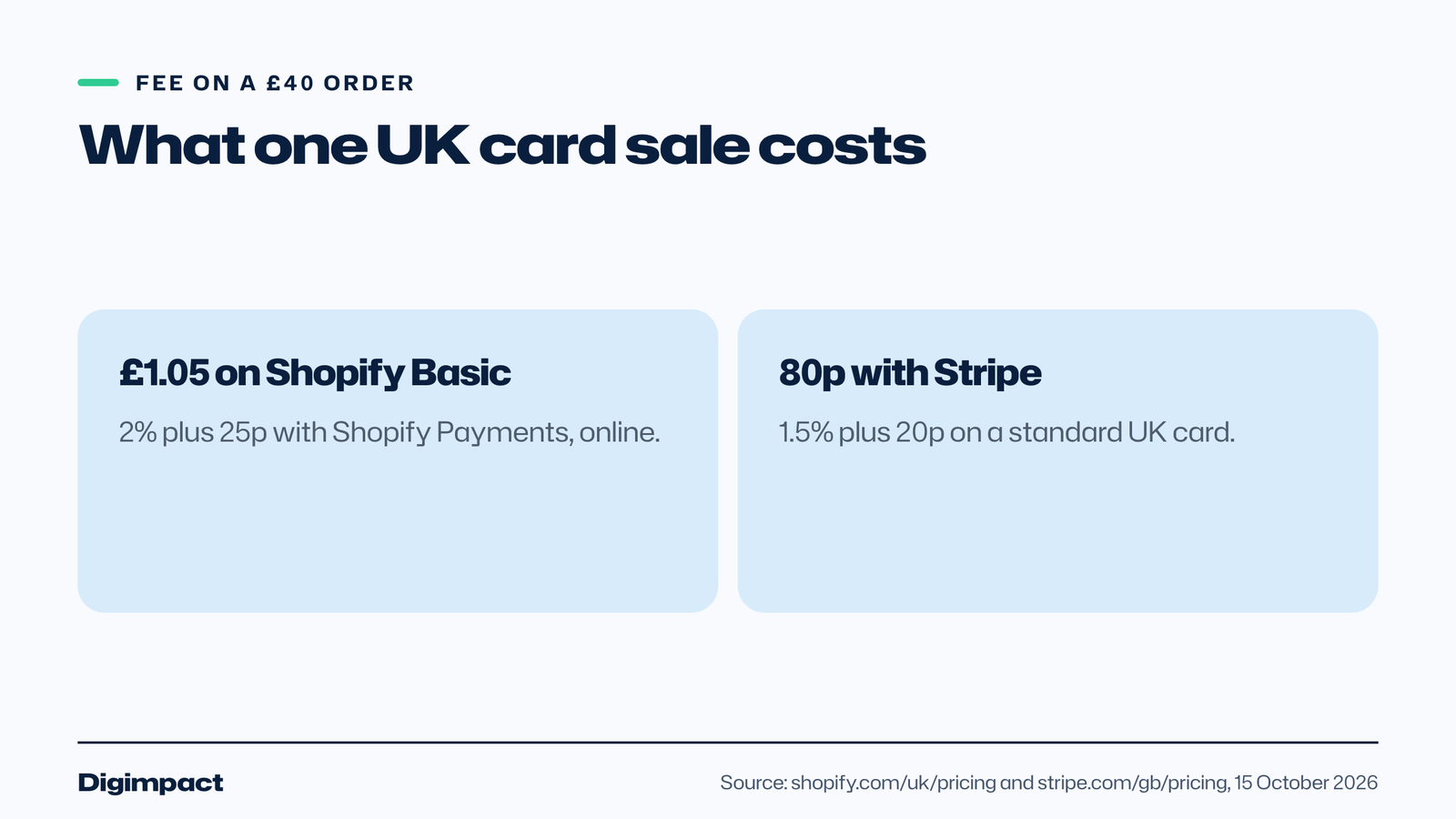
On a £40 order, Shopify Basic’s online rate comes to £1.05 and Stripe’s standard UK card rate to 80p. Across 100 orders a month, that is £105 against £80, or £1,260 against £960 over a year.
5. Apps and extensions
Most shops add a few extras: product reviews, subscriptions, gift cards, delivery rate tools, or a connection to a till or accounting software. On Shopify these are apps, often charged monthly. On WooCommerce they are extensions; WooCommerce lists paid extensions at $29 to $299 a year each.
Add up the extras you know you will need before you choose a platform. Three or four paid apps can cost more over a year than the platform plan, and some features you might expect to be paid, such as discount codes or click and collect, are often built in.
6. Design and build
The build is the one-off or yearly cost of turning a platform into your shop: the design, the product pages, the checkout, delivery rates, tax settings, loading your products and testing orders. You can do it yourself on Shopify or a builder, hire a freelancer, or use an agency.
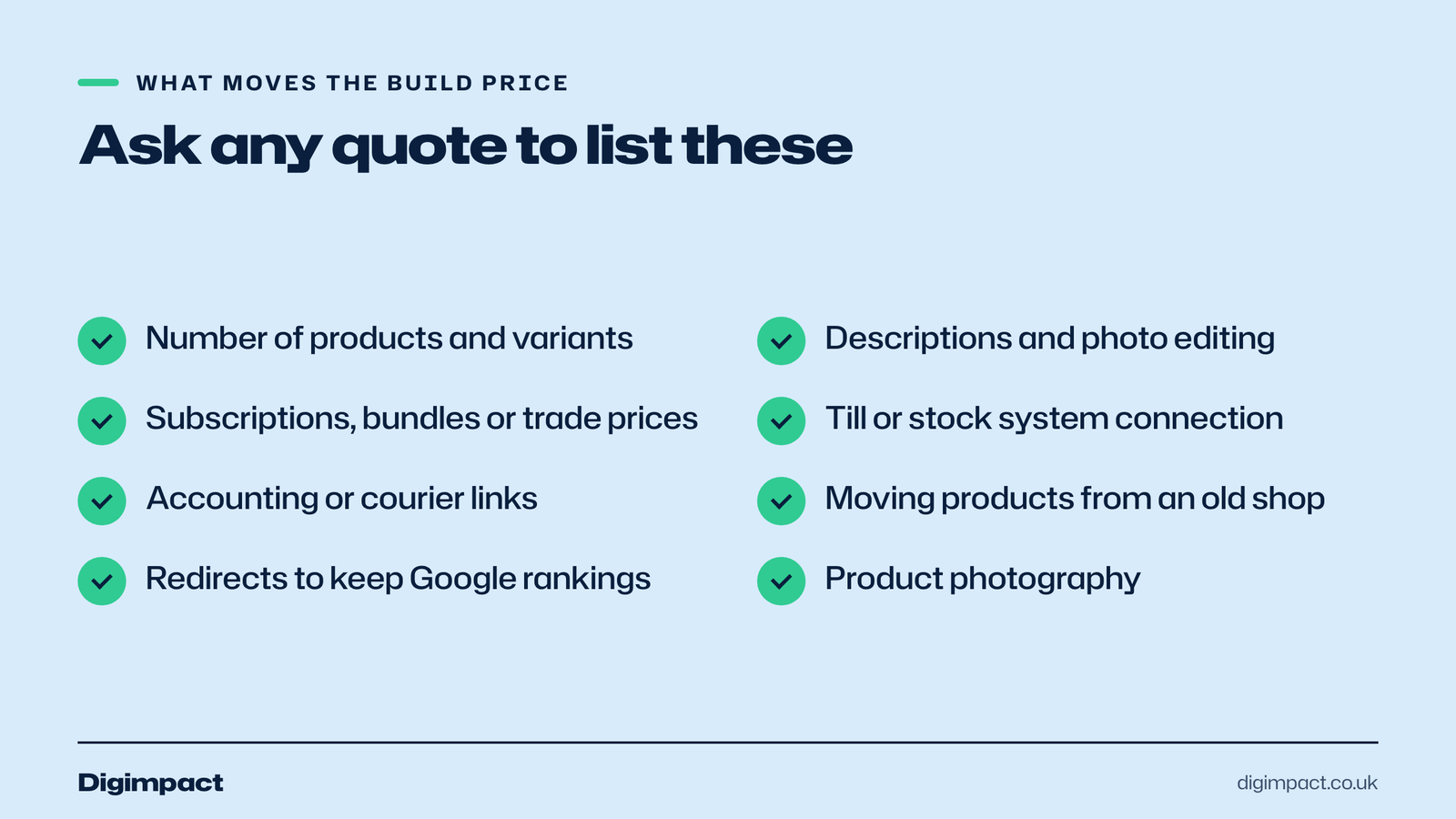
What moves the price is the work involved:
- How many products and variants you have, and whether someone has to write descriptions and edit photos.
- Custom features such as subscriptions, bundles, trade pricing or product personalisation.
- Connections to your till, stock system, accounting software or courier.
- Moving from an old shop, including products, customers and redirects so you keep your Google rankings.
- Photography, which makes the biggest difference to how many people buy.
At Digimpact, websites start from £300 a year per site, including hosting, your domain and five pages, with one fixed price in writing before any work starts. A shop’s exact price depends on the points above, and you see it in writing first. Our online shops page explains how we build them.
What does a small online shop cost in a year?
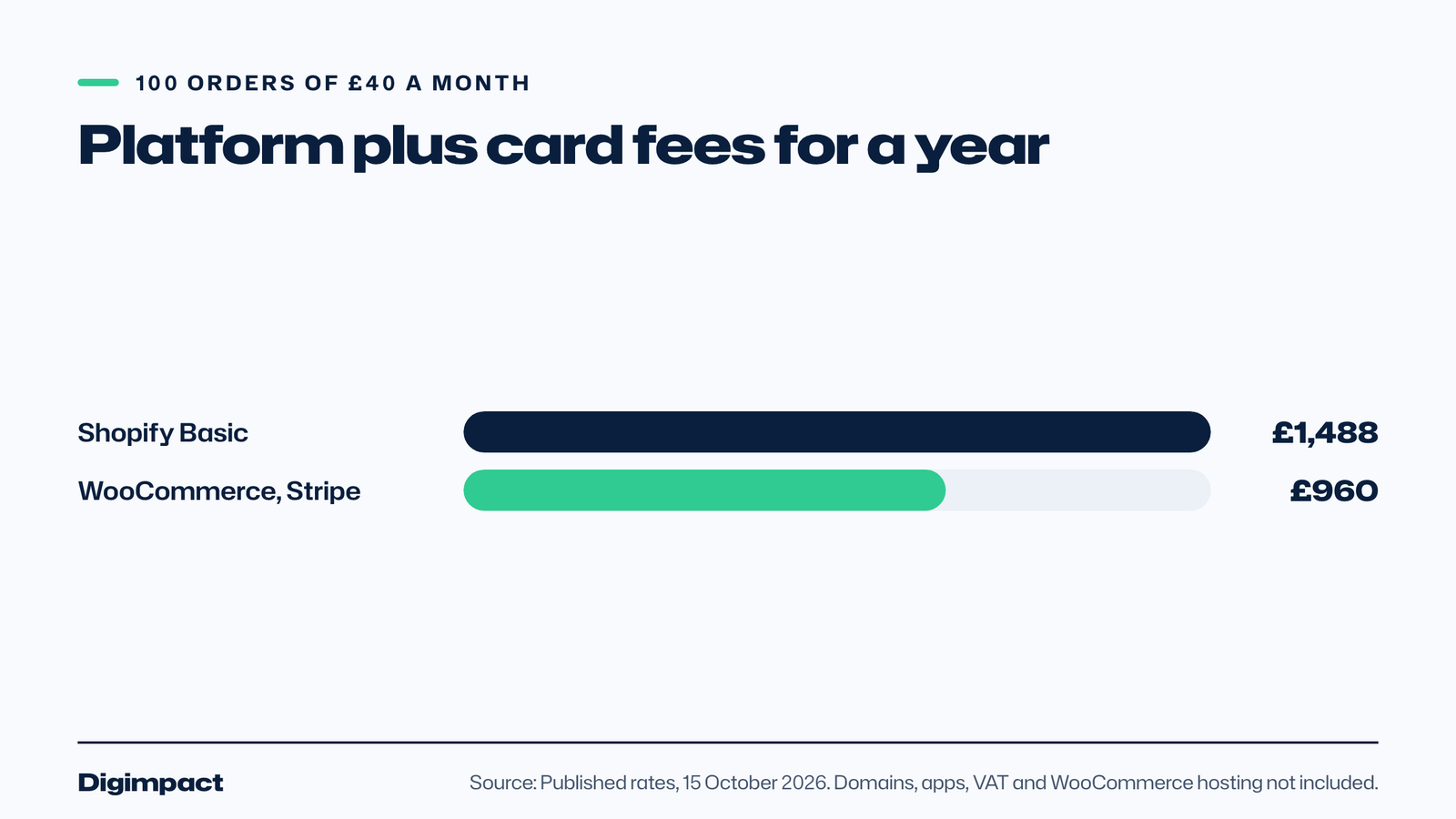
Take a small online shop selling 100 orders of £40 a month, all on standard UK cards. On Shopify Basic with yearly billing, the plan costs £228 a year and card fees about £1,260, so about £1,488 before apps, build costs and VAT. On WooCommerce with Stripe, card fees come to about £960, plus hosting, a domain and any extensions.
| Yearly cost, 100 orders of £40 a month | Shopify Basic | WooCommerce with Stripe |
|---|---|---|
| Platform plan | £228 | £0 |
| Card fees, standard UK cards | £1,260 | £960 |
| Hosting | Included | Your host’s price |
| Domain | Around £11 | Around £11 |
| Apps or extensions | Your choice | Your choice |
The example uses published rates and leaves out VAT and the build. It shows why an ecommerce website cost depends more on your sales and choices than on the cheapest plan on a pricing page. Run the same sums on your own expected orders before you decide. If your orders are larger or smaller than £40, the gap between the two options changes, so use your real average order value and the share of customers paying with premium or international cards.
Work out the total over three years for your own business with our free website cost calculator.
What does an online shop cost for a local business?
For a local shop, café or bakery that wants to sell online as well as in person, the ecommerce website cost is usually lower than for a shop that only trades online, because fewer orders mean lower card fees. The bigger questions are how orders reach you and how stock stays right in both places.
Most local businesses want three things: click and collect from the shop, local delivery to nearby postcodes, and a small range of products or vouchers that sell well online. Both Shopify and WooCommerce can do all three. The cost difference comes from what else the website must do, such as table bookings, a menu that ranks on Google or gift vouchers, and from whether your till can share stock with the website.
If your till cannot connect, you will need to update stock in two places, which costs time every week. That is worth knowing before you choose a platform, because a till connection is often the deciding factor for a shop that sells both in person and online.
How do you get an accurate price for your shop?
Write a short brief before you ask anyone for a price. List what you sell and roughly how many products, how customers will receive their orders, which payment methods you want, whether you sell in person too, and any systems the shop must connect to. Add your expected orders per month, so card fees can be estimated.
Send the same brief to everyone you ask, and ask each to list the build price, the yearly running costs and what is not included. A clear, itemised answer is a good sign; a single number with no detail is not. The fixed price should be in writing before any work starts, so the cost cannot grow while the shop is being built.
What hidden costs should you plan for?
Plan for renewal prices, VAT, paid apps, card fees on refunds and disputes, photography, packaging and postage, and your own time. These rarely appear on a platform’s pricing page but add up quickly in the first year of running an online shop.
- Renewals. First-term hosting and domain offers renew at the regular price.
- VAT. Many prices are shown before VAT. If you are not VAT registered, you cannot claim it back.
- Chargebacks. Payment providers usually charge a fee when a customer disputes a payment; check your provider’s terms.
- Postage and packaging. These are a cost of every order, even if you charge customers for delivery.
- Your time. Adding products, answering messages and packing orders all take time each week.
How can you keep the cost of an online shop down?
Start with the features you need now, choose a platform that matches how you sell, and avoid paying for apps that duplicate built-in tools. Compare card rates on your real order sizes, and ask for one fixed price in writing for the build, so the cost cannot grow while the work is under way.
- Write down your expected orders and average order value, then calculate card fees for each option.
- Pay yearly where it saves money and you are sure of the platform.
- Check what is built in before buying apps: discount codes, click and collect and gift cards often are.
- Keep your photos and descriptions ready before the build starts, so you are not paying for delays.
- Own your domain and accounts, so you can change supplier without starting again.
Is it cheaper to build an online shop yourself?
Building it yourself on Shopify or a website builder saves the build cost, but not the platform, card fees or apps. It suits a small range of products and an owner with time to learn. A professional build makes sense when you have many products, need integrations, or want the shop to rank and convert from day one.
Many owners start on their own and bring in help later, when the shop grows or something stops working. Whichever route you choose, set it up so the business owns the store account, the domain and the content.
If your business is in Portsmouth or nearby, we design and build websites from £300 a year with hosting and your domain included. See web design in Portsmouth.
Frequently asked questions
How much does it cost to build an online shop in the UK?
It depends on the platform, the number of products and the features you need. The running costs are a platform plan or hosting, a domain, card fees and any apps. At Digimpact, websites start from £300 a year per site, including hosting, your domain and five pages, with one fixed price in writing before work starts.
What are the monthly costs of an ecommerce website?
On Shopify, the plan, from £19 a month on yearly billing for Basic, plus card fees and apps. On WooCommerce, hosting, any paid extensions and card fees. Card fees usually grow fastest as sales increase.
Are Shopify card fees higher than Stripe?
On a standard UK card, yes on the Basic plan. Shopify Basic lists 2% plus 25p online; Stripe lists 1.5% plus 20p for standard UK cards. Higher Shopify plans have lower rates.
Is WooCommerce cheaper than Shopify?
It can be. WooCommerce has no platform fee and works with lower-cost payment providers, but you pay for hosting and any extensions. Work out a full year on your own sales to compare.
Do I need to pay VAT on ecommerce costs?
Many platform, hosting and app prices are shown before VAT. Check the checkout total, and speak to your accountant about whether you can reclaim VAT.
How much does a domain cost for an online shop?
When we checked, Hostinger listed a .co.uk at £10.99 a year after any first-year offer; other registrars charge different prices. Register it in your business’s own name.
What is the biggest cost of running an online shop?
For many shops with regular sales, card fees are the biggest yearly cost, because they are charged on every order. Choose your platform and payment provider with your own order numbers in mind.
Want a clear price for your online shop?
Tell us what you sell and how you deliver, and we will give you one fixed price in writing before any work starts. Websites start from £300 a year per site, including hosting, your domain and five pages. See our Shopify website design and WooCommerce website design services, or start with a free website check of your current shop.
Related reading: how to start an online shop in the UK and showing the total price and drip pricing rules.
See it in practice: the Cheeky Threads online clothing shop.
Keep reading
- LinkedIn company page: how to create one for a UK small business, set it up properly and know what to post A UK guide to the LinkedIn company page: what you need before you start, how to create one in six steps, the image sizes and admin roles LinkedIn recommends, what Premium Company Page adds, and what a small business should post.
- Email marketing rules UK businesses must follow: consent and the soft opt-in What PECR says about marketing emails and texts in the UK, when you need consent, how the soft opt-in for existing customers works, the different rules for companies and sole traders, and a checklist to stay compliant.
- How long does SEO take? A realistic timeline for UK small businesses, with Google’s own answer How long SEO takes for a UK small business: what Google says today and used to say, what a study of millions of pages found, a realistic four stage timeline, how local SEO differs, and the red flags in any promise of fast rankings.
Free website check
How does your own website do?
Enter your website and see a quick check on screen in about 20 seconds: speed, Google, phones and the details that win the click. A full written report follows within two working days, free and with no sales call unless you ask.
Want help with this?
Tell us about your business. We reply within one working day with a time for a 30-minute call, and a fixed quote afterwards.
Rather talk now? Call 07551 079787.
Thanks, that is with us.
We will reply within one working day with a time for a call.