Website redesign: 9 signs your business website needs one
Nine signs that a small business website needs a redesign, the checks you can run yourself in an hour, when a refresh is enough, and how to redesign without losing your Google rankings or the enquiries you already get.
By GP 15 minute read
TL;DR: A website redesign is worth it when your site no longer brings in enquiries, is hard to use on a phone, is slow, cannot be updated without help, or no longer describes what you sell. Check it in an hour with Google PageSpeed Insights, your own phone and your enquiry numbers. If only the words and pictures are out of date, a refresh is enough. If you rebuild, map every old page to a new one and use permanent redirects so you keep your Google rankings.
Key takeaways
- A website redesign is worth paying for when the site stops doing its job: bringing in calls, bookings, orders or enquiries.
- Google indexes and ranks the mobile version of your site, so a site that is hard to use on a phone is a problem for customers and for search.
- In our check of 935 local business websites in October 2026, one in four did not load and more than half of the rest had no tap to call link.
- If only the words, photos and prices are stale, a refresh costs far less than a rebuild.
- When pages move, Google advises mapping every old address to a new one with permanent redirects, kept for at least a year.
When does a business need a website redesign?
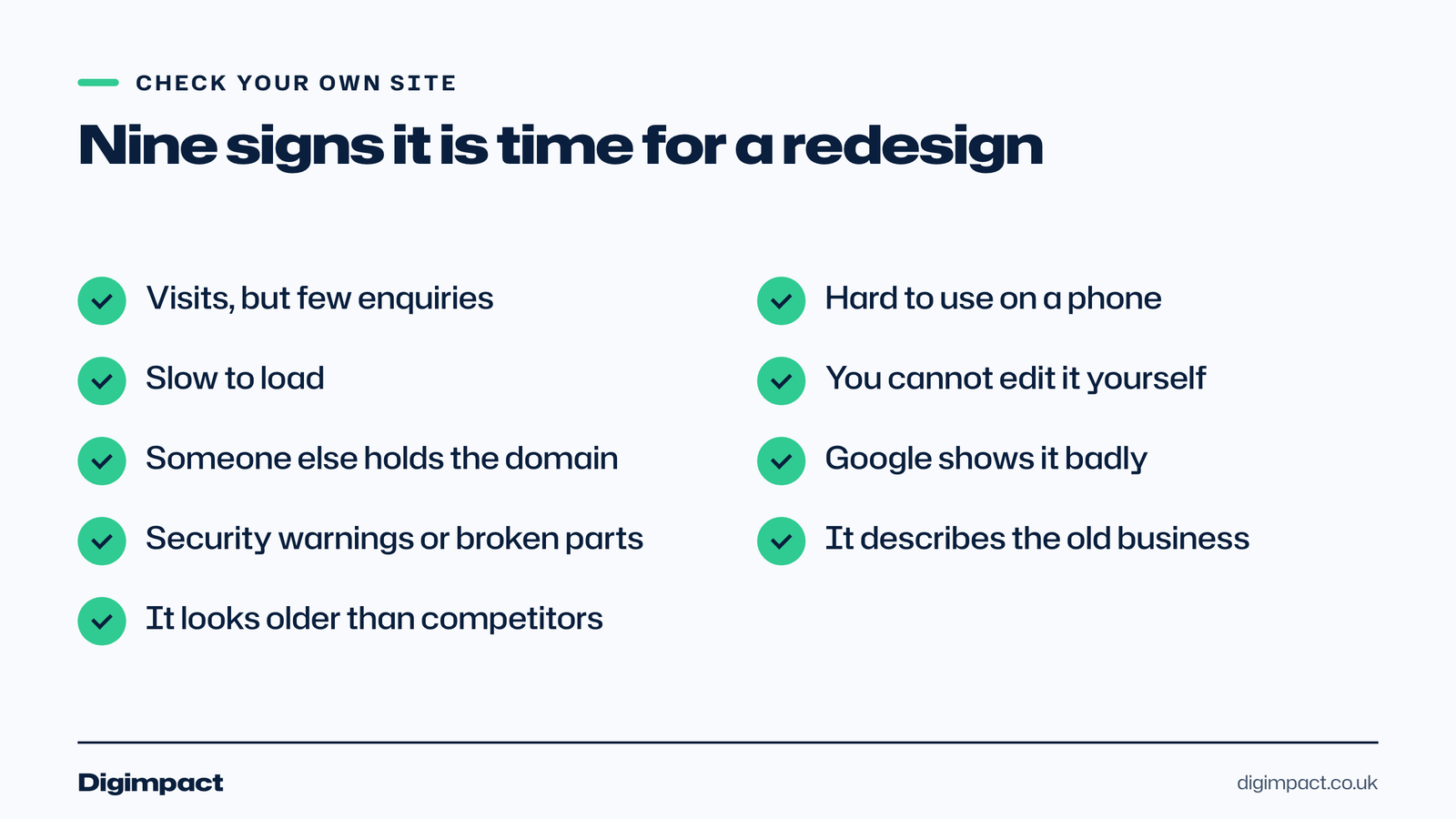
A business needs a website redesign when the site no longer earns its keep: few enquiries from steady visits, a poor experience on phones, slow pages, a system you cannot update yourself, or a site that describes the business you were five years ago. Age alone is not a reason. A five-year-old site that brings in work can be refreshed instead.
The test is simple. Ask what the website is for, then check whether it still does it. For most local businesses the answer is calls, bookings, orders or quote requests. If those have dried up while your Google Business Profile and word of mouth still bring people in, the website is usually the weak link.
This guide gives you nine signs to check, the tools to check them with, and the questions that decide whether you need a full rebuild or a lighter refresh. It is based on Google’s own documentation and on the 935 local business websites we checked around Portsmouth in October 2026. You can run a quick version of the same check on your own site with our free website check.
1. Visitors come, but nobody gets in touch
The clearest sign is traffic without enquiries. If people find your site but do not call, book or fill in the form, the site is losing them somewhere: an unclear opening line, no visible phone number, a form that asks too much, or no price guidance at all.
Look at what you can measure. Count the enquiries that mention the website over the last three months. If you use Google Analytics, compare visits with calls, form sends and bookings. If you have no tracking at all, that is a problem in itself, because you cannot tell whether a change helps.
A redesign that fixes this usually changes the order of the page more than its colours. The homepage should say what you do and where in the first line, show one clear next step, and repeat it further down. Our page on fixing a website that gets no enquiries goes through the usual causes.
2. The site is hard to use on a phone
Most local searches happen on phones, and Google judges your site by its phone version. In Google’s words, it uses the mobile version of a site’s content, crawled with the smartphone agent, for indexing and ranking, as set out in its mobile-first indexing guidance.
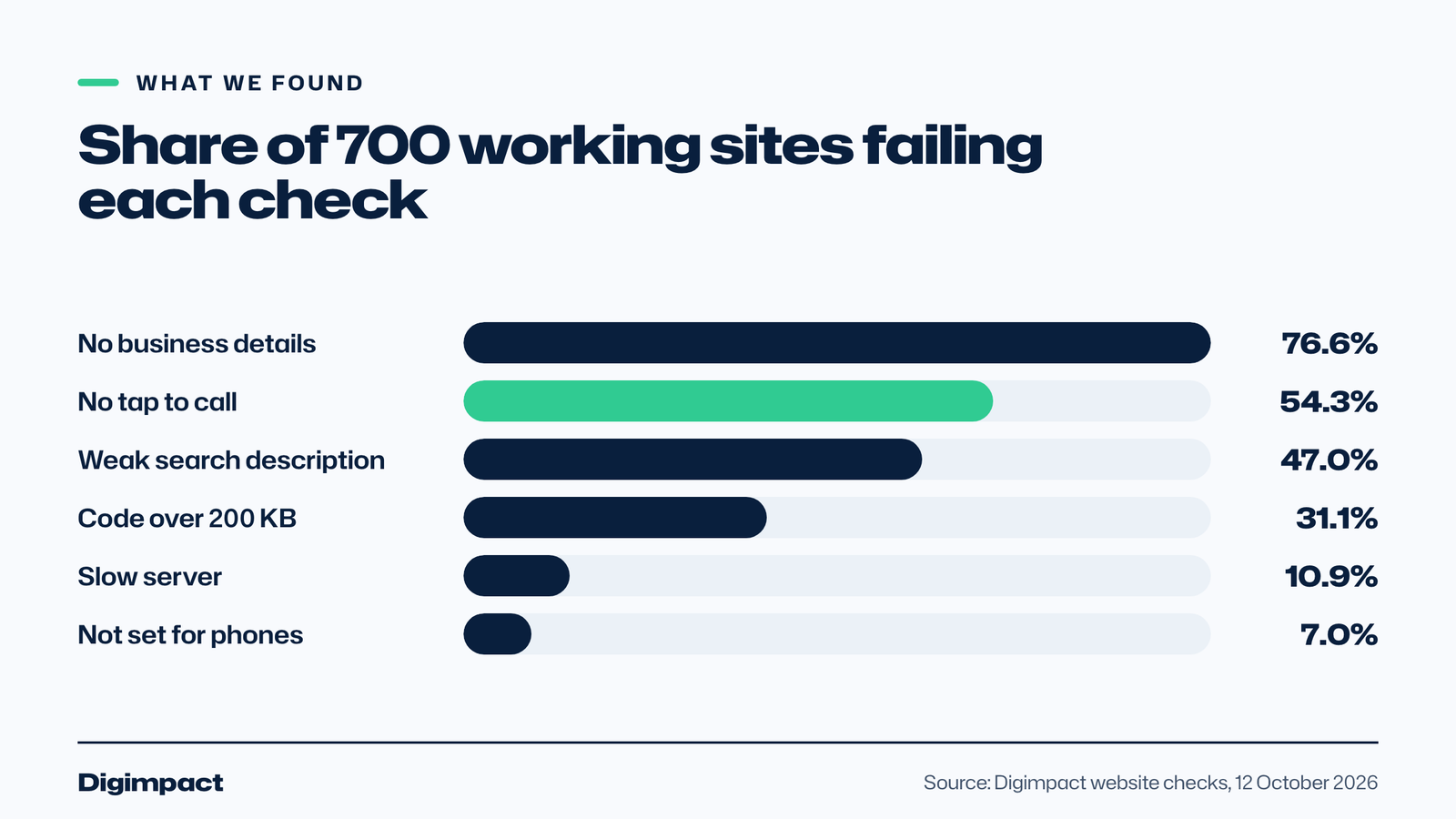
Open your site on your own phone and try to do what a customer does. Can you read the text without zooming? Can you tap the buttons without hitting the wrong one? Does the menu open? Can a customer call you with one tap? In our October 2026 check, 7.0% of the sites that loaded had no instruction telling phones to fit the page, and 54.3% had no tap to call link on the homepage.
If the phone version is a squeezed copy of the desktop layout, a website redesign built for phones first is usually the only proper fix.
3. Pages are slow to load
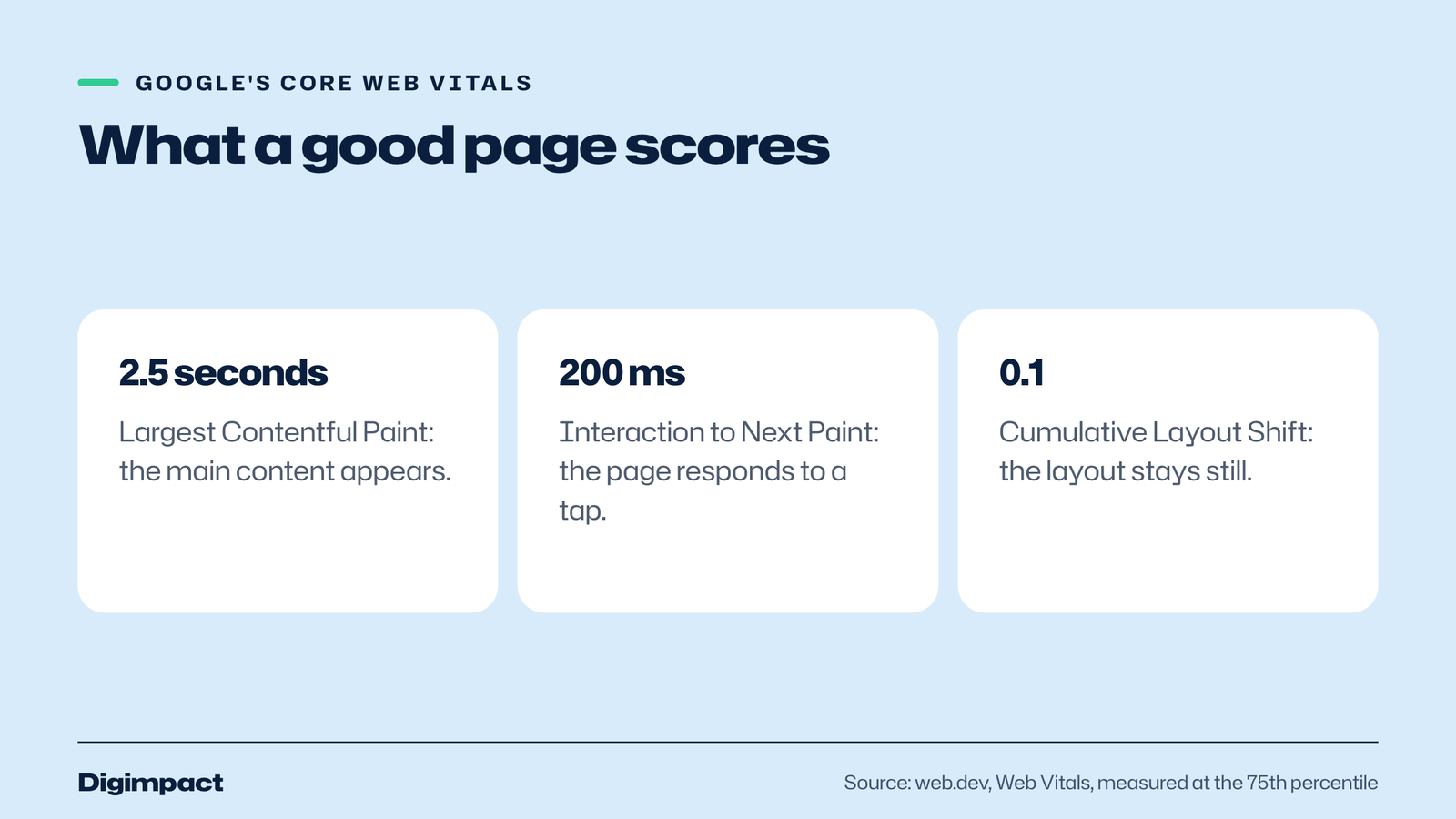
Slow pages lose customers before they read a word, and Google measures speed with three Core Web Vitals. According to web.dev, a good page shows its main content within 2.5 seconds, responds to a tap within 200 milliseconds and keeps its layout shift at 0.1 or less, measured across real visits.
Run your homepage through PageSpeed Insights and read the phone results first. Our free check also times how long your server takes to answer. Large uncompressed photos, heavy page builders and piles of plugins are the usual causes.
In our check of 700 working sites, 31.1% sent more than 200 KB of page code before a single image, and 10.9% took more than 1.5 seconds for the server to answer. Images can often be fixed without a redesign. Bloated code and a slow platform usually cannot.
4. You cannot update it without paying someone
If changing a price, adding a photo or posting opening hours for Christmas needs a developer, the site will always be out of date. That is a common reason for a redesign: moving to a system the business can edit itself, with someone on hand for the bigger jobs.
Ask yourself when you last changed something on the site, and how long it took. A good website lets you edit text, photos, prices and opening times in minutes, from a phone if needed. If you cannot log in at all, or nobody remembers who has the password, sort that out first; the next section explains why.
5. You do not control the domain, hosting or logins
You should hold the keys to your own website. If a former designer registered the domain in their own name, or the hosting account is theirs, you cannot move, fix or redesign the site without their help.
Nominet, which runs the .uk register, defines the registrant as the company or individual the domain is registered on behalf of, in its registry field definitions. For a limited company, that should be the company itself, with its Companies House number. Check who is named before you plan any website redesign, and get it moved if it is wrong.
Copyright matters too. GOV.UK says that for commissioned work the first legal owner of copyright is the person or organisation that created it, not the commissioner, unless you agree otherwise in writing, in its guidance on ownership of copyright works. When you commission the new site, get ownership written into the agreement.
6. Google shows the site badly, or not at all
If your business does not appear when people search for your own name, or the result shows an old title and description, the site is not giving Google what it needs. Common causes are missing page titles and descriptions, no sitemap, no structured business details, or a site that tells search engines not to list it.
In our October 2026 check, 76.6% of working sites gave Google no structured details naming the business type, 47.0% had a missing or poorly sized search description, and 1.3% told search engines not to list the homepage at all. Many of these are quick fixes on a modern platform. On an old one they can be fiddly or impossible.
If the site does not show up at all, read our guide to why a website is not showing on Google before deciding on a redesign; sometimes one setting is the whole problem.
7. Security warnings, broken parts or an old platform
Browsers warn visitors away from sites without a secure address, and old plugins and themes are a common way in for attackers. If your site shows a Not secure label, has forms that no longer send, or runs software that stopped getting updates years ago, it is a risk to you and your customers.
In our check, 4.6% of working sites did not load over https, and a quarter of all listed sites did not load at all. Some had expired domains; some had simply broken. Our guide to website security for small businesses lists the basic checks. When the platform itself is past its supported life, patching it costs more each year than replacing it.
8. The site no longer matches the business
Businesses change. You may have added services, dropped others, moved premises, changed prices or built a new brand. If the website still describes the old business, customers get mixed messages and some will ring about things you no longer do.
Read your site as a stranger would. Does the first screen say what you do now, for whom and where? Are the photos of your real team, premises and work? Are the prices, opening hours and service area current? If most of the answers are no but the site works well on a phone and loads quickly, you may only need a refresh, not a rebuild.
9. It looks older than your competitors
First impressions count when a customer compares three local businesses side by side. Search for your main service and town, open the top three competitors on your phone, then open yours. If yours looks clearly older, harder to read or harder to act on, customers will notice too.
Do not chase trends for their own sake. A website redesign should make the site clearer, faster and easier to act on. Real photos of your work, plain words and a phone number that works with one tap will do more for you than a new colour scheme.
Do you need a redesign or just a refresh?
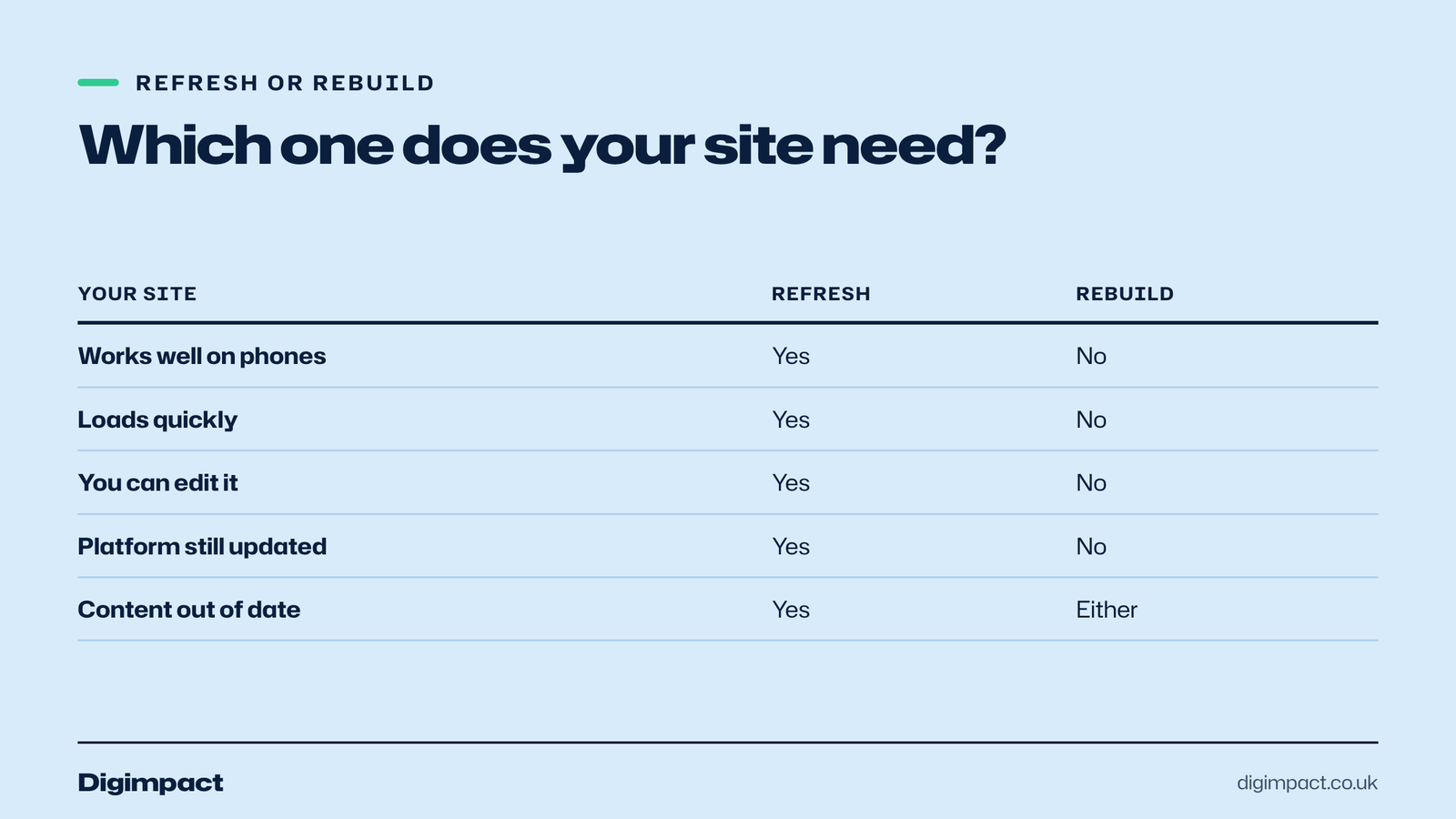
A refresh updates the words, photos, prices and small layout details on the platform you already have. A website redesign, or rebuild, replaces the structure, design and often the platform. Choose a refresh when the site is fast, works on phones and is easy to edit; choose a rebuild when it fails on those basics.
| Situation | Refresh is enough | Rebuild needed |
|---|---|---|
| Works well on phones | Yes | No |
| Loads quickly | Yes | No |
| You can edit it yourself | Yes | No |
| You own the domain and logins | Yes | Sort this first |
| Content is out of date | Yes | Either |
| Platform no longer updated | No | Yes |
| Few enquiries despite visits | Sometimes | Often |
A refresh is quicker and cheaper, and it keeps what already works. Most of the fixes in our list, such as page titles, a tap to call link and a sharing picture, can be done in an afternoon on a modern platform.
How do you redesign a website without losing Google rankings?
Keep every page that earns visits, and send every old address to its new one with a permanent redirect. Google’s guidance on site moves with URL changes says to map old URLs to new ones, use server-side permanent redirects such as 301, and keep them generally for at least a year.
Before the old site goes, export a list of every page from your sitemap or Search Console. Note which pages bring visits and enquiries. Those pages keep their address if possible, or get a direct redirect to the closest new page, never a blanket redirect to the homepage.
After launch, submit the new sitemap in Search Console and watch for errors. Google says a small to medium site can take a few weeks for most pages to move. Rankings can wobble during that time; a careful redirect map keeps the wobble short.
How long does a website redesign take?
A small business website redesign usually takes a few weeks from first call to launch, depending on how many pages there are, whether new photos are needed and how quickly words and decisions come back. Most delays come from content, not code, so gather your text, photos, prices and logins before you start.
A typical order of work is: agree the goal and the pages, write the words, design the key pages, build on a test address, review on your phone, set up redirects, launch, then check Search Console and the contact form. Ask for a dated plan in writing before any work starts.
What should you prepare before a website redesign?
Prepare five things before you speak to anyone: the main job of the site, your enquiry numbers today, the logins for your domain and hosting, a list of the pages that bring in work, and the sites you like and dislike. With these, you will get clearer quotes and a site built around results rather than looks.
- The goal. Calls, bookings, orders or quote requests. Pick one main action.
- Your numbers. Enquiries a month now, so you can tell whether the new site does better.
- Your logins. Domain, hosting, Google Business Profile, Search Console and analytics.
- Your best pages. The ones customers land on and ask about.
- Examples. Three sites you like and one you do not, with a reason for each.
If you are still choosing a platform, our comparison of the best website builder options for UK businesses sets out the real prices.
What should you ask before you start?
Before you commit, ask for a fixed price and a launch date in writing, who will own the domain, code and content, how redirects from the old site will be handled, whether you can edit the site yourself, and what happens after launch. Clear answers to these five questions separate a careful redesign from an expensive mistake.
- Is the price fixed, and what does it include?
- Will the domain stay in the business’s name, and will we own the finished site?
- How will you protect the pages that bring in visits now?
- Will we be able to change text, photos and prices ourselves?
- Who fixes problems after launch, and how fast?
Also ask to see live sites they have built, not just screenshots, and open them on your phone. If you want a second opinion on your current site before anyone quotes, our website design team will look at it with you.
Based in Hampshire and would rather someone local did it? Our Portsmouth web designers meet you at your place, and you can open the sites we have built.
Frequently asked questions
How often should a business redesign its website?
There is no fixed cycle. Redesign when the site stops doing its job or the platform is no longer supported. Keep the content fresh all the time, and review the site properly once a year against the signs in this guide.
Will a website redesign hurt my Google rankings?
It can if pages disappear or move without redirects. Google advises mapping old addresses to new ones, using permanent redirects such as 301, and keeping them for at least a year. Done carefully, rankings usually settle within a few weeks.
Can I keep my domain name when I redesign?
Yes. Your domain is separate from the design. Check that your business is named as the registrant, then point the domain at the new site when it is ready. Keep the same domain if you can; changing it makes the move harder.
Is a redesign the same as a new website?
Mostly. A redesign rebuilds the structure and look, often on a new platform, while keeping your domain, best content and the addresses that bring visits. A refresh changes words, photos and details on the existing site.
How do I know if my website is too slow?
Run your homepage through Google’s PageSpeed Insights and read the phone results. Google’s good thresholds are main content within 2.5 seconds, a response to taps within 200 milliseconds and layout shift of 0.1 or less.
Should I redesign my website myself?
You can if you have the time and the site is simple. The risk is in the details: redirects, page titles, structured data, privacy notices and speed. If enquiries matter to the business, have a professional check those before launch.
What should a redesigned website include?
A clear first line saying what you do and where, a tap to call link, one clear next step on every page, real photos, prices or price guidance, contact details matching your Google profile, and the privacy details the law requires.
Thinking about a website redesign?
If your site shows three or more of these signs, it is worth costing a rebuild. Start with our free website check, which tests your homepage in seconds and sends a written report. If you then want it rebuilt, our website design service gives you one fixed price in writing before any work starts, and your business owns everything we build.
Related reading: image copyright for a business website.
Buy online: a five page website for £300 a year with hosting and domain.
Keep reading
- Email marketing rules UK businesses must follow: consent and the soft opt-in What PECR says about marketing emails and texts in the UK, when you need consent, how the soft opt-in for existing customers works, the different rules for companies and sole traders, and a checklist to stay compliant.
- How long does SEO take? A realistic timeline for UK small businesses, with Google’s own answer How long SEO takes for a UK small business: what Google says today and used to say, what a study of millions of pages found, a realistic four stage timeline, how local SEO differs, and the red flags in any promise of fast rankings.
- How to make Reels for business on a phone, step by step A practical guide to filming Instagram Reels for a local business on a phone: what to film, how long Reels should be, how to edit and caption them, when to post and how to reuse them on other platforms.
Free website check
How does your own website do?
Enter your website and see a quick check on screen in about 20 seconds: speed, Google, phones and the details that win the click. A full written report follows within two working days, free and with no sales call unless you ask.
Want help with this?
Tell us about your business. We reply within one working day with a time for a 30-minute call, and a fixed quote afterwards.
Rather talk now? Call 07551 079787.
Thanks, that is with us.
We will reply within one working day with a time for a call.