Influencer marketing rules for UK small businesses: how to label an ad so the ASA and CMA are satisfied
What the ASA and CAP say about labelling influencer posts as ads, including gifted products, discount codes, affiliate links, where the label goes on Instagram, TikTok, YouTube and X, which words are not clear enough and how a small business can brief an influencer.
By GP 15 minute read
TL;DR: When a brand pays an influencer or gives any other incentive, or the influencer has a personal or commercial connection to the brand, the content must be obviously identifiable as advertising. The ASA expects a prominent Ad label upfront, which usually means at the beginning, visible without clicking, and in plain language. Labels such as sponsored, gifted, ambassador or affiliate, or a bare @ mention or discount code, are unlikely to be enough. Both the brand and the influencer are responsible, and the same applies to a business that gives a local creator a free meal in return for a post.
Key takeaways
- Influencer marketing is advertising, and the ASA says that whenever a brand gives an influencer a payment or any other incentive, requested or unsolicited, or the influencer is otherwise personally or commercially connected to the brand, any content featuring or referring to the brand needs to be obviously identifiable as advertising. This is a requirement under consumer protection law, enforced by the CMA and Trading Standards.
- At a minimum the ASA is likely to expect a prominent Ad label upfront, usually at the beginning, so the audience recognises the post as advertising without clicking or interacting with it.
- Buried labels fail: in a list of hashtags at the end, in a poorly contrasting colour or under See more. A bare @ mention, a discount code, Gifted, Sponsored, Ambassador or Affiliate are unlikely to be clear enough.
- There is no minimum number of followers or particular job that makes someone an influencer. The ASA’s definition covers any persona active on a social media platform.
- Brands and influencers are both responsible. If the ASA finds a breach, both the influencer and the brand are named in the ruling.
- The ASA’s advice is guidance from the CAP Executive and not legal advice. It does not bind the ASA.
A local café gives a food blogger with 3,000 followers a free brunch for four, and asks if she would post about it. She does, with a lovely video, tags the café and thanks it for having her. The café reposts the video on its own page and adds a discount code for her followers. Nobody mentions that it is an ad. The café owner assumes that influencer rules are for big brands. They apply to her too.
Influencer marketing has become a normal part of small business social media, from a free meal for a local creator to a paid post for a salon. The rules on labelling it are the same for a national brand and a café. This guide explains what the Advertising Standards Authority and its sister body CAP say about when a post counts as an ad, where and how to label it, which words do not work, how the rules apply to gifted products, discount codes and affiliate links and how to brief a creator. It is general information, not legal advice.
What counts as influencer marketing?
The ASA typically defines an influencer as any human, animal or virtually produced persona that is active on any online social media platform, such as Facebook, Instagram, Snapchat, TikTok, Twitch or YouTube. There is no minimum number of followers and no particular occupation that makes someone an influencer.
The ASA’s advice on recognising ads in social media and influencer marketing, updated in August 2026, notes that people may be called bloggers, streamers, celebrities or content creators on different platforms, but the rule is the same. It also says influencer marketing is not restricted to social media, though that is its most popular home.
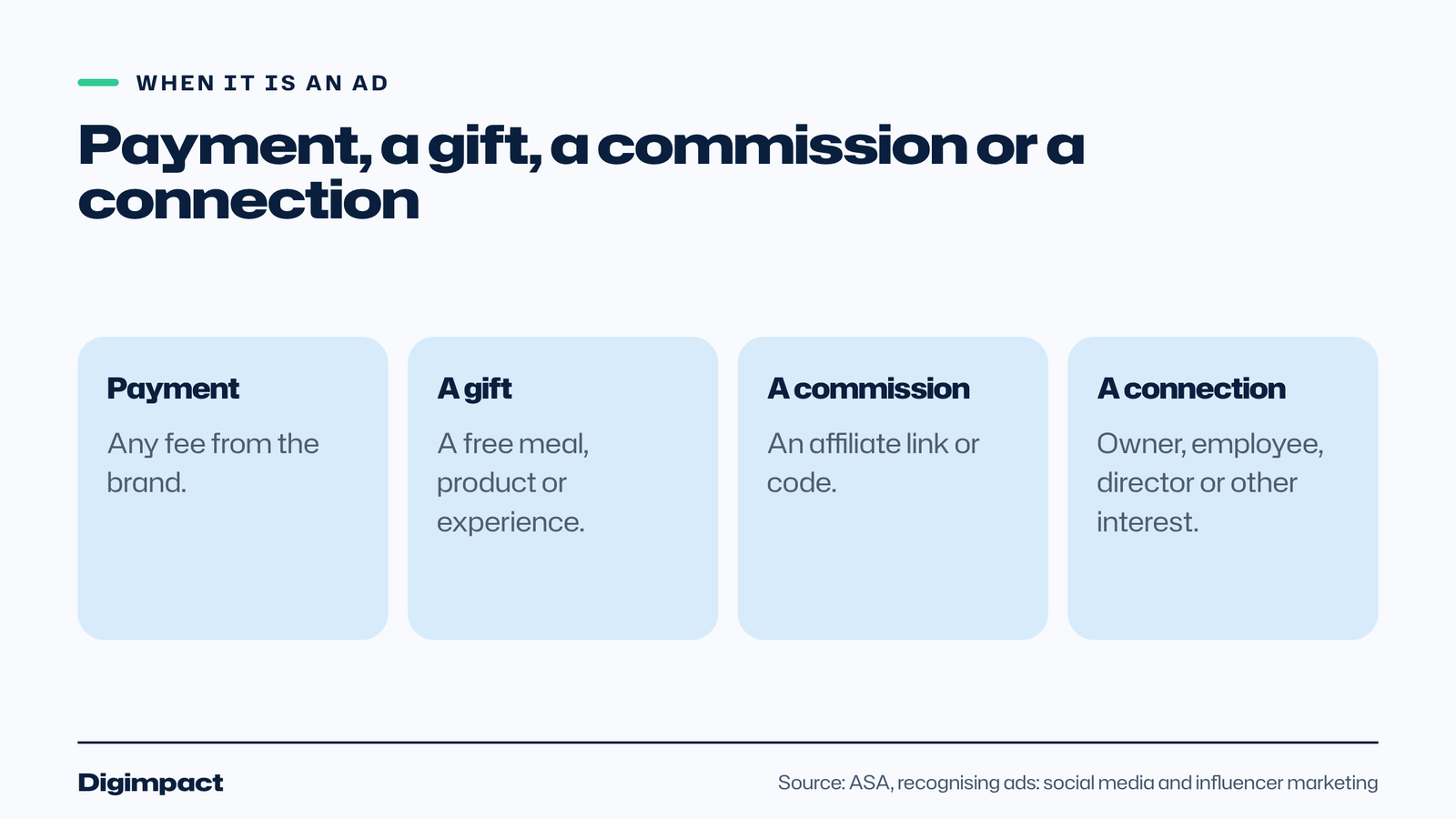
What makes it advertising is the connection between the brand and the creator. The ASA says that whenever a brand gives an influencer a payment or any other incentive, requested or unsolicited, or the influencer is personally or commercially connected to the brand, for example as an owner, employee, shareholder, director or with any other commercial or personal interest, any content featuring or referring to the brand needs to be obviously identifiable as advertising.
That includes free products and experiences. A free brunch, a free haircut or a gifted product is an incentive. If the creator then posts about your business, the content is advertising, even if you did not ask for a post and even if the creator says it is their honest opinion. Honest content can still be an ad.
The ASA also says that the CAP Code applies to an influencer promoting their own brand or products they helped create, because that is marketing content by the brand in space it controls. That matters for your own team: if a member of staff, an owner or a director posts about the business, the content is likely to need the same care.
Why does the ASA care?
The ASA’s research found that social media users really struggle to tell advertising from non-advertising content in this space, especially when influencers use the same editorial style for both types. The ASA says the onus is not on the consumer to work it out. It is the responsibility of brands and influencers.
The research it cites, Labelling of influencer advertising (2019) and Consumer awareness and understanding of influencer marketing (2026), found people scrolling quickly through a vast amount of content and moving from one piece to the next. When brands and influencers seek to blend editorial and advertising seamlessly, the ASA says, it is especially important to take care that the advertising is obviously recognisable.
For a small business the lesson is practical. A creator’s followers trust the creator’s voice. If they later find out that a recommendation was an unlabelled ad, they feel misled, and the trust you hoped to borrow turns into a complaint. A clear label protects your reputation as well as your legal position.
The consumer protection law behind this is enforced by the CMA and Trading Standards, and the ASA can take action under the CAP Code, particularly where a brand has editorial control of the content. The ASA’s advice notes that when a particular advertorial is found to breach the CAP Code, both the publisher (the influencer) and the brand are named in the ruling.
Where should the label go?
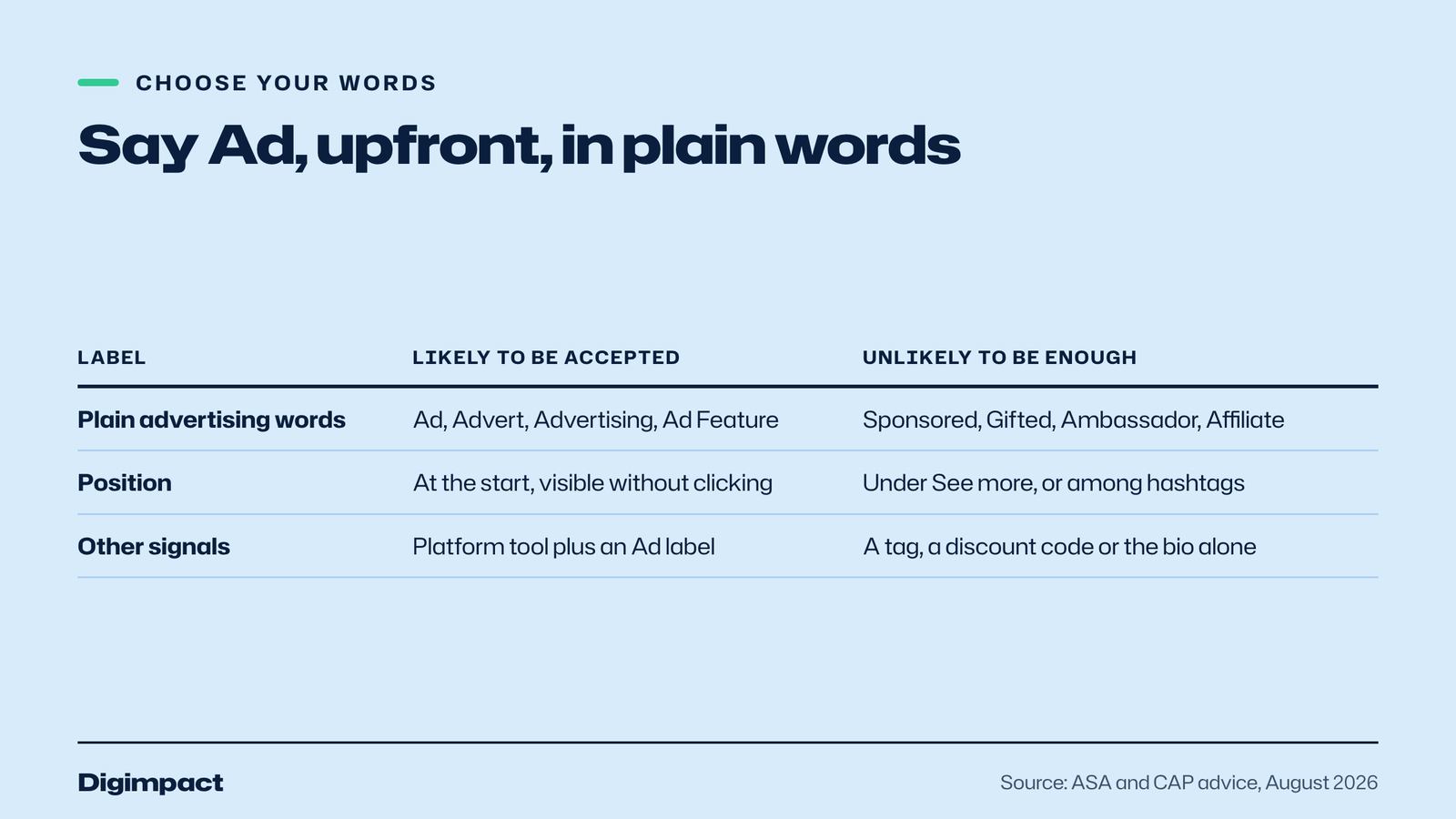
The ASA says the label must be prominent enough to be noticed and early enough to be seen before the audience clicks on anything or engages with the content. Usually that means at the beginning. Burying it in a list of hashtags, using a poorly contrasting colour or placing it under See more is not sufficient.
The ASA says consumers should be able to recognise immediately that content is advertising, without having to click or interact with it, and without any special knowledge. It gives these platform guides:
- Facebook and Instagram. There is no character limit, so most posts need an identifier at the beginning. Very short posts may be acceptable if it is at the end of the text. It is not acceptable for a disclosure to appear only after clicking See more.
- X. Space is limited, so Ad at the start of the post is potentially the clearest, though in a very short post it could be clear at the end if not buried among hashtags.
- Pinterest. Put Ad or similar at the start of the description, because only a small part shows without clicking.
- Video on Instagram and TikTok. Make the commercial intent clear before consumers click through to watch if possible, or immediately at the start if not.
- YouTube. The video title or thumbnail will likely need an identifier such as Ad, so it is clear before the click.
Any label must also be visible on every device, so check how a post looks on desktop, on mobile and in the app. If the text that accompanies a video is not always visible, a label in that text may not be enough. Where an ad autoplays, say so clearly right at the beginning.
The ASA adds that the influencer’s bio is not enough. Posts may be viewed in isolation, in search results or in feeds, where the bio is not visible. A statement in the bio that someone is an ambassador for a brand does not replace a clear label on the post. Each post in a series, including each Story, generally needs to be identifiable on its own.
What words should you use?
The ASA and the CMA prefer labels that explicitly call the content advertising, for example Ad. A hash symbol is not needed provided the label is prominent and clearly separate from other content. Advert, Advertising, Ad Feature and similar are all very likely to be acceptable.
The ASA’s advice sets out the labels that are unlikely to be enough:
- Sponsored. The ASA advises against it, because it is open to varied interpretation.
- Supported by, Funded by, Gifted, In association with, Thanks to X for making this possible. Unlikely to be sufficiently clear.
- Ambassador labels, such as #BrandAmbassador.
- Phrases about ownership, such as my collection, our edit or we created together, in most contexts.
- Abbreviations, such as aff, sp and spon, and the word affiliate, which many consumers do not understand.
- A bare @ mention or tag of the brand, which the ASA has repeatedly found insufficient.
- A discount code on its own. The ASA’s research found most participants did not recognise posts with discount codes as ads, and it has ruled against posts that relied on a code to show the commercial relationship.
Where a platform has a branded content tool, such as Instagram’s Paid partnership label, that may be sufficient if the label is upfront, clear and prominent. The ASA’s 2026 research found the label can help consumers recognise ads but may not be enough on its own. If it is obscured by the image or does not make clear the content is advertising, add an Ad label as well.
You can add more detail after the Ad label, as long as the Ad label is clear upfront and any extra words will be understood by the average person. For instance: Ad, gifted meal.
What about gifted products, discount codes and affiliate links?
The ASA says a gift or any other incentive makes content an ad, an affiliate link or code makes the creator an advertiser because they earn commission, and a discount code alone does not make the commercial relationship clear. In each case the content needs a clear Ad label upfront.
On affiliate marketing, which has its own ASA advice page, the ASA says that when an influencer includes an affiliate link or code, they are acting as an advertiser because they earn commission based on the interest they generate. Any content referring to the product for which there is an affiliate link or code counts as advertising. The ASA typically considers the brand at least jointly responsible for content created by affiliates, regardless of whether it was aware of or controlled the specific content.
For a small business, that has two consequences. If you run an affiliate or referral scheme, such as a code that gives a creator a percentage of sales, the posts that use it are ads. And you cannot rely on not having seen the post. Set out the labelling rules in your agreement, and check what is posted.
The rules apply equally to all forms of marketing communication, whether advertorial, affiliate or own-brand promotion. There is no loophole for a free product or a small payment.
What if the post is on your own page?
Content on a brand’s own social media profile is advertising by its nature, and the ASA has separate advice on brand-owned and paid social ads. The problem arises when you share, repost or pay to promote a creator’s post, or when your own owner or staff post about the business as if independent.
If you repost a creator’s content on your own page, your page is your marketing space and your audience will understand that it is a brand’s channel, but the creator’s original post still needs its label. If you pay to boost the creator’s post, it becomes a paid ad, and the same principles apply.
If an owner or employee posts about the business from a personal account, treat it as marketing. The ASA says personal or commercial connections, including being an owner, employee, shareholder or director, mean the content needs to be obviously identifiable as advertising. A simple rule for staff is to say who you work for in the post and to use Ad where you are promoting the business.
Our guides to the Instagram business account and the Facebook business page explain how to set up the brand channels that carry your own promotional posts.
How do you brief an influencer?
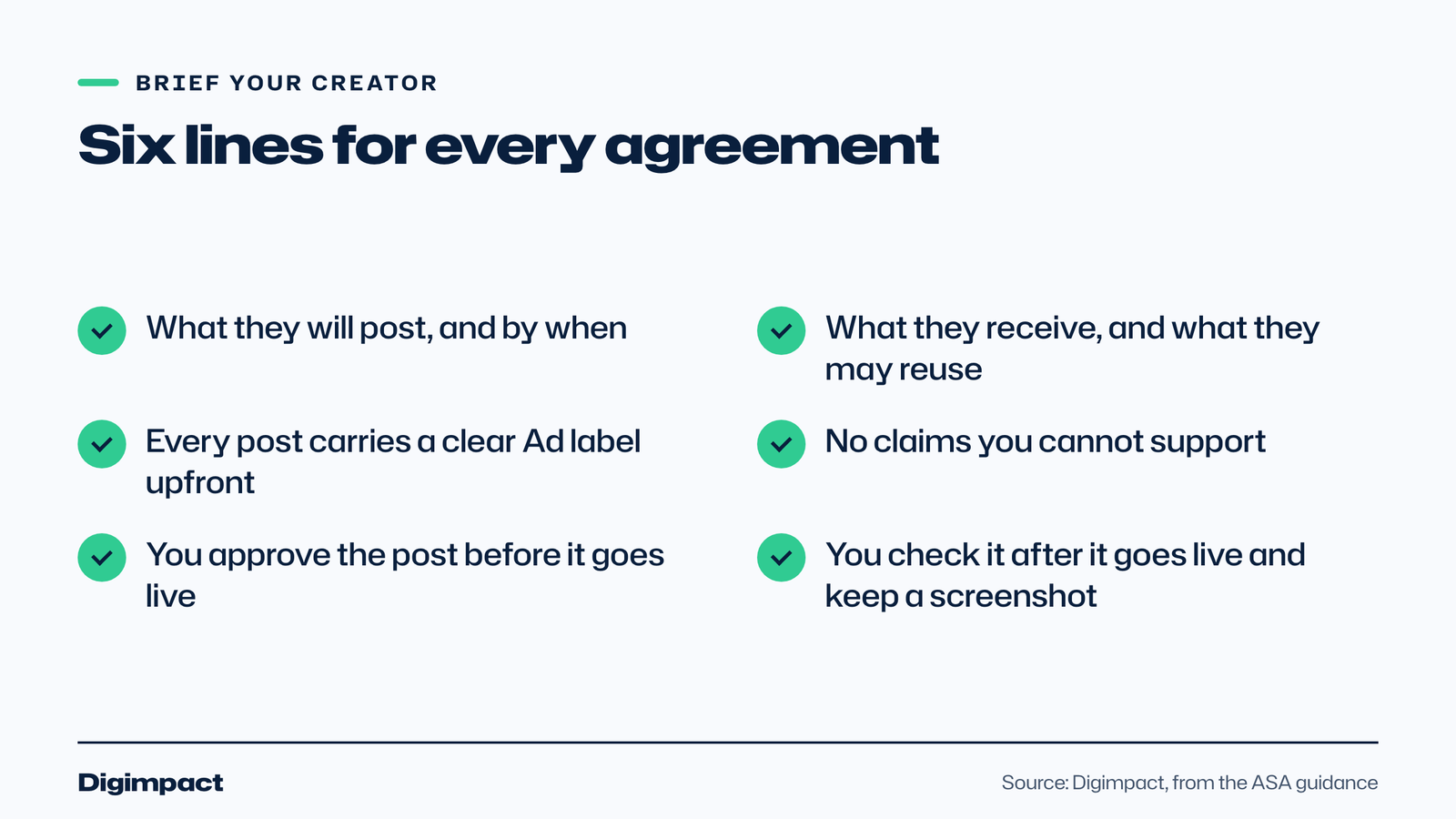
Put it in writing. Say what the creator will do, what they will receive, who approves the content, that every post must carry a clear Ad label upfront and which labels you accept, and that you will ask for a correction or take down any post that does not meet the rules. Check the posts and keep records.
A short agreement for a local creator might cover the deliverables, the dates, the fee or gift, how the content can be reused, the labelling requirement, the claims that must not be made, approval before posting and what happens if the post breaches the rules. Do not tell the creator to remove or play down the label. Ask for the label to be included in the first line or the caption’s opening words.
The ASA’s advice says both brands and influencers are responsible for ensuring that ads are obviously identifiable. If the creator does not label a post, the brand is not off the hook. Check posts when they go live and ask for a fix straight away. Save a screenshot as evidence.
Make sure claims are true. The ASA notes that many different rules apply to the types of claims and to the products being advertised. Do not ask a creator to repeat claims you cannot support, for example health claims or comparisons. Take extra care if content may reach children.
For competitions and giveaways, other rules apply, so check them before you ask a creator to run one for you.
What if the content is not covered by the CAP Code?
The ASA’s advice notes a section on content that falls outside the CAP Code, but the consumer protection law enforced by the CMA and Trading Standards still applies. The safe route is to label anything that is a commercial communication, whatever the platform or format.
New formats do not change the principle. The ASA says the principles apply to new formats too, and that brands should take extra care when targeting children. If you are unsure whether content is advertising, the ASA offers a self-help tool and advice service for brands and influencers, and its Influencers’ guide to making clear that ads are ads is the best starting point.
Keep your own records: the agreement, the dates, what was given, screenshots of the posts and any messages about labelling. If a complaint is made, a clear record helps you show you acted responsibly.
What are the common mistakes?
The common mistakes are treating a free meal as not an ad, relying on a tag or discount code, using Sponsored or Gifted, putting the label under See more, relying on the bio, forgetting that the brand is responsible and not checking posts after they go live.
- Free meal, no label. A gift is an incentive.
- Tag only. An @ mention alone has been found insufficient.
- Code only. A discount code does not show the commercial relationship.
- Wrong words. Sponsored, Gifted, Ambassador and Affiliate are risky.
- Label buried. Under See more or among hashtags.
- Bio only. Each post must stand on its own.
Frequently asked questions
Do influencer marketing rules apply to small businesses?
Yes. The rules apply to any brand that pays or gives an incentive to a creator, and to any creator with a commercial or personal connection to a brand, whatever the size of the business or the following.
Is a free meal in exchange for a post an ad?
According to the ASA, whenever a brand gives an influencer a payment or any other incentive, requested or unsolicited, content featuring the brand needs to be obviously identifiable as advertising.
What label should I use?
The ASA and CMA prefer an upfront Ad label. Advert, Advertising and Ad Feature are also likely to be acceptable. Avoid Sponsored, Gifted, Ambassador and Affiliate.
Is a platform’s paid partnership tag enough?
It may be if it is upfront, clear and prominent, but the ASA’s research found it may not be enough on its own. If it is hard to see, add an Ad label.
Who is responsible if the influencer forgets the label?
Both. The ASA says brands and influencers are responsible, and in a ruling both are named. For affiliate content the brand is typically considered at least jointly responsible.
Want a social media plan that follows the rules?
We run social media for UK small businesses, with a clear posting plan, approvals and the right labels on anything that is promotional. Our plans start from £300 a month. See our social media management service, or start with a free website check.
Keep reading
- How to make Reels for business on a phone, step by step A practical guide to filming Instagram Reels for a local business on a phone: what to film, how long Reels should be, how to edit and caption them, when to post and how to reuse them on other platforms.
- Apple Business Connect is now Apple Business: how to get your business on Apple Maps (2026 UK guide) Apple Business Connect became part of Apple Business in April 2026. This UK guide shows how to add your business to Apple Maps in seven steps, what is free and available in the UK, and how to use showcases, action buttons and insights.
- How to choose your Google Business Profile categories How to choose the right Google Business Profile categories, why the primary category matters most, when additional categories help, the mistakes Google warns against, and how to change them safely.
Free website check
How does your own website do?
Enter your website and see a quick check on screen in about 20 seconds: speed, Google, phones and the details that win the click. A full written report follows within two working days, free and with no sales call unless you ask.
Want help with this?
Tell us about your business. We reply within one working day with a time for a 30-minute call, and a fixed quote afterwards.
Rather talk now? Call 07551 079787.
Thanks, that is with us.
We will reply within one working day with a time for a call.