Staff rota rules UK employers must follow: breaks, rest and working hours
The legal limits every UK rota must respect: breaks, rest between shifts, weekly rest, the 48-hour week, young workers, night work, holiday and the shift notice rules coming in 2027.
By GP 14 minute read
TL;DR: The main staff rota rules UK employers must follow come from the Working Time Regulations 1998: a 20-minute break for shifts over 6 hours, 11 hours’ rest between working days, 24 hours off each week or 48 each fortnight, and an average of no more than 48 hours a week unless the worker opts out in writing. Under-18s have tighter limits: 8 hours a day, 40 a week, a 30-minute break after 4.5 hours and no work between midnight and 4am.
Key takeaways
- The staff rota rules UK employers must follow mostly come from the Working Time Regulations 1998, explained by GOV.UK and Acas.
- Anyone working more than 6 hours gets an uninterrupted 20-minute break, taken in the middle of the shift, not at the start or end.
- Workers get 11 hours’ rest between working days, and 24 hours off each week or 48 hours off each fortnight.
- The average working week is capped at 48 hours over 17 weeks, unless a worker aged 18 or over opts out voluntarily and in writing.
- Under-18s can work no more than 8 hours a day or 40 a week, need a 30-minute break after 4.5 hours, and cannot work between midnight and 4am.
What are the staff rota rules UK employers must follow?
The staff rota rules UK employers must follow set minimum rest and maximum hours: a 20-minute break for shifts over 6 hours, 11 hours’ rest between working days, 24 hours off a week or 48 a fortnight, an average of no more than 48 hours a week, and tighter limits for under-18s and night workers. They come from the Working Time Regulations 1998.
These staff rota rules UK law sets are the floor, not the target. A worker’s contract can give more breaks or more rest, and many good employers do. This guide uses the plain-English versions on GOV.UK and Acas, checked on 14 October 2026, and covers what each rule means when you sit down to build next week’s staff rota.
Acas points out that the right to rest covers agency workers, apprentices, casual and seasonal workers and zero-hours workers too, so the rules apply to almost everyone on a typical hospitality, retail or care rota. If you need a rota to start from, our free staff rota template adds up hours and handles shifts past midnight.
| Rule | Adults (18 and over) | Young workers (under 18) |
|---|---|---|
| Break during a shift | 20 minutes if working more than 6 hours | 30 minutes if working more than 4.5 hours |
| Rest between working days | 11 hours | 12 hours |
| Weekly rest | 24 hours a week or 48 a fortnight | 48 hours a week |
| Maximum hours | 48 a week on average over 17 weeks | 8 a day and 40 a week, no averaging |
| Night work | Average of 8 hours in 24 for night workers | Not between midnight and 4am, ever |
| Opt out of the weekly limit | Yes, voluntarily and in writing | No |

Do the Working Time Regulations apply to every business?
The Working Time Regulations apply to almost every worker, whatever the size of the business, including part-time, casual, agency and zero-hours staff. GOV.UK lists a few exceptions, such as the armed forces and emergency services in a disaster, jobs where people freely choose their own hours, like a managing director, and some sea, air and road transport work.
For a restaurant, pub, café, shop, salon, clinic or care business, that means the staff rota rules UK law sets apply to everyone on the rota. Lorry and coach drivers have their own rules, and young workers have stricter ones, covered below. A worker’s contract can always give more rest breaks, longer rest or fewer hours than the law requires, but it cannot give less.
If you are unsure whether a rule applies to a particular job, Acas runs a free helpline for employers and workers, and its guidance on working time and rest covers the less common cases, such as on-call time and lay-offs.
How long must a break be on a shift?
Workers over 18 have the right to one uninterrupted 20-minute rest break if they work more than 6 hours in a day. GOV.UK says the break can be unpaid, depending on the contract, and must be taken in one go somewhere in the middle of the day, not at the beginning or end, and away from where the person works.
On a staff rota, that means every shift over 6 hours needs a planned break written into it. Acas says rest breaks should be planned in advance. A break that a manager cuts short by calling someone back to the floor does not count: GOV.UK says it is not a rest break if the employer asks the employee to go back before it is finished.
There is no automatic right to a longer break on a longer shift. Acas gives the example that a 12-hour shift does not mean a 40-minute break, though the employer should consider giving more. Workers do not have a legal right to smoking breaks or paid breaks unless the contract says so.
For under-18s the rule is stricter. Acas says young workers must have a 30-minute break if their working day is longer than 4.5 hours, so their rest breaks start earlier in the shift.
How many hours must there be between shifts?
Workers have the right to 11 hours’ rest between working days. GOV.UK’s example is that someone who finishes at 8pm should not start again until 7am the next day. Young workers need 12 hours’ rest in any 24-hour period in which they work. Of all the rota rules, this is the one rotas break most often.
The classic problem is the close then open. A bartender who closes at 11pm and opens at 7am the next morning gets 8 hours between shifts, not 11. Count from the real finish time, including clearing up, not the time the doors close.
Some jobs allow this rest to be moved, with what the law calls compensatory rest. GOV.UK lists shift workers who cannot take daily or weekly rest between ending one shift and starting another, and industries that are very busy at certain times of year, such as retail and tourism. Acas is clear that this should not happen regularly, the employer needs a valid reason, and the missed rest must be made up later with an equivalent period of the same length.
The safest approach is to build every staff rota so it never needs compensatory rest, and keep that option for genuine rushes and emergencies.

How many days off must staff have each week?
Workers have the right to either an uninterrupted 24 hours without any work each week, or an uninterrupted 48 hours without any work each fortnight. Young workers must have 48 hours’ rest each week, taken together, or at least 36 hours if there is a good business reason, with the remaining 12 hours taken as soon as possible afterwards.
The weekly rest is on top of the 11 hours between working days. In practice that means a full day off, plus the overnight rest either side of it. Fortnightly rest lets you run a longer stretch one week, as long as the worker then gets 48 hours off in one block.
Watch for staff who pick up extra shifts by swapping, because swaps are where rota rules slip. A worker who swaps their day off with a colleague can end up working a whole fortnight without a full day off, which breaks the weekly rest rule even though nobody planned it. Check swaps against the rules before you approve them.
What is the maximum working week in the UK?
Workers cannot work more than 48 hours a week on average, normally averaged over 17 weeks, according to GOV.UK. Someone can work more than 48 hours in one week, as long as the average over the reference period stays under 48. Workers aged 18 and over can choose to opt out of the limit.
GOV.UK says opting out must be voluntary and in writing, an employer can ask but cannot sack or treat someone unfairly for refusing, and the employer must keep a record that the worker has opted out. A worker can cancel an opt-out whenever they want by giving at least 7 days’ notice, or up to 3 months if their agreement says so. Acas publishes a 48-hour opt-out agreement template.
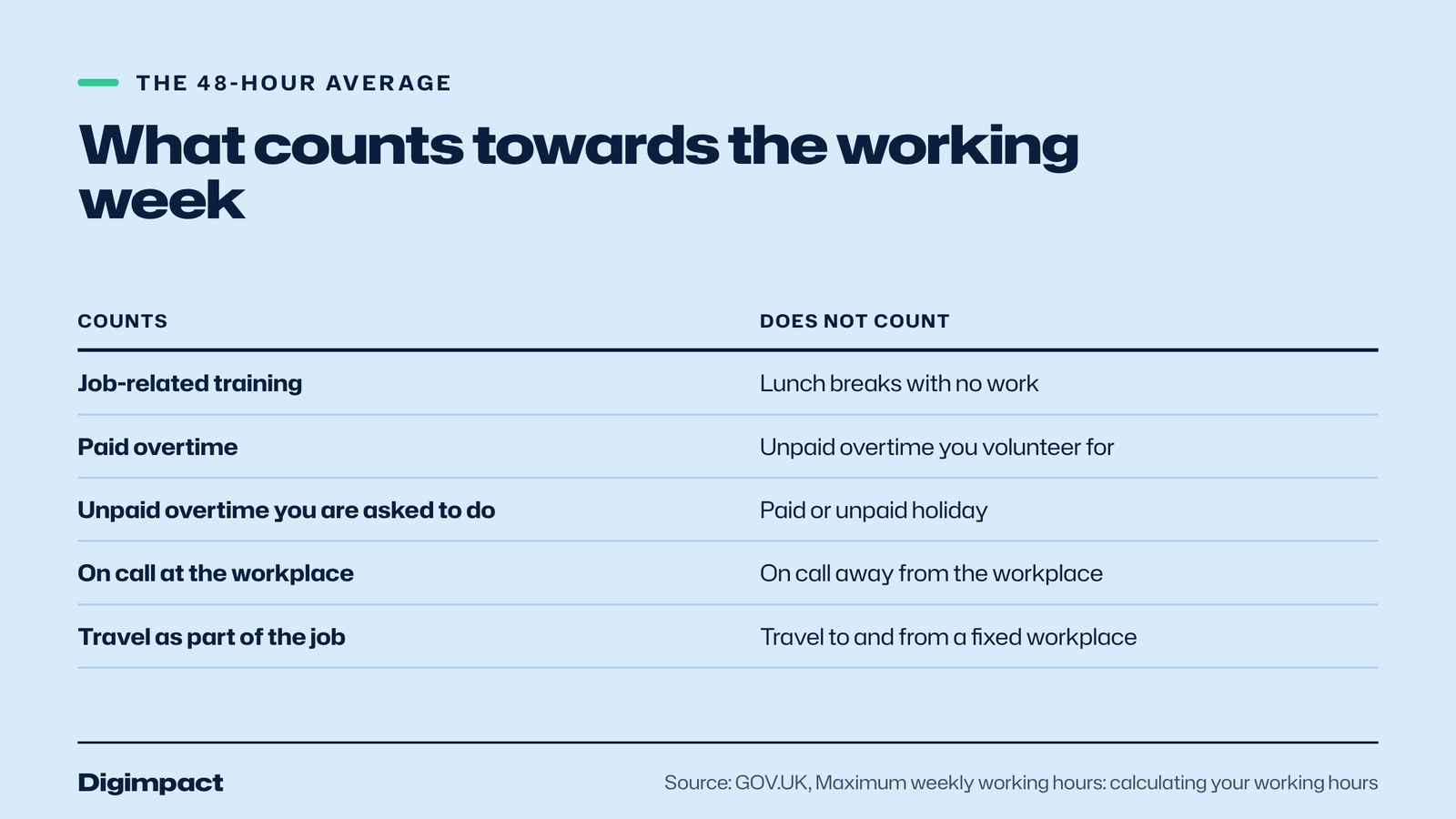
What counts towards the 48 hours matters for a staff rota. GOV.UK says the working week includes job-related training, paid overtime, unpaid overtime the worker is asked to do and time on call at the workplace. It does not include lunch breaks where no work is done, or travel to and from a fixed place of work. If someone has two jobs, GOV.UK says their combined hours should not be more than 48 a week on average.
What are the rota rules for workers under 18?
Under-18s can work no more than 8 hours a day and 40 hours a week, and their hours cannot be averaged. Acas says they must get a 30-minute break after 4.5 hours, 12 hours’ rest between working days and 48 hours off each week, and they must not work between midnight and 4am under any circumstances.
Young workers also have a restricted period at night. Acas says they must not work between 10pm and 6am, or between 11pm and 7am if their contract allows work after 10pm. In some jobs, including hotels, pubs, restaurants, catering, bakeries and retail, they can work until midnight or from 4am where it is necessary, but only if no adult workers are available, it will not harm their education or training, and they are supervised where needed.
Employers must keep records to prove young workers stay within the 8-hour and 40-hour limits and do not work in restricted hours. Acas says these records must be kept for 2 years. For children below school leaving age the rules are tighter again, usually with a permit from the local council, as set out on GOV.UK’s child employment page.
What are the rules for night shifts?
A night worker is someone who regularly works at least 3 hours during the night period, which is 11pm to 6am unless agreed otherwise. GOV.UK says night workers must not work more than an average of 8 hours in a 24-hour period, usually averaged over 17 weeks, and they cannot opt out of this limit.
Regular overtime counts towards the average; occasional overtime does not. Night workers whose work involves special hazards or heavy mental or physical strain cannot work more than 8 hours in any 24-hour period, without averaging. Employers must keep records of night workers’ hours for at least 2 years, and must not discriminate against a worker who does not want to work nights.
GOV.UK also notes that there is no higher legal minimum wage for night work. The National Minimum Wage applies at the same rate day or night.
Do rotas affect holiday and pay?
Yes. Almost all workers are entitled to 5.6 weeks’ paid holiday a year, which GOV.UK says is 28 days for someone working a 5-day week, capped at 28 days. Workers with irregular hours build up leave based on the hours they work. Every hour on the staff rota must also be paid at least the National Minimum Wage.
From April 2026, GOV.UK lists the minimum hourly rates as £12.71 for workers aged 21 and over, £10.85 for 18 to 20 year olds, and £8 for under-18s and apprentices. A rota that runs shifts over by 15 minutes every night without paying for the time can quietly push someone below the minimum.
Part-time staff get the same 5.6 weeks pro rata. GOV.UK’s example is that someone working 3 days a week must get at least 16.8 days’ leave a year. Bank holidays do not have to be given as paid leave on top, but an employer can include them in the statutory entitlement.
What changes to rota rules are coming?
The government’s timeline for the Employment Rights Act 2025, updated on 14 October 2026, lists a right to reasonable notice of shifts and short notice payments, alongside a right to guaranteed hours, among the measures that will take effect in 2027. It says the timings will be updated after consultation, so the detail is not final yet.
For rota planners, that points one way: publish rotas earlier, change them less, and keep a record of when each shift was offered, changed or cancelled. The timeline update on GOV.UK is the page to watch for confirmed dates.
Some changes have already arrived. The same timeline says that from 6 April 2026 Statutory Sick Pay lost its waiting days and its lower earnings limit, which matters when someone calls in sick and their shift needs covering.

How do you build a rota that follows the rules?
Build the staff rota in the same order as the rota rules: set the weekly day off first, then make sure every gap between shifts is at least 11 hours (12 for under-18s), then add breaks to every shift over 6 hours (4.5 for under-18s), then check each person’s total against the 48-hour average and their age limits.
- Mark days off first. Give everyone a full day off each week, or two together each fortnight.
- Check every gap. Make sure no shift starts within 11 hours of the same person’s last finish.
- Plan the rest breaks. Write a break time into every shift over 6 hours, in the middle of the shift.
- Flag under-18s. Keep them within 8 hours a day and 40 a week, out of restricted hours, with 30-minute breaks.
- Watch the average. Track weekly totals so no one creeps above 48 hours on average without an opt-out.
- Check swaps. Re-check rest and weekly limits whenever staff swap or pick up shifts.
- Keep the records. Save each published rota and any changes, and keep young and night workers’ records for 2 years.
A staff rota spreadsheet can do this if someone checks it carefully every week. A rota app can do the checking for you, warning you before a close then open goes out. Our staff rota app flags breaks, rest gaps and weekly totals as you plan, and our page on running a staff rota without spreadsheets explains how it works in a busy venue.
Frequently asked questions
Do staff have to be paid for their breaks in the UK?
No, not by law. GOV.UK says the 20-minute rest break does not have to be paid; it depends on the employment contract. Workers also have no legal right to smoking breaks unless the contract gives them.
Can I schedule someone to close and then open the next morning?
Only if there are 11 hours between the end of one shift and the start of the next, or compensatory rest genuinely applies. Acas says compensatory rest should not happen regularly and the missed rest must be made up with an equivalent period.
How many hours can a 16-year-old work in the UK?
A young worker over school leaving age can work no more than 8 hours a day and 40 hours a week, with a 30-minute break after 4.5 hours, and never between midnight and 4am. Hours cannot be averaged.
Can an employer make staff opt out of the 48-hour week?
No. GOV.UK says an employer can ask a worker to opt out, but the opt-out must be voluntary and in writing, and the worker cannot be sacked or treated unfairly for refusing. Workers can cancel it with at least 7 days’ notice.
How much notice must I give staff of their shifts?
There is no general legal minimum notice period for shifts in force today, unless a contract sets one. The Employment Rights Act 2025 timeline lists a right to reasonable notice of shifts for 2027, with timings to be confirmed after consultation.
Want rotas that check themselves?
Keeping every staff rota inside the staff rota rules UK law sets takes time every week by hand, and one missed close then open is enough to cause a problem. Our staff rota app is installed for your business and checks rest, breaks and hours as you plan. Ask us for a fixed quote, or start with our free staff rota template.
Keep reading
- How to make Reels for business on a phone, step by step A practical guide to filming Instagram Reels for a local business on a phone: what to film, how long Reels should be, how to edit and caption them, when to post and how to reuse them on other platforms.
- Apple Business Connect is now Apple Business: how to get your business on Apple Maps (2026 UK guide) Apple Business Connect became part of Apple Business in April 2026. This UK guide shows how to add your business to Apple Maps in seven steps, what is free and available in the UK, and how to use showcases, action buttons and insights.
- How to choose your Google Business Profile categories How to choose the right Google Business Profile categories, why the primary category matters most, when additional categories help, the mistakes Google warns against, and how to change them safely.
Free website check
How does your own website do?
Enter your website and see a quick check on screen in about 20 seconds: speed, Google, phones and the details that win the click. A full written report follows within two working days, free and with no sales call unless you ask.
Want help with this?
Tell us about your business. We reply within one working day with a time for a 30-minute call, and a fixed quote afterwards.
Rather talk now? Call 07551 079787.
Thanks, that is with us.
We will reply within one working day with a time for a call.