30 restaurant social media ideas for UK restaurants, pubs and cafés
Thirty practical restaurant social media ideas for UK restaurants, pubs and cafés, grouped by theme, with a weekly plan, the UK alcohol advertising rules for pubs and bars, and how to turn posts into bookings.
By GP 13 minute read
TL;DR: The best restaurant social media ideas show your food, your people and what is happening this week: dishes coming off the pass, short kitchen Reels, specials, the team, events, reviews and local partners. Post three to five times a week, with Stories on service days, and use Google Business Profile posts too. Pubs and bars must follow the UK advertising code for alcohol, which bans anyone who seems under 25 drinking and anything that encourages excessive drinking.
Key takeaways
- The best restaurant social media ideas show real food, real people and what is happening this week, not stock images or generic quotes.
- Buffer’s study of over 2 million Instagram posts found three to five posts a week gave around 12% more reach per post than one or two.
- Google says single-location food and drink businesses in the UK can have featured posts from Facebook and Instagram shown on their mobile Business Profile.
- Pubs and bars must follow the UK advertising code for alcohol: nobody who is or seems under 25 can be shown drinking, and posts must not encourage excessive drinking.
- Every post should give people a reason and a way to visit: a dish, a date, a booking link.
What are the best restaurant social media ideas?
Restaurants should post what makes people hungry and what makes them book: dishes as they come off the pass, short videos from the kitchen, this week’s specials, the people who cook and serve, events and offers, and what customers say. These restaurant social media ideas work because they are specific to you and give people a reason to visit soon.
The thirty ideas below are grouped into six themes, so you can rotate through them and never run short. Pick three to five a week. Buffer’s study of over 2 million Instagram posts found that posting three to five times a week gave around 12% more reach per post than posting once or twice, and our guide to how often to post on social media explains how to keep that pace.
Instagram is where most of this belongs. DataReportal’s Digital 2026 UK report, based on Meta’s advertising tools, put Instagram’s UK ad audience at 35.5 million people in late 2025 and Facebook’s at 38.8 million. Share the same posts to both.
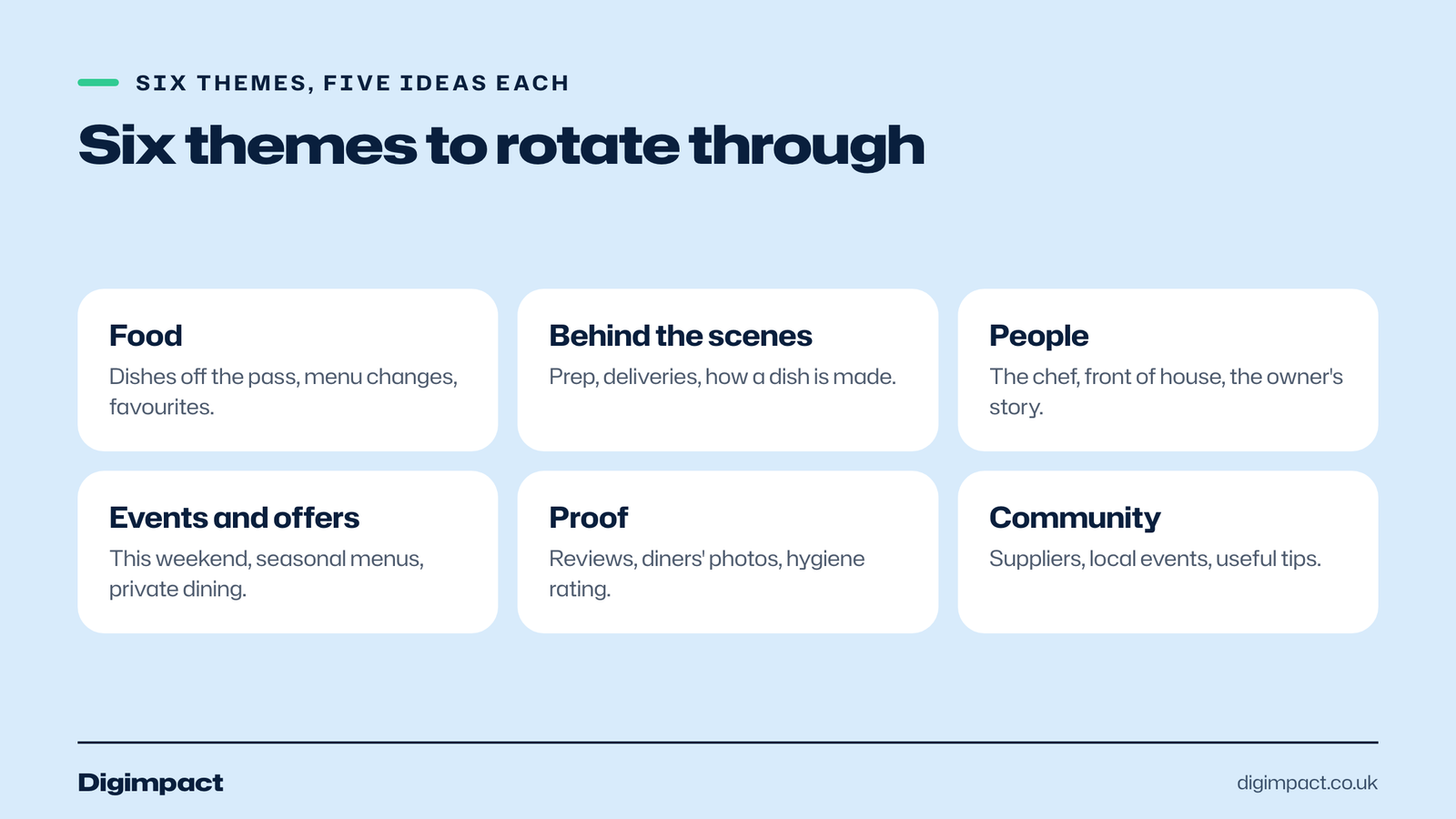
Food: ideas 1 to 5
Your food is your best content. Show it the way it looks on the table, in natural light, with its real name and what is in it. Close-ups of steam, sauce and texture stop people scrolling far better than a wide shot of a full table.
- The dish of the day, photographed as it leaves the pass, with its name and price.
- A slow pour or a cut, such as gravy on a roast or a knife through a pie, as a 10-second Reel.
- The menu change, a carousel of new dishes when the season turns.
- Ingredient spotlight, the local cheese, fish or vegetables you are using this week.
- Customer favourites, the dish people order most, with a line on why.
Name every dish exactly as it appears on your menu. A beautiful photo with no name or price is a missed booking.
Behind the scenes: ideas 6 to 10
People love seeing how food is made and who makes it. Behind-the-scenes posts build trust and give your account personality. They also suit short Reels, which Buffer suggests posting in the evening, when people have time to watch.
- Prep in the morning, the kitchen before service, chopping, rolling, baking.
- The delivery, fresh produce or fish arriving from a named supplier.
- How a signature dish is made, in three or four quick steps.
- Setting up for service, tables laid, candles lit, the room ready.
- The pass during a rush, a few seconds of a busy Saturday, without showing customers’ faces.
Keep these short and real. A phone in good light is enough; polished production matters far less than showing something genuine.
People: ideas 11 to 15
Introduce the people behind the food. A face and a name make a restaurant feel welcoming before anyone walks in, and staff may share posts about themselves, which can bring your account to new people.
- Meet the chef, with their favourite dish on the menu.
- Front of house, the people who greet regulars by name.
- A new team member, welcomed on their first week.
- Staff picks, each person’s recommendation for the week.
- The owner’s story, why you opened and what you care about.
Ask permission before posting anyone, staff or customers, and respect anyone who would rather not appear.

Events and offers: ideas 16 to 20
Events and offers give people a reason to book now. Post them early, repeat them as the date gets closer, and always include how to book. Buffer’s 2026 data found Thursday morning one of the strongest times to post, which suits weekend plans.
- What is on this weekend, live music, a quiz or a special menu.
- Seasonal menus, such as Christmas, Mother’s Day or summer terrace openings, announced weeks ahead.
- A countdown, three posts in the week before a big night.
- Limited specials, a dish available for one week only.
- Private dining and parties, the room set up, with how to enquire.
Post the same events on your Google Business Profile. Google’s help page on Business Profile posts says you can create update, offer and event posts, schedule them, and set them to repeat. Google also says that for single-location food and drink businesses in the UK, featured posts drawn from your Facebook and Instagram posts can appear on your mobile Business Profile.
Proof: ideas 21 to 25
What customers say persuades more than anything you say about yourself. Share genuine reviews, real photos from diners, and anything that shows you are trusted, from your food hygiene rating to a local award.
- A review of the week, a short quote from a real Google review, with the reviewer’s first name.
- Diners’ photos, reshared with permission and credit.
- Your food hygiene rating, if it is a 5 or 4, with the date of the inspection.
- Awards and mentions, from a local guide, newspaper or competition.
- Regulars, a long-standing customer’s favourite table or dish, with their permission.
Share only genuine reviews, and never offer anything in return for one; Google’s review policy bans incentives and UK law bans fake reviews. The Food Standards Agency’s Food Hygiene Rating Scheme guidance says businesses in England are encouraged but not required to display their rating at their premises, while in Wales and Northern Ireland display is a legal requirement.

Community and useful posts: ideas 26 to 30
Show that you are part of your area. Local suppliers, neighbours, charities and events connect you to people who already care about the place, and useful posts give people a reason to follow even when they are not booking.
- Your suppliers, a farm, brewery or baker you work with, tagged.
- Local events, what is happening in town and how to fit dinner around it.
- A charity night, a cause your team supports.
- Simple tips, such as how to cook the perfect steak at home or which wine suits your Sunday roast.
- Answers to common questions, such as whether you take dogs, have parking or cater for allergies, with your full allergen information available on request.
Tag the people and businesses you mention. They may share the post, which puts you in front of their followers too.
Which format suits each idea?
Match the idea to the format. Reels suit movement: a pour, a sizzle, a busy pass. Carousels suit menus, specials and step-by-step posts that people swipe through. Single photos suit a hero dish or a review. Stories suit what is happening right now, such as today’s soup or a table that just came free.
Buffer’s 2026 best-time study suggests evenings for Reels, the midweek peaks of Wednesday lunchtime, Wednesday evening and Thursday morning for carousels, and Stories once or twice a day, because they disappear after 24 hours. It analysed all formats together, so treat these as starting points and test them against your own insights.
| Idea | Best format | Why |
|---|---|---|
| Dish of the day | Photo or Story | Quick, timely, easy to make |
| Kitchen prep or a pour | Reel | Movement stops the scroll |
| Weekly specials | Carousel | People swipe through options |
| This weekend’s events | Carousel or Reel | Room for dates and details |
| Review of the week | Photo | Simple and easy to read |
| A table just came free | Story | Live and short-lived |
How do you photograph food on a phone?
Shoot by a window in daylight, turn off the flash, clean the plate rim, and photograph the dish at the angle a diner sees it, or from directly above for flat dishes like pizza. Take several shots, pick the sharpest, and keep editing light so the food still looks like it does on the table.
A few habits make a big difference:
- Use daylight. A table near a window beats any restaurant lighting. Avoid mixing daylight with warm bulbs.
- Clear the background. Move bottles, cloths and phones out of shot.
- Get close. Fill the frame with the food rather than the table.
- Shoot quickly. Steam, melt and shine fade within a minute of plating.
- Keep it honest. Heavy filters make food look unreal and set expectations the plate cannot meet.
For video, hold the phone steady with both hands or rest it on something, film in short clips of a few seconds, and keep the sound of the kitchen, which often works better than music.
Rules for pubs, bars and restaurants that serve alcohol
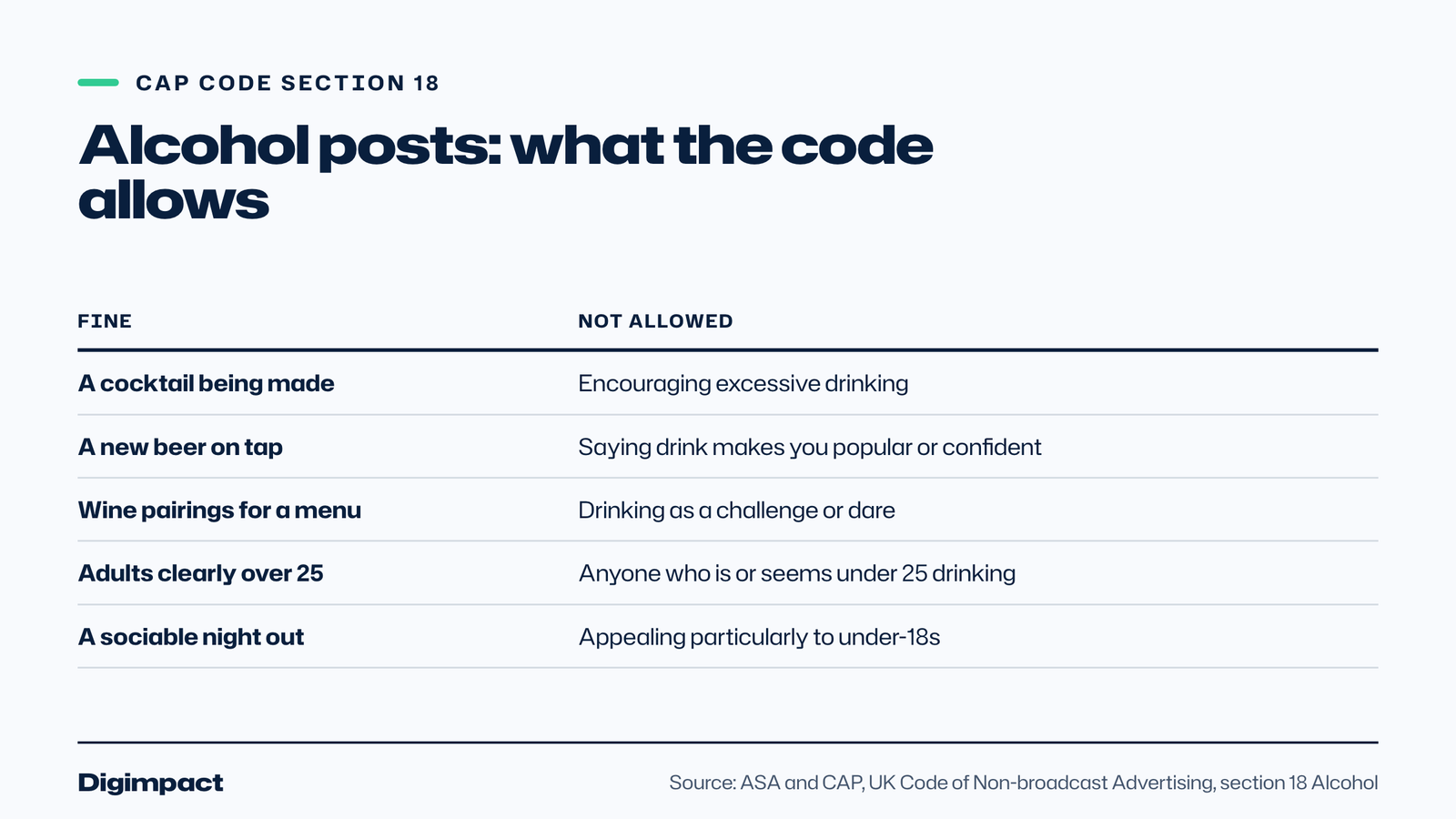
Posts about alcohol must follow the UK advertising code, which the Advertising Standards Authority applies to marketing on social media. The code says anyone shown drinking must not be, or seem to be, under 25, and that posts must not encourage excessive drinking or suggest alcohol makes people more confident or popular.
The CAP Code’s alcohol rules include that marketing must be socially responsible and must not encourage excessive drinking; must not claim alcohol can enhance confidence or popularity; must not portray drinking as a challenge or link it with daring or aggressive behaviour; must not link it with seduction or sexual success; must not appeal particularly to people under 18; and must not show anyone who is or seems to be under 25 drinking or playing a significant role.
In practice, that means drinks offers should not push quantity, bottomless or drinking-game style promotions need great care, and photos of drinks should feature staff or customers who are clearly over 25. Showing a cocktail being made, a new beer on tap or a wine pairing is fine.
What should restaurants avoid posting?
Avoid stock photos, unnamed dishes, out-of-date prices and menus, customers’ faces without permission, public arguments with reviewers, and any drinks promotion that pushes quantity. Each one either misleads people or makes the restaurant look careless, and some break the rules.
- Stock or borrowed photos. Customers expect to get what they see. Use your own food.
- Dishes with no name or price. Every food post should say what it is.
- Old menus and prices. Delete or update posts when a dish comes off or a price changes.
- Customers without permission. Ask before posting anyone, and blur or crop faces in busy shots.
- Arguments in the comments. Reply calmly once and take complaints offline.
- Drinks offers that push quantity. The CAP Code bans encouraging excessive drinking.
- Fake reviews or rewarded reviews. Google’s policy and UK law both ban them.
A quick check before posting, asking whether the post is true, named, current and fair, catches almost all of these. Keeping these restaurant social media ideas honest is what makes customers trust the next post.
A simple weekly plan for a restaurant
A simple restaurant plan is three to five feed posts a week plus Stories on service days: a dish early in the week, a kitchen Reel midweek, an events or weekend post on Thursday, and proof or people at the weekend. Plan and film once a week, then schedule.
| Day | Post | Idea |
|---|---|---|
| Tuesday | Reel | A dish being finished on the pass |
| Wednesday | Carousel | This week’s specials with prices |
| Thursday | Photo or Reel | What is on this weekend, with a booking link |
| Saturday | Stories | Service in action, without customers’ faces |
| Sunday | Photo | A review of the week or a team member |
Buffer’s 2026 best time to post on Instagram study found Wednesday and Thursday the strongest days and evenings the strongest times on most weekdays. For a restaurant, also think about when people decide where to eat: a lunch special works best posted before midday, and tonight’s special in the afternoon.
How do you turn posts into bookings?
Make it easy to book from every post: a booking link in your bio, the same link in Stories, and the date, time and how to book in the caption. Reply to every comment and message quickly. A post that makes someone hungry is wasted if they cannot see how to book in a tap.
Use a link in your Instagram bio that goes straight to your booking page, not your homepage. Add the Reserve button to your Google Business Profile if your booking system supports it. Our comparison of restaurant booking software shows which systems include Google’s booking button.
Then measure. Check which posts brought profile visits, link clicks and messages, and ask new guests how they heard about you. Within a month, you will know which of these restaurant social media ideas work best for your customers.
Short on time? We film, edit and post for businesses across Hampshire. See social media management in Hampshire and the real posts we made for El Greco.
Frequently asked questions
What should a restaurant post on Instagram?
Post your dishes with their names and prices, short kitchen videos, specials, events, the team and genuine reviews. Rotate through these themes so your feed stays varied, and include how to book in every post.
How often should a restaurant post on social media?
Three to five feed posts a week is a sustainable target, with Stories on service days. Buffer found three to five Instagram posts a week gave around 12% more reach per post than one or two.
Can pubs post about drink offers on social media?
Yes, but posts must follow the CAP Code’s alcohol rules. They must not encourage excessive drinking, appeal particularly to under-18s or show anyone who is or seems under 25 drinking.
Should restaurants use Reels?
Yes. Short videos of food being made or served suit restaurants well. Buffer suggests posting Reels in the evening, when people have time to watch, with Wednesday and Thursday the strongest days.
Do restaurants need to post on Google as well as Instagram?
It helps. Google Business Profile posts appear where people decide where to eat, and Google says featured posts from your Facebook and Instagram can show on the mobile profile for single-location food and drink businesses in the UK.
Want your restaurant’s social media done for you?
Coming up with restaurant social media ideas is the easy part; filming, editing and posting every week during service is the hard part. Our social media management plans include filming in your restaurant, editing and scheduling, with a plain monthly report. See our restaurant websites page for how we bring social, booking and your website together.
Keep reading
- How to make Reels for business on a phone, step by step A practical guide to filming Instagram Reels for a local business on a phone: what to film, how long Reels should be, how to edit and caption them, when to post and how to reuse them on other platforms.
- Apple Business Connect is now Apple Business: how to get your business on Apple Maps (2026 UK guide) Apple Business Connect became part of Apple Business in April 2026. This UK guide shows how to add your business to Apple Maps in seven steps, what is free and available in the UK, and how to use showcases, action buttons and insights.
- How to choose your Google Business Profile categories How to choose the right Google Business Profile categories, why the primary category matters most, when additional categories help, the mistakes Google warns against, and how to change them safely.
Free website check
How does your own website do?
Enter your website and see a quick check on screen in about 20 seconds: speed, Google, phones and the details that win the click. A full written report follows within two working days, free and with no sales call unless you ask.
Want help with this?
Tell us about your business. We reply within one working day with a time for a 30-minute call, and a fixed quote afterwards.
Rather talk now? Call 07551 079787.
Thanks, that is with us.
We will reply within one working day with a time for a call.