How often to post on social media: a realistic plan for small businesses
How often a small business should post on Instagram, Facebook, TikTok, LinkedIn and Google, what posting frequency studies show, and a realistic weekly schedule for a busy owner.
By GP 14 minute read
TL;DR: For most small businesses, a sustainable answer to how often to post on social media is three to five Instagram posts a week, two to five on TikTok or LinkedIn if you use them, and a Google Business Profile update every week or two. Buffer’s studies of millions of posts found the biggest gains come from moving from one or two posts a week to three to five, and that consistency matters more than volume.
Key takeaways
- There is no single right answer to how often to post on social media; the best schedule is one you can keep up every week.
- Buffer’s study of over 2 million Instagram posts found 3 to 5 posts a week is the sweet spot, with about 12% more reach per post than 1 to 2.
- Buffer’s LinkedIn and TikTok data points to 2 to 5 posts a week as the most sustainable range on each.
- Google says Business Profile posts older than six months are archived unless a date range is set, so regular updates keep the profile current.
- Consistency matters more than volume: going quiet for weeks costs more than posting a little less often.
How often to post on social media: the short answer
For most small businesses, the realistic answer to how often to post on social media is three to five Instagram posts a week, two to five on TikTok or LinkedIn if you use them, and a Google Business Profile update every week or two. That is enough to stay visible without the quality of each post dropping.
Those numbers come from data, not guesswork. Buffer, the social media scheduling company, analysed millions of posts from its own users to see how posting frequency affects reach and growth. Its social media frequency guide, updated in January 2026, makes the key point plainly: for small businesses, the right number is the one you can stick to.
That matters because most owners are not full-time content creators. A café owner, plumber or salon manager posting in the gaps between customers will do better with three good posts a week, every week, than with ten posts one week and nothing for a month.
| Platform | A sustainable posting frequency | Notes |
|---|---|---|
| 3 to 5 feed posts a week | Reels, carousels and photos. Stories on top for followers | |
| Share the same posts as Instagram | Use Meta Business Suite to post to both at once | |
| TikTok | 2 to 5 videos a week | Only if you can film regularly |
| 2 to 5 posts a week | Most useful for business to business services | |
| Google Business Profile | 1 update every week or two | Offers, events and news. Posts archive after six months |

What does the data say about posting on Instagram?
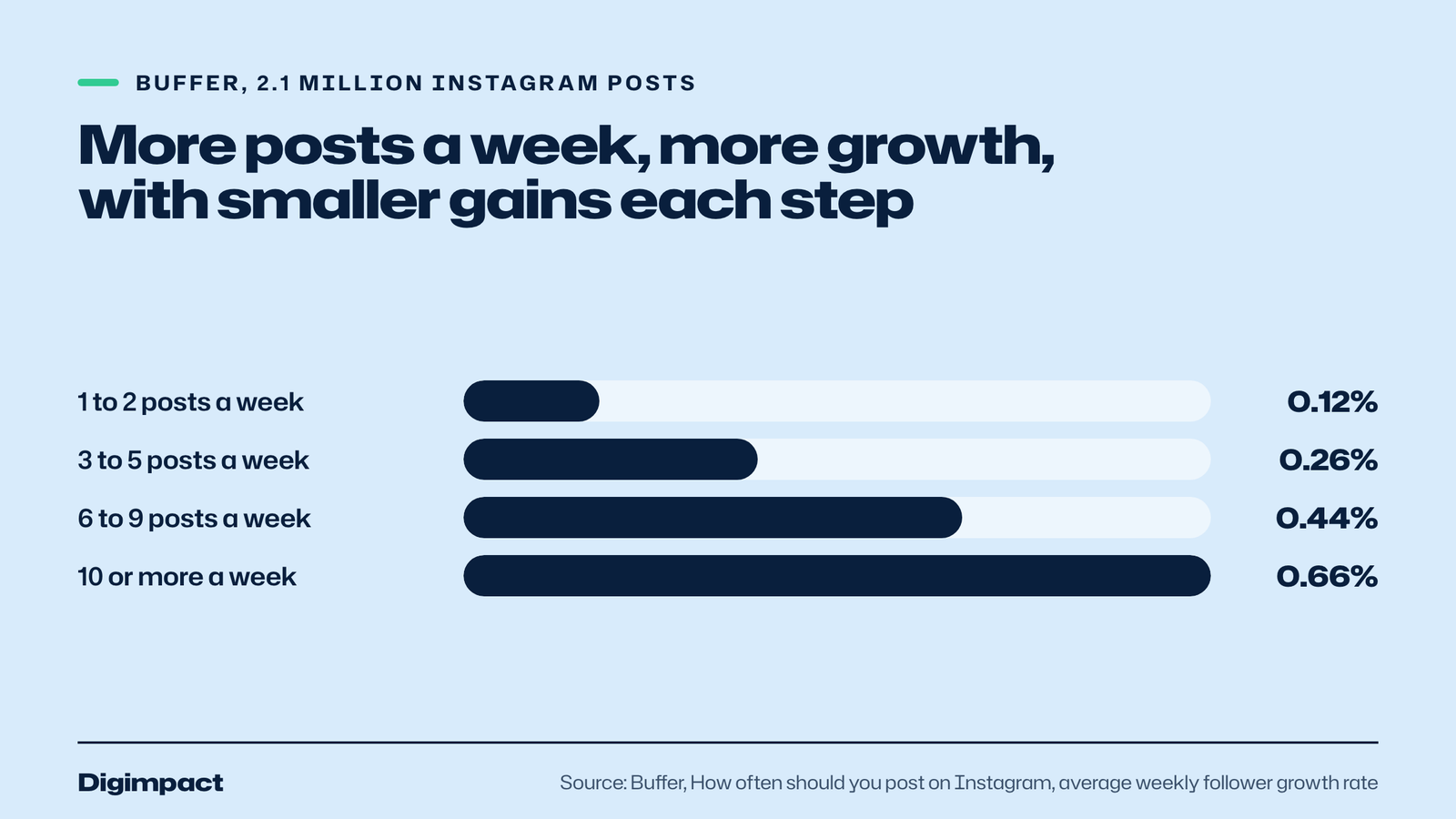
Buffer analysed more than 2 million Instagram feed posts from over 100,000 accounts and found that posting 3 to 5 times a week is likely the sweet spot. Compared with 1 to 2 posts a week, it gave around 12% more reach per post and more than doubled the follower growth rate.
The Instagram study, published in August 2025, grouped accounts by how many feed posts they made each week, counting photos, Reels and carousels but not Stories. Its figures for the average weekly follower growth rate at each posting frequency were:
- 1 to 2 posts a week: a follower growth rate of 0.12%.
- 3 to 5 posts a week: 0.26%.
- 6 to 9 posts a week: 0.44%.
- 10 or more posts a week: 0.66%.
More posts gave more growth, but with diminishing returns: each extra step added less than the one before. Buffer also found that weeks with no posts at all were linked to slower growth than an account’s normal weeks, which is the strongest argument for posting something every week.
Buffer is careful to say that larger, faster-growing accounts tend to post more anyway, so it compared each account with its own normal weeks rather than with other accounts. The pattern held: weeks with more posts were better weeks for the same account.
How often should you post on TikTok and LinkedIn?
Buffer’s data points to two to five posts a week on both TikTok and LinkedIn. On TikTok, moving from one post a week to two to five gave up to 17% more views per post. On LinkedIn, two to five posts a week was where reach and engagement per post started to improve meaningfully.
On TikTok, Buffer’s guide notes that posting more mainly gives you more chances of a breakout video rather than lifting every post: its figures show around 29% more views per post at 6 to 10 posts a week and about 34% at 11 or more, but median views stayed fairly flat. For a local business, two or three short videos a week filmed on a phone is a realistic start.
Buffer’s LinkedIn study looked at more than 2 million posts from over 94,000 accounts and recommends two to five posts a week as the sustainable range. LinkedIn suits businesses that sell to other businesses, such as accountants, IT support or commercial cleaners. Most restaurants, cafés and salons can skip it.
How often should you post on Facebook?
For most local businesses, the simplest approach is to share your Instagram posts to your Facebook Page as well, so Facebook gets the same three to five posts a week without extra work. Meta Business Suite can publish to both at once, and scheduling posts in advance keeps the posting schedule steady through busy weeks.
Facebook still reaches a lot of people in the UK. DataReportal’s Digital 2026 UK report, based on Meta’s advertising tools, put Facebook’s UK ad audience at 38.8 million people in late 2025 and Instagram’s at 35.5 million. Those are the people ads can reach, not daily users, but they show why it is worth keeping both active.
Facebook also matters for events, groups and older customers. If you run quiz nights, live music or seasonal menus, a Facebook event alongside the post helps people save the date and share it.
How often should you post on your Google Business Profile?
Post an update on your Google Business Profile every week or two. Google’s help page on creating Business Profile posts says posts can share announcements, offers, updates and events on Search and Maps, and that posts older than six months are archived unless a date range is set.
Google Business Profile posts are often overlooked, but they appear right where local customers are deciding where to go. Google lets you schedule a post for later and set it to repeat weekly or monthly, which suits regular offers such as a Tuesday lunch deal.
For single-location food and drink businesses in the UK, Google says featured posts can now appear on the mobile profile, drawn from your Facebook and Instagram posts or from posts you create on the profile. That makes regular social media posting useful on Google too. Our guide to setting up a Google Business Profile covers the profile itself.
How often should you post when you are just starting?
When you are starting from zero followers, post two or three times a week for the first month while you build a routine and a small backlog of photos and videos, then move up to three to five posts a week. Starting at a pace you can keep matters more than a big launch week followed by silence.
Before the first post, get the basics right: a clear profile photo, a bio that says what you do and where, your opening hours and a link to your website or booking page. Our guide to setting up an Instagram business account walks through each setting. Then fill the grid with six to nine posts so a new visitor sees a business that is active, not an empty page.
In the first few weeks, spend as much time replying as posting. Answer every comment and message, follow local businesses and community pages, and share posts from the people you work with. Buffer’s guide lists engaging with your audience and posting content that is relevant and helpful alongside posting frequency as the factors that drive growth.
How often should different types of business post?
The right posting frequency depends on how visual your business is and how often things change. Restaurants, cafés and salons have something new to show every day, so they can post most. Trades and clinics have fewer, bigger moments, such as a finished job or a new treatment, so two or three strong posts a week works well.
| Type of business | Feed posts a week | What to post most |
|---|---|---|
| Restaurant, café or pub | 4 to 5 | Dishes, specials, events, the team |
| Hair and beauty salon | 3 to 5 | Before and after, new looks, availability |
| Trades and home services | 2 to 3 | Finished jobs, short how it was done videos |
| Clinic or health business | 2 to 3 | Advice, the team, what to expect |
| Shop or retailer | 3 to 5 | New stock, products in use, offers |
These are starting points, not rules. If your posts start bringing in calls and bookings at two a week, there is no need to force five. If they are not, try adding one more post a week for a month and compare.
Should you schedule social media posts in advance?
Yes. Scheduling lets you plan and create a week of posts in one sitting, then have them go out on time even on your busiest days. Meta Business Suite schedules posts for Facebook and Instagram, and Google lets you schedule Business Profile posts and set them to repeat weekly or monthly.
Batching is what makes a steady posting schedule possible for a small business. Pick a quiet hour each week, film or photograph several things at once, write the captions together and schedule them. Leave room for one or two live posts each week for things that happen on the day, such as a sold-out special or a last-minute appointment slot.
Is it better to post more often or post better content?
Better content wins, but only if you keep posting. When you decide how often to post on social media, start from what you can do well every week. Buffer’s guide is clear that quality comes first and that a consistent posting schedule, even with fewer posts, performs better than posting daily and then disappearing. The goal is the highest frequency you can keep up without the quality slipping.
A useful test before you add more posts: would a customer stop scrolling for this? A photo of today’s special, a 20-second clip of a finished job, or a quick answer to a question customers ask all pass. A stock image with a motivational quote does not, however often you post it.
If you are short of ideas, rotate through a few types of post each week:
- The product or service. A dish, a haircut, a finished bathroom, shown properly.
- Behind the scenes. Prep in the kitchen, loading the van, setting up for the day.
- The people. A team member, a regular customer with permission, the owner.
- Proof. A new review, a before and after, a happy customer’s words.
- Useful advice. A tip that shows you know your trade.
What is a realistic weekly posting schedule?
A realistic weekly posting schedule for a busy small business is three Instagram and Facebook posts, a few Stories, one Google Business Profile update and, if you use it, two TikTok videos. Plan them once a week, film in one batch, and schedule them so they go out even on your busiest days.
| Day | Post |
|---|---|
| Monday | Instagram and Facebook: product or service photo |
| Tuesday | Google Business Profile: offer or update |
| Wednesday | Instagram and Facebook: short video or Reel |
| Thursday | TikTok: the same video, edited for TikTok |
| Friday | Instagram and Facebook: review or customer post |
| Saturday | Stories: what is happening today |
| Sunday | Plan and film next week’s posts |
Once you have a routine, that plan takes roughly two hours a week: one hour to plan and film, half an hour to edit, half an hour to write captions and schedule. Reusing one video across Instagram, Facebook and TikTok keeps the work down without making the accounts feel repetitive.

What happens if you stop posting for a few weeks?
Going quiet costs more than posting a little less often. In Buffer’s Instagram study, weeks with no posts at all were the only weeks linked to a drop in an account’s usual follower growth, and Buffer warns that posting less than once or twice a week could mean stagnation or even losing followers.
Busy seasons, holidays and staff shortages happen, so plan for them. Keep a small bank of evergreen posts, such as team introductions, popular dishes or finished jobs, that you can schedule when there is no time to create anything new. A simple social media posting schedule with two or three backup posts ready means the account never goes silent, even in the week everything else goes wrong.
When you come back after a break, do not try to make up for lost time with a burst of posts. Return to your normal posting frequency and keep it steady; the consistency is what rebuilds reach.
How do you know if your posting frequency is working?
Check your numbers once a month: reach per post, new followers, profile visits, website clicks, calls and direction requests. If reach and enquiries are steady or growing, keep going. If they stall, change one thing at a time, such as adding one post a week or switching more posts to video, and compare the next month.
Instagram’s professional dashboard, Meta Business Suite, TikTok analytics and the Performance section of your Google Business Profile all show these numbers for free. What matters most for a local business is not likes but actions: calls, bookings, messages and visits.
Give any change at least four weeks before judging it. One good or bad week tells you very little, as Buffer’s own method shows: it compares each account with its own normal weeks, because every account has ups and downs.

Short on time? We film, edit and post for businesses across Hampshire. See social media management in Hampshire and the real posts we made for El Greco.
Frequently asked questions
Is posting once a week on social media enough?
It keeps an account alive, but it is unlikely to grow it. Buffer’s Instagram data treats 1 to 2 posts a week as the minimum to stay active, and found 3 to 5 posts a week more than doubled the follower growth rate.
Can you post too much on social media?
Buffer’s data shows more posts generally led to more reach and growth, with diminishing returns. The real risk for a small business is quality dropping or the owner burning out, so post as often as you can keep the standard up.
Do Instagram Stories count towards posting frequency?
Buffer’s study counted feed posts only: photos, Reels and carousels. Stories are mainly seen by existing followers, so they are good for keeping customers engaged but do less to reach new people.
How often should a restaurant post on social media?
A restaurant does well with three to five Instagram and Facebook posts a week, daily Stories on service days, and a weekly Google Business Profile post for menus, offers and events. Food photos and short kitchen videos usually work best.
Should I post the same content on every platform?
You can share the same post to Instagram and Facebook, and reuse the same video on TikTok, as long as each fits the platform’s format. Captions can be adjusted slightly for each audience without creating new content each time.
Want someone to post for you?
Knowing how often to post on social media is the easy part; finding time to film, edit and post every week is the hard part. Our social media management plans cover filming, editing and posting for local businesses around Portsmouth, with a plain monthly report. If you are starting from scratch, our guide to setting up an Instagram business account is the first step.
Keep reading
- How to make Reels for business on a phone, step by step A practical guide to filming Instagram Reels for a local business on a phone: what to film, how long Reels should be, how to edit and caption them, when to post and how to reuse them on other platforms.
- Apple Business Connect is now Apple Business: how to get your business on Apple Maps (2026 UK guide) Apple Business Connect became part of Apple Business in April 2026. This UK guide shows how to add your business to Apple Maps in seven steps, what is free and available in the UK, and how to use showcases, action buttons and insights.
- How to choose your Google Business Profile categories How to choose the right Google Business Profile categories, why the primary category matters most, when additional categories help, the mistakes Google warns against, and how to change them safely.
Free website check
How does your own website do?
Enter your website and see a quick check on screen in about 20 seconds: speed, Google, phones and the details that win the click. A full written report follows within two working days, free and with no sales call unless you ask.
Want help with this?
Tell us about your business. We reply within one working day with a time for a 30-minute call, and a fixed quote afterwards.
Rather talk now? Call 07551 079787.
Thanks, that is with us.
We will reply within one working day with a time for a call.